
Siemens' Strategic M&A Play in AI and Life Sciences: A Catalyst for Long-Term Value Creation
The industrial technology sector is undergoing a seismic shift, driven by the convergence of artificial intelligence (AI) and digital transformation. At the forefront of this evolution is Siemens, which has embarked on an aggressive M&A strategy to consolidate its position in AI-driven industrial software and life sciences R&D. By acquiring Dotmatics and Altair Engineering, Siemens is not only expanding its technological footprint but also aligning itself with a market poised for exponential growth.
Strategic Acquisitions: Bridging Data and Innovation
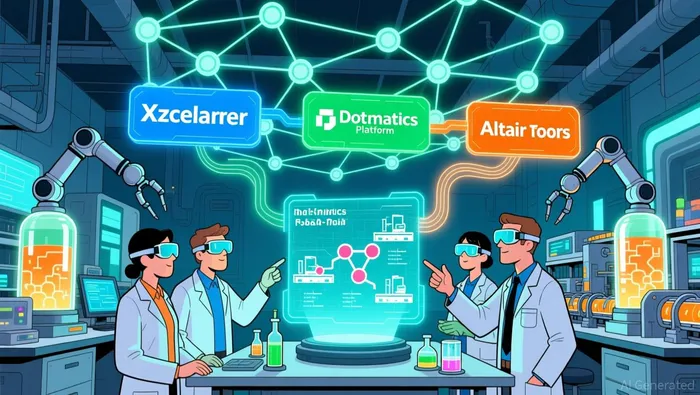
In 2023–2025, Siemens completed two landmark acquisitions: Dotmatics, a life sciences R&D software firm, for $5.1 billion, and Altair Engineering, a U.S.-based industrial software company, for $10.6 billion according to Siemens announcements. These deals are central to Siemens' ONE Tech Company program, which aims to unify its industrial software offerings under a single, AI-powered ecosystem. The Dotmatics acquisition, in particular, has added a critical component to Siemens' Siemens Xcelerator portfolio: an end-to-end digital thread connecting research data to production in life sciences. Dotmatics' Scientific Intelligence Platform, including its Luma tool, enables AI-driven drug development and contextualized data analysis, addressing a sector where software spending is projected to double in five years.
The Altair acquisition further strengthens Siemens' industrial software capabilities, integrating advanced simulation and optimization tools into its AI-driven workflows. Together, these acquisitions underscore Siemens' commitment to creating a seamless digital infrastructure for industries reliant on complex R&D processes.
Market Tailwinds: AI Industrial Software as a Growth Engine
The global industrial AI market, valued at $43.6 billion in 2024, is forecasted to grow at a compound annual growth rate (CAGR) of 23% to $153.9 billion by 2030 according to industry analysis. This surge is fueled by AI applications in quality control, predictive maintenance, and process optimization-areas where Siemens has already demonstrated tangible ROI for clients. The company's strategic investments, including over €1 billion allocated to scale AI offerings over three years, position it to capitalize on this expansion.
 Siemens' collaboration with Microsoft to develop an Industrial Foundation Model (IFM) exemplifies its forward-looking approach. This initiative aims to democratize AI adoption in engineering and automation, reducing the technical barriers for industrial clients. Meanwhile, partnerships with NVIDIA and AWS are enhancing Siemens' digital twin capabilities, enabling real-time simulation and decision-making across supply chains and production lines.
Competitive Advantages: Geographic Reach and Ecosystem Integration
Siemens' competitive edge lies in its geographic diversification and ecosystem integration. The company's strong presence in the United States, China, and India-markets with varying but robust CAGRs- ensures exposure to global demand shifts. Moreover, its ONE Tech strategy integrates AI, automation, and digital twins into a cohesive platform, offering clients a unified solution for modernization.
The financial metrics of the Dotmatics acquisition further validate Siemens' long-term value proposition. The deal is projected to generate over $300 million in revenue for Siemens in fiscal 2025, with an adjusted EBITDA margin exceeding 40%. Such high-margin growth is rare in capital-intensive industrial sectors and signals a shift toward software-driven profitability.
Conclusion: A Blueprint for Sustainable Growth
Siemens' M&A strategy in AI and life sciences is more than a series of transactions-it is a calculated move to redefine industrial software as a strategic asset. By leveraging AI to streamline R&D, optimize operations, and expand into high-growth markets, Siemens is positioning itself as a leader in the next industrial revolution. For investors, the company's disciplined approach to integration, coupled with favorable market dynamics, presents a compelling case for long-term value creation.







Comentarios
Aún no hay comentarios