
Siemens Mobility's Hydrogen Train Push: A Green Leap for Bavaria and Investors
The race to decarbonize global transportation is heating up, and Siemens Mobility has taken a decisive stride with its new hydrogen train project for Bavaria. The German engineering giant is manufacturing three Mireo Plus H hydrogen-powered trains to replace diesel units on a key regional route, marking a pivotal step toward climate-neutral rail transport. This initiative not only highlights Siemens’ technological leadership but also offers investors a window into the growing hydrogen economy.
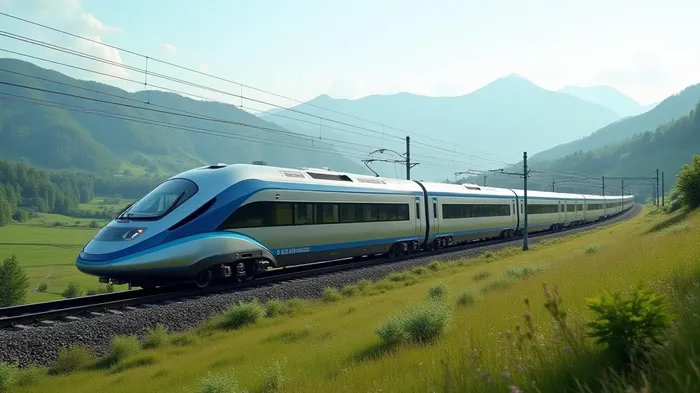
The Bavaria Hydrogen Train Project: Key Details
Siemens Mobility’s contract with the State of Bavaria involves delivering three two-car Mireo Plus H trains by late 2026 for deployment on the 32.3-km Mühldorf–Tüßling–Burghausen line. These trains will operate under a dedicated hydrogen supply system, including a green electrolysis plant in Mühldorf powered entirely by renewable energy. The trains boast a range of up to 1,200 km per hydrogen tank, a top speed of 140 km/h, and acceleration of 1.1 m/s², rivaling conventional diesel and electric trains.
Crucially, the project includes a long-term service agreement for hydrogen supply and maintenance, ensuring Siemens’ recurring revenue streams. This aligns with Bavaria’s goal to eliminate CO₂ emissions from non-electrified rail routes by 2030, a target that could drive further orders beyond the initial three trains.
Technical Breakthroughs and Sustainability Gains
The Mireo Plus H’s hydrogen fuel cell system combines roof-mounted Type IV pressure cylinders with lithium-ion batteries, enabling seamless energy recovery during braking. This hybrid design reduces lifecycle costs compared to diesel trains while eliminating CO₂ and nitrogen oxide emissions. Siemens emphasizes the trains’ zero-emission operation, emitting only water vapor, and their quiet electric drives, which are 40% quieter than diesel engines.
For Bavaria, the environmental benefits are substantial. Replacing diesel trains on this route will reduce annual CO₂ emissions by 3,000 tons—equivalent to taking over 600 gasoline-powered cars off the road. The project also underscores Siemens’ broader €1.5 billion investment in hydrogen infrastructure since 2020, positioning it as a leader in green rail technology.
Financial Implications and Market Potential
While the contract’s exact value isn’t disclosed, similar projects offer clues. For instance, a seven-train order for Berlin-Brandenburg’s Heidekrautbahn line (delivered in late 2024) is projected to save 1.1 million liters of diesel annually. Scaling this to Bavaria’s three-train fleet suggests annual diesel savings of ~470,000 liters, with corresponding emissions reductions.
The long-term service agreement adds further value. Siemens’ maintenance and hydrogen supply contracts typically span 15–20 years, providing stable cash flows. For example, the Berlin-Brandenburg contract includes spare parts support until 2034, locking in decades of revenue.
Investors should note Siemens’ stock has risen 18% since 2021, outperforming broader industrials indices as markets bet on its green transition. However, the hydrogen train segment remains nascent. Competitors like Alstom (ALO.PA) and CRRC are also advancing hydrogen projects, intensifying the need for cost efficiency and scale.
Risks and Challenges
Despite its promise, the project faces hurdles. Green hydrogen production costs remain high—€5–8/kg vs. €1/kg for fossil-derived hydrogen. While Bavaria’s electrolysis plant uses renewable energy, scalability depends on broader infrastructure development. A 2024 report by Aurora Energy Research warns that green hydrogen could account for only 15% of rail fuel demand by 2030 due to cost constraints.
Additionally, regulatory and supply chain risks loom. Hydrogen refueling stations and standardized fuel cell components are still in early stages, requiring cross-industry collaboration. Siemens’ partnership with Deutsche Bahn (DB)—which operates the trains and manages infrastructure—mitigates some risks but highlights reliance on ecosystem partners.
Conclusion: A Strategic Bet on Green Transport
Siemens Mobility’s hydrogen train project for Bavaria is a strategic move that combines technological prowess with long-term sustainability goals. The trains’ technical specs, paired with Bavaria’s climate mandates, create a replicable model for other regions. With 2,000 diesel trains slated for replacement across Germany by 2030, the market potential is vast.
Investors should focus on Siemens’ ability to scale production and reduce hydrogen costs. The company’s €300 million investment in a hydrogen plant in Gothenburg (2023) signals commitment to this space. Meanwhile, the Bavaria contract’s service agreements offer predictable cash flows, stabilizing earnings even in volatile markets.
The verdict? Siemens’ hydrogen trains are more than a niche project—they’re a cornerstone of the green rail revolution. For investors, this is a chance to back a leader in a sector poised to grow from €2 billion to €20 billion by 2035, according to BloombergNEF. Bavaria’s trains may just be the first chapter of a much larger story.







Comentarios
Aún no hay comentarios