
The Shrinking U.S. Mortgage Market: Implications for Real Estate and Alternative Housing Investments
The U.S. mortgage market has undergone a profound structural transformation since 2023, driven by persistently high interest rates, tightening credit standards, and a stubborn affordability crisis. These shifts have not only reshaped housing demand but also redefined the risk-return profiles of traditional real estate investments. As the market adapts to a new normal, investors must rethink their exposure to REITs, multi-family assets, and alternative lending models to navigate the evolving landscape.
Structural Shifts in Mortgage Lending: Credit Tightening and Rate Volatility
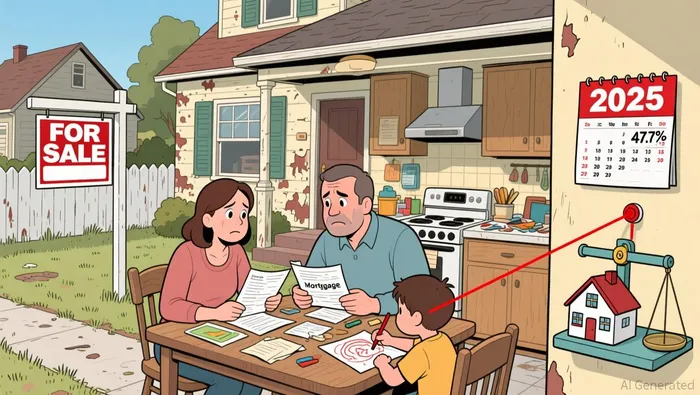
The past three years have seen a dramatic recalibration of mortgage lending. By 2025, the 30-year fixed-rate mortgage averaged 6.23%, down from a peak of 6.81% in 2024, yet still elevated compared to pre-pandemic levels. This moderation has created a fragile equilibrium: while lower rates have spurred cautious buyer activity, affordability constraints remain severe. The Atlanta Fed's Housing Ownership Affordability Monitor (HOAM) reports that owning a median-priced home now consumes 47.7% of the median household's income, a level that has persisted despite rate declines.
Credit standards have also tightened, particularly for nonconventional loans. Banks have imposed stricter underwriting criteria, even as they slightly relaxed rules for conventional mortgages. This bifurcation has pushed borrowers toward alternative lending models, such as non-QM (Non-qualified Mortgage) programs and DSCR (Debt-Service Coverage Ratio) loans, which assess creditworthiness through property cash flow rather than personal income. These models have become critical for self-employed individuals, gig workers, and real estate investors, who struggle with traditional documentation requirements.
Affordability Squeeze and Housing Demand
The affordability crisis is not merely a function of high rates but also structural supply-side issues. A 4.7 million unit housing deficit, coupled with soaring non-mortgage costs like insurance and utilities, has locked many households into their current homes. This "lock-in effect" has suppressed inventory, with J.P. Morgan Research estimating that house prices will rise by 3% in 2025 despite stagnant demand.
Housing mobility has also declined, exacerbating regional imbalances. The South and West have seen softening prices and potential corrections, while the Northeast and Midwest continue to experience appreciation. According to market analysis, this divergence underscores the risks of a one-size-fits-all approach to real estate exposure.
REITs and Multi-Family Assets: Navigating a High-Cost Environment
Multifamily REITs have faced headwinds as elevated interest rates have pressured property valuations and constrained transaction activity. Investors are increasingly favoring lower leverage and shorter-term debt, anticipating future rate cuts. However, the sector's long-term outlook remains cautiously optimistic. As supply pressures ease-particularly in coastal markets where rental demand is surging due to the AI boom- multifamily REITs could see a rebound in 2026.
That said, the path to recovery is uneven. Sun Belt markets, already oversupplied with new construction, remain vulnerable to further corrections. Investors must carefully evaluate regional fundamentals and avoid overexposure to areas with weak absorption rates.
Alternative Lending Models: Innovation in a Constrained Market
Alternative lending models have emerged as a lifeline for both borrowers and investors. DSCR loans, which account for nearly one-third of non-QM production in 2025, have gained traction in high-growth markets like Miami and Houston. These loans enable investors to finance properties based on cash flow, bypassing the limitations of traditional income verification.
Non-QM lending, meanwhile, has expanded rapidly, with originations projected to exceed $150 billion in 2025. This growth reflects a broader shift in the workforce toward self-employment and the gig economy, which traditional underwriting struggles to accommodate. Innovations such as hybrid loan structures- combining interest-only periods with step amortization-have further enhanced flexibility for borrowers while maintaining credit discipline.
Technological advancements are also reshaping the non-QM landscape. AI-driven underwriting tools are streamlining documentation processes, reducing turn times, and improving risk assessment for non-traditional borrower profiles. These efficiencies are critical for scaling alternative lending models without compromising credit quality.
The Case for Rethinking Traditional Real Estate Exposure
The shrinking mortgage market has exposed the limitations of conventional real estate strategies. With housing demand constrained by affordability and mobility, and REITs facing valuation pressures, investors must diversify their approaches. Alternative lending models like DSCR and non-QM offer a pathway to capitalize on market gaps while mitigating risks associated with traditional underwriting.
Moreover, the rise of second-lien products and HELOC solutions is unlocking equity in existing homes, enabling homeowners to access liquidity without refinancing their low-rate mortgages. This trend could stimulate demand in the single-family rental (SFR) market, where DSCR loans have already gained prominence.
Conclusion: A New Paradigm for Real Estate Investment
The U.S. housing market is at an inflection point. Structural shifts in mortgage lending, coupled with affordability challenges and declining mobility, have created a landscape where traditional strategies are no longer sufficient. Investors must embrace innovation-whether through alternative lending models, regional diversification, or technology-driven underwriting-to navigate the uncertainties ahead.
As the market adapts to macroeconomic realities, those who pivot early to non-QM, DSCR, and hybrid financing structures will be best positioned to capitalize on the opportunities emerging in a shrinking but resilient mortgage market.







Comentarios
Aún no hay comentarios