
Shorting Ethereum: Institutional Dynamics and Market Shifts
Bearish Catalysts: ETF Outflows and Fractured Treasuries
Ethereum ETF outflows in Q4 2025 revealed moments of volatility, such as the $422 million single-day redemption in August 2025, according to a PowerDrill report. However, these short-term dips masked a broader trend: Ethereum ETF assets under management (AUM) surged from $10.3 billion in July to $28.6 billion by late September 2025. This growth was driven by institutional accumulation, with investment advisors holding 541K ETHETH-- and hedge funds doubling their positions to 296K ETH.
Yet, fractured digital treasury models introduce complexity. While Ethereum Treasury Companies-listed firms holding and staking ETH-have grown to 14 entities collectively holding 4.36 million ETH (3.6% of total supply), according to an Oak Research report, this fragmentation could create liquidity risks. For instance, SharpLink Gaming's $200 million ETH commitment to Consensys' LineaLINEA-- network, as noted in a Cryptopolitan report, highlights institutional confidence but also underscores the potential for uneven capital distribution.
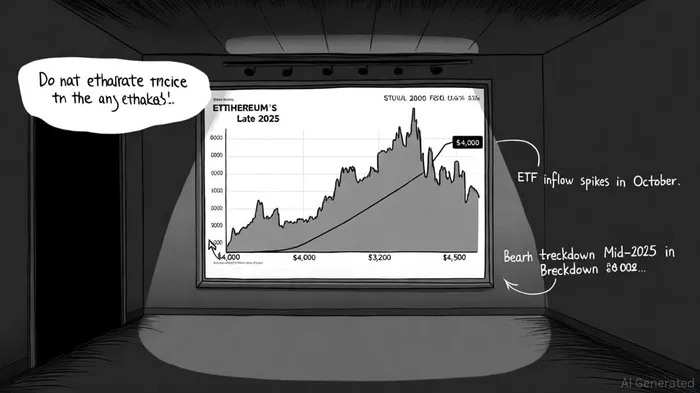
Bearish technical signals further complicate the picture. Ethereum's RSI at 43 and MACD at -73.4, per AltIndex technical stats, suggest weakening momentum, while the price retests a broken ascending trendline. A failure to reclaim the $4,300–$4,500 triangle formation could push ETH toward $3,200–$3,400 liquidity zones, as argued in a Bitcoinist analysis.
Bullish Fundamentals: Institutional Inflows and On-Chain Resilience
Despite bearish headwinds, Ethereum's fundamentals remain robust. October 2025 saw Ethereum ETFs outperform BitcoinBTC--, with $246.02 million in inflows led by Fidelity's FETH, according to a CoinPedia report. Total AUM reached $27.66 billion, per a Coinotag report, driven by whale activity like Bitmine's $113 million ETH purchase.
On-chain metrics reinforce this bullish narrative. Daily Ethereum transactions averaged 1.65 million in Q4 2025, according to CoinLaw statistics, with smart contracts accounting for 62% of volume. Active addresses hit 127 million in March 2025, and DeFi TVL surged to $114.9 billion by September 2025, per the Oak Research report. These figures highlight Ethereum's role as a foundational layer for decentralized finance.
Institutional demand is also reshaping Ethereum's narrative. The GENIUS Act's regulatory clarity, noted in a Mitrade article, and BlackRock's dominance in ETF inflows signal growing acceptance. Meanwhile, Ethereum's Fusaka hard fork in December 2025 promises scalability upgrades, further solidifying its technical edge.
Balancing the Scales: Actionable Insights for Traders and Investors
For short-term traders, Ethereum's technical fragility offers opportunities. A breakdown below $3,400 could trigger a short squeeze, especially if the negative funding rate (-73.4) indicated in AltIndex technical stats reverses. However, institutional inflows and DeFi resilience suggest a floor near $3,200.
Institutional investors should focus on Ethereum's dual role as a yield asset and a decentralized infrastructure backbone. The 3.5%–5% annualized yields from staking and the ETH/BTC ratio's 62% Q3 2025 increase, according to a CoinMetrics report, indicate Ethereum's growing appeal over Bitcoin.
Long-term holders, meanwhile, should monitor the Fusaka hard fork and macroeconomic factors like the FOMC's rate decisions. A sustained recovery above $4,500 could reignite bullish momentum toward $5,500, as noted in a Bitget analysis.
Conclusion
Ethereum's late 2025 landscape is a tug-of-war between bearish catalysts and bullish fundamentals. While ETF outflows and technical fragility pose risks, institutional adoption and on-chain strength offer a counterbalance. For investors, the key lies in hedging against volatility while capitalizing on Ethereum's evolving role in institutional portfolios.





Comentarios
Aún no hay comentarios