
Why Shorting Crude Oil Ahead of OPEC+ is a No-Brainer
The June 1 OPEC+ meeting looms as a critical catalyst for oil markets, and the writing is on the wall: a supply glut is brewing. With Kazakhstan's relentless overproduction, OPEC+'s credibility at risk, and U.S.-China tariffs kneecapping demand, the case for shorting crude oil has never been stronger. Here's why investors should act now—and how to do it safely.
The Supply Glut: Kazakhstan's Defiance and OPEC+'s Punitive Hike
OPEC+ compliance has collapsed to 67% in Q1 2025, with Kazakhstan, Iraq, and Russia collectively overproducing by 890,000 b/d (see 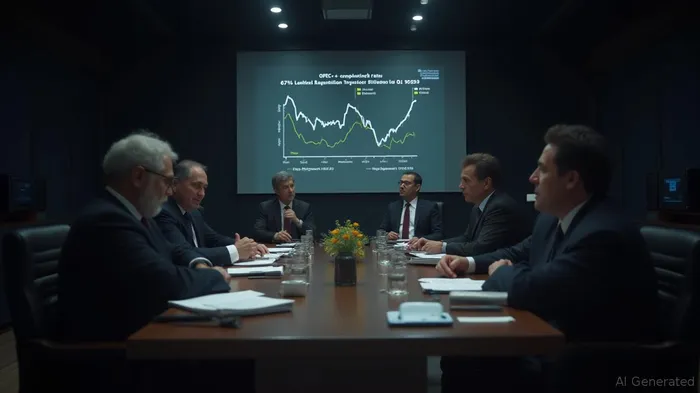 ). Kazakhstan's refusal to curb output—driven by its $533 million expansion at the Tengiz field, which added 260,000 b/d—is the poster child for noncompliance. Despite OPEC+ quotas of 1.486 million b/d, Kazakhstan produced 1.86 million b/d in May, defying the cartel's authority.
In response, OPEC+ plans a 411,000 b/d output hike for June, tripling the initial target. This punitive move aims to flood markets and punish overproducers, but it risks exacerbating oversupply. The mathMATH-- is brutal: global oil inventories could swell by 1.5 million b/d by year-end, with prices plummeting toward $50–$55/bbl (Kazakhstan's fiscal breakeven point).
U.S.-China Tariffs: A Demand-Side Tsunami
The U.S.-China tariff war isn't just a trade issue—it's a demand destroyer. The May 12 tariff truce (cutting rates to 10% temporarily) provided a brief reprieve, lifting oil prices to $63.54/bbl. But the long-term outlook is bleak:
- Global trade volumes: China's share of U.S. imports has halved to 6%, slashing transpacific tanker traffic.
- Manufacturing contraction: U.S. construction and agriculture sectors are shrinking by 3.1% and 1.1%, respectively, reducing energy-intensive activity.
- Automotive pain: U.S. auto prices are up 9.3%, crimping sales and reducing demand for fuel-efficient vehicles.
The $2.7 trillion in tariff revenue by 2035 comes at a cost: global GDP is 0.4% smaller, with Canada's economy hit hardest (-2.3%). This isn't just a paper cut—it's a systemic drag on oil demand.
Investment Strategy: Short Crude Oil—Now
The June 1 OPEC+ meeting is the catalyst. Here's how to position:
1. Entry Point: Short WTI crude oil futures at $60/bbl.
- Catalyst: If OPEC+ confirms the 411,000 b/d hike, prices could drop to $55–$50/bbl within weeks.
2. Exit Strategy:
- Profit Target: $55/bbl (Kazakhstan's fiscal break-even).
- Stop-Loss: $65/bbl (to guard against OPEC+ compliance surprises).
3. Risk Mitigation:
- Pair the short with a long position in oil refiners (e.g., Valero (VLO) or Marathon Petroleum (MPC)) to profit from lower feedstock costs.
- Use options: Buy put options on crude oil ETFs like USO with strike prices at $55/bbl.
The Bottom Line: Time is Ticking
The combination of OPEC+'s self-inflicted supply glut and U.S.-China tariff-driven demand destruction creates a textbook short opportunity. With inventories rising and geopolitical tensions unresolved, the risk-reward favors crude oil bears.
Act before June 1—once the OPEC+ decision drops, the market will already be pricing in the glut. For those who move first, the drop to $50/bbl could deliver a 20%+ return—and that's just the start.








Comentarios
Aún no hay comentarios