
Shorting Aya Gold & Silver: A Case of Speculative Overvaluation in a Volatile Sector
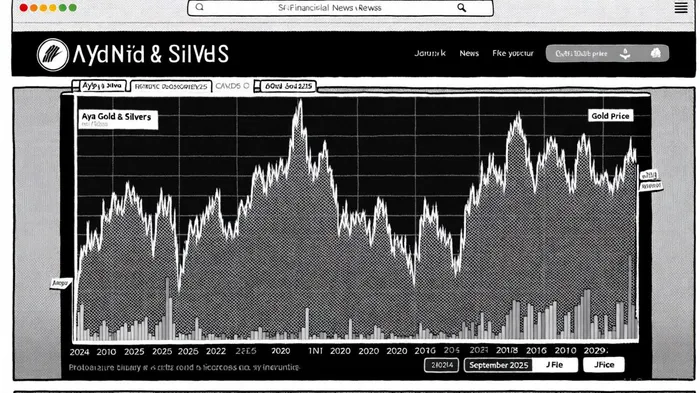
The junior gold mining sector has been a darling of 2025, riding a wave of speculative fervor as gold prices surged past $3,500 per ounce. Investors, lured by the allure of high leverage to gold's rally, have poured money into exploration-stage companies like Aya Gold & Silver (AYASF). Yet beneath the surface of this optimism lies a precarious reality: many junior miners, including Aya, are trading at valuations that defy their weak fundamentals and expose investors to outsized risks. For those considering shorting Aya, the case is compelling—but not without its caveats.
Aya's Financials: A House Built on Debt
Aya Gold & Silver reported record Q2 2024 revenue of $13.7 million, a 42% year-over-year increase, driven by silver price gains and inventory sales[1]. On the surface, this appears robust. However, the company's balance sheet tells a different story. Aya's debt-to-equity ratio spiked by 3,634% in 2024 due to a $100 million EBRD loan[1], pushing total non-current liabilities to $100.1 million. While management claims flexibility in repaying the loan (which begins in 2026), this debt load is a double-edged sword. If gold prices falter or exploration results disappoint, Aya's leverage could quickly become a liability.
Moreover, Aya's valuation metrics are deeply problematic. The company trades at a forward P/E of 31.82[2], a stark contrast to its trailing twelve-month (TTM) P/E of -98.6[5], reflecting historic losses. This disconnect suggests investors are betting on a future where Aya's Zgounder Mine—still in development—drives profitability. But such optimism ignores the reality that junior miners often fail to deliver on exploration promises. For every success story, there are countless write-offs.
The Junior Miner Paradox: High Leverage, Higher Risk
Junior gold miners are inherently volatile, and Aya is no exception. The sector's valuation surge—driven by gold's 50% year-to-date rally—has created a bubble-like environment[3]. Companies with minimal production and speculative projects now trade at EV/oz multiples that rival or exceed those of senior miners. Aya's enterprise value of $1.56 billion[2] (or C$2.24 billion[3]) implies a premium to its peers, many of which have more concrete production timelines.
Consider the math: Aya's market cap is roughly 15 times its cash reserves of $103 million[1]. This suggests investors are paying handsomely for the hope of future gold ounces, not current cash flow. In a sector where exploration success rates are notoriously low, such optimism is perilous. For context, peers like Orezone Gold (market cap: $242 million) trade at far lower valuations despite similar growth profiles[1]. Aya's premium appears unjustified.
Systemic Risks: Exploration Costs and Market Volatility
Junior miners like Aya face a unique set of challenges. Exploration costs are rising, with companies often forced to raise capital through dilutive private placements or joint ventures[4]. Aya's recent 30,000-meter drilling program at Zgounder—doubled from its original scope—highlights this risk. While management touts the expansion as a sign of progress, it also signals higher capital expenditures. If the drilling fails to uncover economically viable reserves, Aya could face a liquidity crisis.
Market volatility compounds these risks. Gold's recent surge to $3,500/oz has been fueled by macroeconomic uncertainties, but such trends are not guaranteed to persist. A sharp correction in gold prices would disproportionately hurt junior miners, which lack the diversified revenue streams of seniors. Aya's high leverage to gold prices—while a tailwind in bull markets—could become a death sentence in a downturn.
Why Short Aya? A Calculated Bet
Shorting Aya is not without risks. The company's cash reserves and exploration momentum could delay a reckoning. However, the case for a short position rests on three pillars:
1. Speculative Overvaluation: Aya's P/E and EV/oz metrics are unsustainable without material production growth.
2. Debt Vulnerability: Aya's $100 million loan creates a near-term overhang, particularly if gold prices soften.
3. Sector Weakness: Junior miners are inherently volatile, and Aya's lack of near-term production makes it one of the riskiest plays.
For short-sellers, the key is to hedge against gold's potential continued rise. A short position in Aya paired with a long position in gold futures or a gold ETF could mitigate directional risk. Alternatively, investors could target the broader sector by shorting Aya alongside other overvalued juniors.
Conclusion: A Cautionary Tale for Speculators
Aya Gold & Silver epitomizes the speculative frenzy gripping the junior gold sector. While its recent financial results are encouraging, they mask a company built on debt and hope. For investors, the lesson is clear: junior miners offer high-reward, high-risk propositions. In Aya's case, the risks—exploration uncertainty, leverage, and overvaluation—outweigh the potential rewards. Shorting Aya is a calculated bet against speculative excess, but one that demands close monitoring of gold prices and exploration outcomes.







Comentarios
Aún no hay comentarios