
Short Squeezes and Contrarian Catalysts: Decoding Short Interest in Crypto-Related Stocks for 2025
In the volatile world of crypto-related equities, short interest has emerged as a critical contrarian signal. As of September 2025, MicroStrategy (MSTR) and Riot PlatformsRIOT-- (RIOT) exemplify this dynamic. MSTR's short interest stood at 21.17 million shares, a 6.7% decline from August's 22.68 million, while RIOT's short interest totaled 75.35 million shares with a short interest ratio of 1.91, as reported by MarketBeat. These metrics suggest moderate pessimism but also hint at potential short-covering catalysts, according to Bitget analysis.
Short Interest as a Contrarian Barometer
Short interest ratios-calculated as the number of shorted shares divided by average daily volume-offer insight into market sentiment. MSTR's ratio of 2.0 implies that, at current trading volumes, it would take two days to cover all short positions, per MarketBeat. This is a relatively low threshold compared to historical extremes, suggesting short sellers may be vulnerable to a rally. Similarly, RIOT's 1.91 ratio indicates a similar risk profile, as noted by Bitget. Institutional shorting activity, including positions held by Valeo Financial Advisors and Hudson Bay Capital, further underscores strategic bearish bets reported by MarketBeat and Bitget.
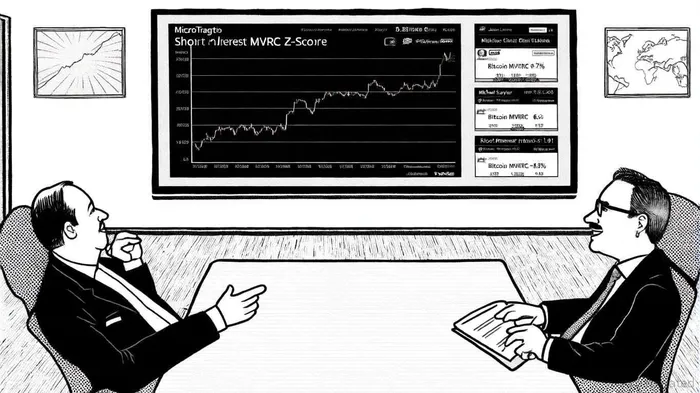
Derivatives markets reinforce this narrative. Negative funding rates in BitcoinBTC-- perpetual futures, which reached deeply bearish levels in Q3 2025, signaled panic-driven capitulation, according to a Cryptowisser guide. Such conditions often precede rebounds, as seen in prior cycles where oversold metrics (e.g., MVRV Z-Score dipping to 1.43) coincided with institutional accumulation, per Bitget. Meanwhile, the Bitcoin long/short ratio normalized to 1.03 in August 2025 from an extreme bearish 0.44, reflecting reduced short dominance and a potential inflection point, according to Bitget.
Technical and Sentiment Indicators
For trend-following strategies, the ADX (Average Directional Index) and moving averages remain pivotal. When ADX exceeds 20 and moving averages align in a bullish configuration, momentum traders gain confidence, per Cryptonewer. Conversely, contrarian strategies thrive in range-bound markets, leveraging RSI (Relative Strength Index) and Bollinger Bands. RSI below 30 or above 70 often signals reversals, per MarketBeat, making it a dual-purpose tool for both approaches. Historical backtesting from 2022 to 2025 shows that the 14-day RSI <30 signal, when used to enter positions in MSTRMSTR-- and hold for 30 trading days, produced very strong positive returns, whereas the same strategy yielded only marginal results for RIOTRIOT--. This suggests the RSI oversold signal is more reliable for MSTR over this period.
Macro factors also play a role. Bitcoin's inverse correlation with the U.S. dollar and its positive relationship with tech stocks highlight its duality as a risk-on asset and macro-hedge, according to Bitget. Meanwhile, AI-driven sentiment analysis tools now parse social media and on-chain data to distinguish between genuine bearish sentiment and speculative noise, according to Exchainer.
Near-Term Catalysts and Positioning
The interplay of these indicators suggests a near-term reversal could be triggered by short-covering rallies. For MSTR and RIOT, a sharp rebound in share prices could force short sellers to buy back shares at higher prices, exacerbating upward momentum. This dynamic is amplified by the normalization of speculative positioning in Bitcoin derivatives, which historically precedes sustained recoveries, per Bitget.
Investors should monitor three key thresholds:
1. MSTR's short interest ratio breaching 2.5, which could signal renewed bearishness.
2. Bitcoin's MVRV Z-Score falling below 1.3, indicating deeper undervaluation.
3. Funding rates turning positive, which would signal a shift in perpetual futures sentiment (per Cryptowisser).
Conclusion
Short interest in crypto-related stocks remains a potent contrarian indicator, particularly when aligned with derivatives metrics and macroeconomic signals. While MSTR and RIOT's current short interest levels suggest moderate pessimism, the broader market environment-including normalized speculative positioning and institutional accumulation-points to a potential inflection point. For investors, the key lies in synthesizing these signals to identify catalysts for near-term reversals.





Comentarios
Aún no hay comentarios