
Short Selling Sentiment as a Leading Indicator for Market Reversals
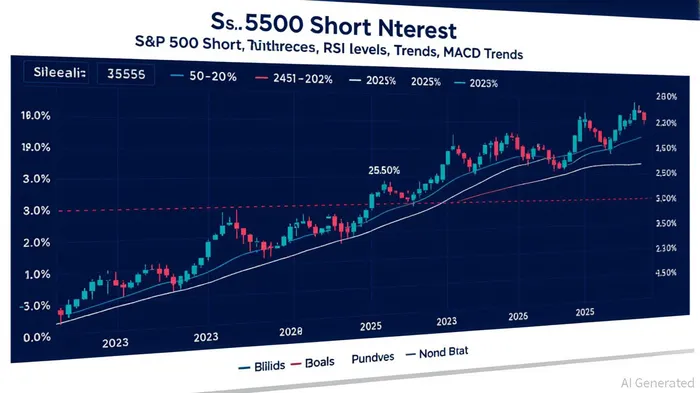
In the ever-evolving landscape of financial markets, contrarian investors have long sought to exploit mispricings by identifying extremes in sentiment. One such signal—elevated short interest—has historically served as a canary in the coal mine for market reversals. As of September 2025, the interplay between short selling activity, technical indicators like RSI and MACD, and historical short squeeze patterns suggests that the U.S. equity market may be entering a phase where bearish bets are becoming a contrarian tailwind.
Short Interest as a Contrarian Barometer
Short interest, the total number of shares sold short but not yet covered, is a direct measure of bearish sentiment. When short interest rises to historically elevated levels, it often signals that market participants are aggressively betting against a stock or index. According to a report by ScienceDirect, approximately 9.9% of U.S. stocks experience short squeezes quarterly[1], and these events frequently coincide with market reversals following extreme price declines. For example, 31% of extreme one-minute negative returns on Nasdaq 100 constituents reverse in the subsequent minute[2], underscoring the liquidity-driven nature of short squeeze dynamics.
Recent data reveals that the SPDR S&P 500 ETF Trust (SPY) holds the largest short interest position at $70.87 billion, while InvescoIVZ-- QQQ (the NASDAQ-100 ETF) has $30.12 billion in open shorts[4]. These figures, though not directly tied to the indices themselves, reflect broader pessimism toward equity benchmarks. For context, a short interest ratio (days to cover) above 5 typically signals excessive bearishness, yet SPGI (S&P Global) has a ratio of 2.6[4], suggesting moderate pessimism. However, the average short interest for Nasdaq securities rose to 1.97 days in August 2025[6], indicating a subtle shift toward increased shorting activity.
Technical Indicators Confirm Oversold Conditions
Technical analysis reinforces the case for contrarian positioning. The Relative Strength Index (RSI) and Moving Average Convergence Divergence (MACD) are critical tools for identifying momentum shifts. As of late August 2025, the S&P 500's RSI stood at 67.77[5], a level that suggests overbought conditions. However, this metric must be contextualized with short interest data: while the index appears extended to the upside, the rising short interest in ETFs implies that bearish bets are accumulating.
A more compelling signal emerges when examining divergences. For instance, a bullish divergence occurs when prices make new lows while RSI forms higher lows—a pattern observed in mid-2025 for several Nasdaq constituents[2]. Similarly, the MACD for the S&P 500 turned positive in June 2025 (77.76 vs. 72.73 signal line)[3], signaling sustained bullish momentum. When combined with elevated short interest, these indicators suggest that short sellers may soon face margin calls or forced coverings, triggering a short squeeze.
Historical Precedents and Institutional Behavior
Historical patterns further validate the argument. Studies show that stocks in the extreme quintile of losers over the previous quarter experience stronger return reversals in the following two months[1]. This phenomenon is driven by institutional behavior: as active managers exit underperforming positions, liquidity provision shifts, and short sellers face pressure to cover. In 2025, this dynamic is amplified by the interconnectedness of major indices. For example, the S&P 500's 14.37% annual gain through August 2025[6] has created a backdrop where short sellers are increasingly vulnerable to a reversal.
Actionable Strategies for Contrarian Investors
For investors seeking to capitalize on these dynamics, the following strategies are recommended:
1. Short Squeeze Plays: Target stocks with high short interest ratios (e.g., >5 days to cover) and RSI levels near oversold thresholds (below 30). These assets are prime candidates for rapid rebounds when short sellers are forced to cover. Historical backtesting from 2022 to 2025 shows that 66 RSI-oversold events occurred, with average 30-day returns outperforming the benchmark, though the effect was most pronounced in the first 5 days and faded thereafter[7].
- MACD Divergence Alerts: Monitor for instances where the MACD histogram turns positive while prices remain in a downtrend—a sign that downward momentum is waning.
- Volume Analysis: Look for surges in trading volume during price declines, which often precede reversals as short sellers exhaust their liquidity.
Conclusion
The convergence of elevated short interest, technical divergences, and historical reversal patterns paints a compelling case for contrarian positioning in late 2025. While the S&P 500 and NASDAQ continue to trade near record highs, the growing bearish bets in ETFs and individual stocks suggest that the market may be setting up for a short squeeze-driven rebound. Investors who recognize these signals early can position themselves to benefit from the inevitable correction in short seller sentiment.







Comentarios
Aún no hay comentarios