
Shopify's Talent Play: Acquiring the Future of AI-Driven Commerce
In the tech sector's current downturn, companies are under pressure to prioritize efficiency and innovation. Few have mastered the balance better than ShopifySHOP--, which recently acquired key talent from struggling food ordering startup Ritual Technologies. This move epitomizes Shopify's strategic focus on long-term innovation over short-term ROI, while divesting non-core assets—a model that could position it as a leader in AI-driven commerce. For investors, this signals a compelling opportunity to capitalize on Shopify's founder-centric ecosystem.
The Acquisition: Acqui-Hiring as a Growth Engine
Shopify's acquisition of Ritual's leadership—CEO Ray Reddy, co-founder Larry Stinson, and their R&D team—is not about saving Ritual's fading food delivery app. Instead, it's about securing critical AI and e-commerce expertise to fuel its core mission: empowering small businesses. Reddy, now Shopify's VP of Retail, will spearhead efforts to integrate generative AI into tools like the new Horizon theme and Storefront MCP (conversational shopping agents). Meanwhile, Stinson's team will contribute to backend infrastructure, ensuring Shopify remains a platform of choice for merchants.
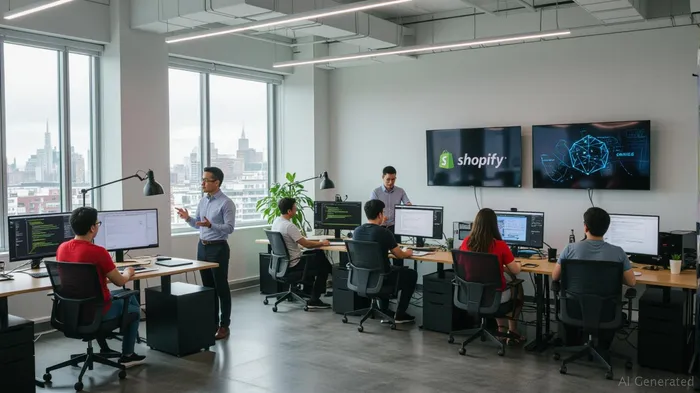
This isn't Shopify's first acquihire. Over the past five years, it has absorbed teams from startups like Peel Insights (AI analytics), Threads (design tools), and Stellate (developer platforms). These moves have allowed Shopify to avoid costly bidding wars for AI talent, instead acquiring entire teams with proven track records. As Reddy noted, joining Shopify means “helping businesses adapt to an AI revolution as transformative as mobile internet”—a vision that resonates with founders and engineers alike.
Operational Restructuring in a Tech Downturn
While Ritual's revenue has plummeted from $50 million in 2019 to $3.9 million in 2024, Shopify's approach avoids the pitfalls of a full acquisition. By focusing solely on talent, Shopify sidesteps Ritual's underperforming assets, which are now being sold to new buyers. This reflects a sharp operational discipline: divest non-core liabilities while doubling down on high-impact teams.
Shopify's financial strength enables this strategy. With Q3 2024 revenue up 26% to $2.16 billion, the company has the cash to invest in AI without compromising liquidity. Meanwhile, its founder-centric culture—where acquired leaders like Reddy become mentors to new teams—creates a flywheel of innovation. As COO Kaz Nejatian put it, “One of Shopify's secret weapons is that we're full of founders. And we keep adding more.”
Implications for Investors: Buy the Ecosystem, Not the App
For investors, Shopify's model offers two key advantages:
- Scalable Innovation: Acqui-hiring ensures Shopify's product pipeline remains robust. AI tools like Horizon Themes and conversational agents reduce the need for costly trial-and-error development.
- Risk Mitigation: By avoiding full acquisitions of underperforming startups, Shopify limits liabilities while retaining upside from talent-driven growth.
The risks? Short-term write-offs from divesting non-core assets may pressure near-term earnings. However, the long-term gains—dominating AI-native commerce tools—outweigh these costs. Competitors like AmazonAMZN-- and WalmartWMT-- are also investing in AI, but Shopify's agile, founder-driven ecosystem gives it an edge in adapting to rapid tech shifts.
Conclusion: A Buy for the AI Economy
Shopify's acquisition of Ritual's talent is more than a defensive move—it's an offensive play to lead the AI-driven transformation of retail. With strong fundamentals, a proven acqui-hiring model, and a focus on sustainable innovation, Shopify is well-positioned to capitalize on the next wave of e-commerce disruption.
Investment recommendation: Buy Shopify (SHOP). While short-term volatility is possible, the company's founder-led ecosystem and AI-first strategy make it a core holding for investors betting on tech's future.
This analysis underscores that in a downturn, the smartest companies aren't just cutting costs—they're building the tools to dominate the next upswing. Shopify is doing both, and investors should take note.





Comentarios
Aún no hay comentarios