
Shopify's Agentic Commerce Bet: Building the Rails for AI-Driven Shopping
The retail paradigm is shifting from a search-driven model to one built on conversation. This isn't incremental change; it's a fundamental reordering of the commerce stack, moving discovery, engagement, and conversion into a single, seamless flow. The catalyst is AI evolving from a research tool into a trusted buyer. New data shows artificial intelligence and agents drove about 20% of retail sales this past holiday season, a clear signal that the technology is moving from influence to execution.
This adoption is hitting an inflection point. The recent unveiling of the Universal Commerce Protocol (UCP) by Google, ShopifySHOP--, and major retailers like Walmart and Target is a critical step in building the open standards needed to scale this new model. The protocol is designed to be the common language that lets AI agents complete purchases across different platforms, effectively moving shoppers from "I'm interested" to "I've bought it" without friction. It addresses the core vulnerability of the current system: checkout. As Google notes, roadblocks are costing retailers a lot of money because billions are left in abandoned carts.
For Shopify, this represents a strategic pivot to build the infrastructure layer for this emerging paradigm. By co-developing the UCP and integrating it with its own ChatGPT integration, Shopify is positioning itself not just as a merchant platform, but as the foundational rail for agentic commerce. The goal is to create a frictionless conversational experience where a shopper's question directly triggers a purchase, with orders flowing back to the merchant's existing systems. This is the exponential shift: the customer journey is collapsing into a single interaction, and the company that provides the open standard for that interaction controls a critical piece of the next technological S-curve.
Shopify as the Infrastructure Layer
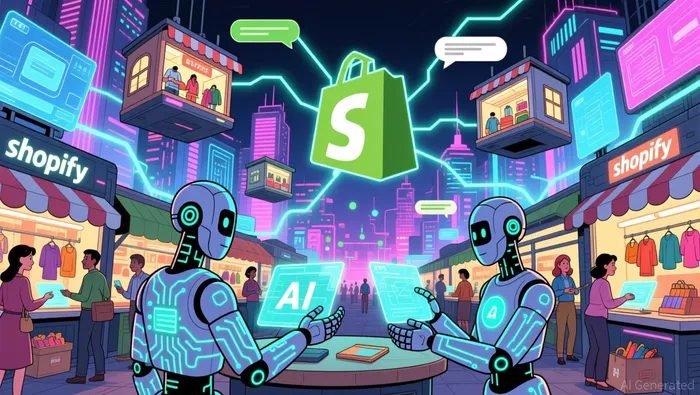
Shopify is betting that its platform can become the essential infrastructure for this new conversational economy. The company's integration with ChatGPT is a direct play to capture the first touchpoint in the AI-driven customer journey. By enabling instant checkout directly inside AI-powered conversations, Shopify is creating a new sales channel where discovery, engagement, and conversion collapse into a single interaction. This isn't just a feature; it's an attempt to embed the merchant's storefront within the AI assistant's workflow, ensuring the merchant remains the record holder for every order.
This strategy extends beyond the customer-facing channel. Shopify's own AI assistant, Sidekick, already helps merchants manage operations, from generating custom apps to automating workflows. This suggests a deeper integration where AI isn't just a sales tool but a core part of the merchant's daily operations. The company is building a closed loop: AI helps the merchant run the business, and AI also helps the customer buy from it.
Yet this very model faces a fundamental risk. The open standards being championed, like the Universal Commerce Protocol (UCP) developed by Google, are designed to be agnostic. They establish a common language that lets any AI agent interact with any retailer. While this expands reach, it also opens the door to disintermediation. An AI agent could theoretically bypass a Shopify storefront entirely, using the UCP to complete a purchase directly. This would strip Shopify of its critical role as the transactional and data hub, reducing its franchise value.
The financial impact of such a shift is significant. Merchants lose the last touch point for cross-selling, which accounts for 33% to 76% of upsell and cross-sell. If an AI agent fulfills a simple request like "buy me a new pair of running shoes," it may not prompt for complementary socks or a fitness tracker. In this scenario, Shopify's infrastructure becomes a utility, not a strategic advantage. The company's bet is that its deep integration with merchant systems and its role in the UCP will keep it central. But the protocol itself is a double-edged sword, built to scale the paradigm while potentially weakening the very platform that helped build it.
The Exponential Growth Math
Shopify's strategic bet is being priced for exponential growth. The stock has shown strong momentum, climbing 51% in 2025 and gaining 28% over the last 120 days. This rally reflects market optimism about the company's pivot to become the infrastructure layer for agentic commerce. Yet the valuation suggests that optimism is already baked in. With an enterprise value to EBITDA multiple of 156, the market is pricing in extraordinary future earnings. This leaves little room for execution missteps or slower-than-expected adoption of the new paradigm.
The key financial metric to watch is the adoption rate of the Universal Commerce Protocol (UCP) by Shopify merchants. The protocol is designed to let AI agents complete purchases across different platforms, moving shoppers from "I'm interested" to "I've bought it" in one flow. For Shopify, the goal is to have its merchants adopt the UCP, ensuring that AI-driven sales still route through its systems and generate transaction fees. The risk is that the open standard could enable off-platform sales, eroding that fee stream.
This creates a tension between scale and margin. The UCP aims to remove friction and expand the total addressable market for AI-driven shopping. But if it allows AI agents to bypass Shopify's storefronts entirely, the company could see a decline in its core transaction revenue. The financial math hinges on Shopify's ability to maintain its central role within the UCP ecosystem. The market is betting it can. The coming quarters will show whether the adoption curve is steep enough to justify the current valuation.
Risks and Counterpoints
The thesis for Shopify as the infrastructure layer for agentic commerce is compelling, but it faces a clear and present execution risk. The company is betting that its deep merchant relationships and role in building the Universal Commerce Protocol (UCP) will keep it central. Yet the UCP's very design-a critical open standard co-developed by Shopify-could eventually dilute its proprietary advantage. The protocol is built to be agnostic, allowing any AI agent to interact with any retailer. This accelerates adoption but also opens the door to disintermediation, where the AI agent bypasses the merchant's storefront entirely.
This is the core vulnerability. If an AI agent can complete a purchase directly through a platform like Google's AI Mode in Search, the merchant loses the final touchpoint for cross-selling and upselling. That channel accounts for 33% to 76% of upsell and cross-sell, a massive revenue stream. In this scenario, Shopify's role shifts from a strategic partner to a utility provider, merely routing the transaction. The company's franchise value, built on controlling the customer journey, would be significantly reduced.
The financial math hinges on Shopify's ability to navigate this tension. It must enable the open standard to drive industry-wide adoption while finding ways to maintain its fee-generating position within that ecosystem. The coming quarters will provide the first real data on this balance. Investors should watch for two key indicators: the rate at which Shopify merchants adopt the UCP, and any changes in the mix of transaction fees, which could signal whether sales are being routed through or around the platform. The risk is not that the paradigm shift won't happen, but that Shopify may not be the one to capture its full economic value.
Strategic Implications and Catalysts
The forward path for Shopify hinges on a single, massive catalyst: the integration of the Universal Commerce Protocol (UCP) with Google's AI Mode and the Gemini app. This is the critical test of whether the open standard can drive exponential user adoption. The setup is clear. Google plans to use UCP to power a new checkout feature that lets people buy directly within AI conversations, starting with saved payments from Google Wallet. If the experience is seamless, it could instantly unlock billions in AI-driven sales that were previously abandoned at checkout. For Shopify, the goal is to have its merchants adopt the protocol, ensuring that AI-driven purchases still flow through its systems and generate transaction fees.
The key watchpoints are twofold. First, monitor the merchant adoption rate. The protocol's success depends on Shopify's vast network of merchants making their inventory discoverable and their systems compatible. Second, watch for any shift in the transaction fee mix. If sales are routed through Google's AI interfaces, the merchant loses the final touchpoint for cross-selling, which accounts for 33% to 76% of upsell and cross-sell. This could pressure Shopify's core revenue model if not offset by new fee structures or value-added services within the UCP ecosystem.
The bottom line is that Shopify is betting on becoming the protocol layer for agentic commerce. This is a high-stakes move that could redefine its franchise value. The company is building the rails for a paradigm shift, but the protocol itself is a double-edged sword. It accelerates adoption by removing friction, yet it also opens the door to disintermediation. The coming quarters will show whether Shopify's deep merchant relationships and role in shaping the standard are enough to keep it central, or if it becomes a utility in a more open, agent-driven economy. The market is pricing in success; the execution will determine if the bet pays off.





Comentarios
Aún no hay comentarios