
Shoe Carnival's 8.9 P/E Ratio: Contrarian Opportunity or Mispricing?
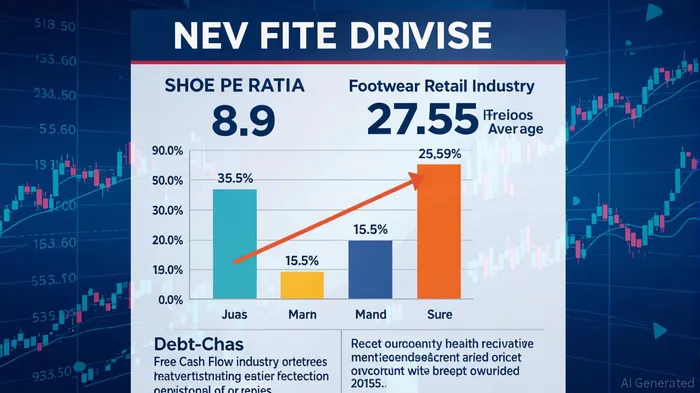
In the world of value investing, few metrics spark as much debate as the price-to-earnings (P/E) ratio. Shoe CarnivalSCVL-- (SCVL), a regional footwear retailer, currently trades at a P/E of 8.9, starkly below the footwear retail industry's average of 27.55 for 2025 [1]. This discrepancy raises a critical question: Does this low valuation reflect a mispricing of the company's intrinsic value, or does it signal deeper concerns about earnings sustainability? A contrarian lens, combined with a granular analysis of financial and industry trends, offers clarity.
Contrarian Value Investing: The Case for Undervaluation
Shoe Carnival's P/E ratio of 8.9 is a fraction of its peers' average, suggesting potential undervaluation. For context, the S&P 500's forward P/E in 2025 hovers around 22, while the broader Consumer Discretionary sector trades at 24.41X [2]. Shoe Carnival's discount implies the market is either discounting its earnings aggressively or overlooking its operational strengths.
The company's financials provide some justification for optimism. In 2024, Shoe CarnivalCCL-- generated $1,203 million in revenue, a marginal increase from $1,160 million in 2023 [4]. More compelling is its liquidity position: cash and equivalents rose to $109 million by year-end, and operating cash flow totaled $103 million [4]. These figures suggest resilience in a sector grappling with inflationary pressures and soft demand.
Moreover, Shoe Carnival's debt-to-equity ratio of 0.539 [5] is conservative, reducing the risk of financial distress. Coupled with $33 million in free cash flow [6], the company has flexibility to reinvest, pay down debt, or return capital to shareholders—factors that often go undervalued in volatile retail sectors.
Earnings Sustainability: A Mixed Picture
While the low P/E hints at value, earnings sustainability remains a concern. The footwear retail industry's earnings have contracted quarter-over-quarter, with cumulative net income declining 3.85% in Q1 2025 [1]. Shoe Carnival's performance mirrors this volatility. For instance, its gross profit margin expanded to 38.8% in Q2 2025 [4], but this followed a contraction to 34.5% in Q1 2025 [5]. Such inconsistency raises questions about the durability of its margins in a competitive landscape marked by rising operational costs [3].
However, Shoe Carnival's Q2 2025 results offer a silver lining. The 270-basis-point margin expansion suggests effective cost management or pricing strategies, potentially signaling a turnaround. If this trend persists, the current P/E could appear increasingly attractive.
Industry Context: A Sector in Transition
The footwear retail industry's challenges cannot be ignored. Analysts rank it poorly at #215 in earnings outlook [2], with inflation, labor costs, and shifting consumer preferences eroding margins. Shoe Carnival's 3.7% revenue growth in 2024 [1] outperformed many peers, but a 7.9% sales decline in Q2 2025 [4] underscores the sector's fragility.
Yet, contrarian investors often thrive in such environments. A P/E of 8.9 implies the market is pricing in worst-case scenarios, such as prolonged margin compression or stagnant growth. If Shoe Carnival can stabilize its earnings and leverage its liquidity, this valuation could represent a compelling entry point.
Conclusion: A Calculated Bet
Shoe Carnival's 8.9 P/E ratio appears to reflect a blend of undervaluation and risk. For contrarian investors, the key lies in assessing whether the company's operational improvements (e.g., margin expansion in Q2 2025) are sustainable. Its conservative debt levels and free cash flow provide a buffer against industry headwinds, while the stark discount to peers suggests the market may be overcorrecting.
However, caution is warranted. Earnings volatility and macroeconomic pressures remain significant hurdles. Investors must weigh Shoe Carnival's potential to adapt against the broader sector's challenges. In a market where “cheap” often means “risky,” Shoe Carnival's valuation demands rigorous due diligence—but for those willing to look beyond the numbers, it may reveal a hidden gem.





Comentarios
Aún no hay comentarios