
The Shifting Tides of U.S. Treasury Auction Demand: Liquidity Dynamics and Market Implications
The U.S. Treasury market, long considered the bedrock of global financial stability, is undergoing a seismic shift in investor demand patterns. Recent auction results, coupled with evolving secondary market liquidity dynamics, reveal a complex interplay between fiscal policy, investor behavior, and systemic risk. This analysis unpacks the implications of these shifts for bond market stability and broader financial systems.
Auction Dynamics: Strong Demand, Fragile Foundations
The bid-to-cover ratio-a metric reflecting the ratio of bids received to bids accepted in Treasury auctions-has remained robust in 2025. For instance, a recent 10-year auction posted a bid-to-cover ratio of 2.61, placing it in the upper 25% of the last 50 auctions. This strength, however, masks structural vulnerabilities. Direct bidders, including investment funds, now account for a historically high share of purchases (24.8% in the latest 5-year note auction, as reported by The Finance Herald), while primary dealers' participation has dwindled to 11.1%, a record low.
This shift signals a transition from price-insensitive buyers (e.g., foreign central banks) to price-sensitive entities (e.g., leveraged funds and households). While domestic demand has offset declining foreign participation, the reliance on end-user investors raises concerns about market resilience. As noted by a Brookings analysis, primary dealers are increasingly inflating bid/cover ratios with mechanical bids, masking a collapse in organic private investment demand. This artificial support risks unraveling when net issuance surges post-debt-ceiling resolutions, potentially triggering a "violent reset" in yields, according to the Brookings piece.
Secondary Market Liquidity: Tight Spreads, Hidden Strains
The bid-to-cover ratio's correlation with secondary market liquidity is nuanced. Strong auction demand often signals confidence, which can tighten bid-ask spreads in the secondary market, according to Global Treasurer. However, recent volatility-such as the April 2025 tariff-driven selloff-reveals fragility. During this period, bid-ask spreads for longer-term off-the-run Treasuries and TIPS doubled, while market depth eroded sharply, as documented in the Brookings analysis.
Academic studies underscore that regulatory constraints on primary dealers exacerbate these strains. Tighter capital requirements, such as the supplementary leverage ratio, have reduced dealers' ability to hold Treasury positions, leading to lower turnover and wider spreads, according to a Boston Fed working paper. This dynamic is compounded by strategic bidding behavior: investment funds often reduce pre-auction demand, creating inverted V-shaped yield patterns and temporary price pressure, as shown in an academic study. Such practices highlight the growing influence of non-dealer participants in shaping liquidity conditions.
Structural Challenges and Systemic Risks
The Treasury market's structural evolution-driven by rising deficits, a shrinking dealer base, and a shift toward price-sensitive investors-has made it more susceptible to liquidity shocks. Total Treasury issuance has surged to $19.4 trillion year-to-date (YTD), with outstanding debt reaching $29.0 trillion as of July 2025, a trend documented in the Brookings piece. This expansion, coupled with reduced dealer intermediation, has strained the market's capacity to absorb large trades.
Historical precedents, such as the March 2020 pandemic crash, illustrate the risks. During that period, a flood of sell orders overwhelmed dealers, causing sharp price declines and yield spikes, as recounted by Brookings. While the April 2025 disruptions were less severe, they underscored the market's fragility. The Federal Reserve's interventions, including the Standing Repo Facility (SRF), have mitigated some risks, but long-term solutions remain elusive, according to the Brookings analysis.
Policy Responses and the Road Ahead
Regulators have introduced measures to bolster liquidity, such as mandating central clearing for Treasury trades and requiring high-speed trading firms to register as dealers, steps highlighted by Global Treasurer. These steps aim to enhance transparency and intermediation capacity. However, challenges persist. The Federal Reserve's rate-hiking cycle since 2022 has tightened liquidity, reducing the appeal of existing bonds and complicating trading activity, an effect discussed in the Global Treasurer piece.
Looking ahead, the market's resilience will depend on balancing fiscal sustainability with liquidity provision. As noted by State Street in coverage cited by Global Treasurer, the shift in investor composition-away from central banks toward funds-will likely amplify yield volatility and market stress during crises. Investors must remain vigilant, as the next liquidity shock could test the system's limits, particularly if geopolitical tensions or economic downturns coincide with peak Treasury issuance.
Conclusion
The U.S. Treasury market remains a critical pillar of global finance, but its liquidity dynamics are increasingly shaped by structural vulnerabilities. While strong auction demand and resilient domestic participation offer short-term reassurance, the long-term outlook hinges on addressing systemic risks. For investors, the key takeaway is clear: diversification and liquidity management are paramount in an era where even the safest assets face unprecedented pressures.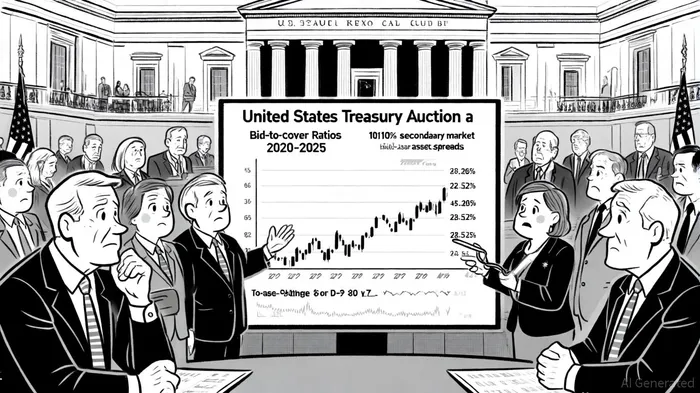







Comentarios
Aún no hay comentarios