
The Shifting Tides in Crypto ETF Flows: Why Solana is Outperforming Bitcoin and Ethereum
A Divergence in ETF Flows: Solana's Surge vs. Bitcoin and Ethereum's Retreat
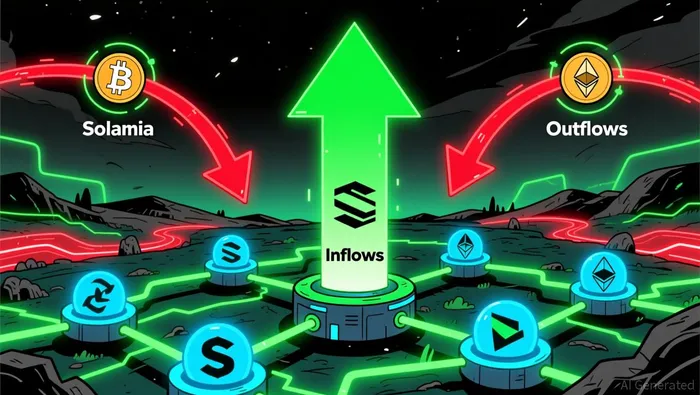
In Q3 2025, Ethereum ETFs briefly eclipsed Bitcoin's inflows, with $9.6 billion versus $8.7 billion, according to a Coinotag analysis. However, by November 2025, the narrative had flipped. SolanaSOL-- ETFs, led by Bitwise's BSOL, saw $70.05 million in net inflows on November 3 and $14.83 million on November 4, marking six consecutive days of positive flows, according to a CoinEdition report. In stark contrast, Bitcoin and Ethereum ETFs faced outflows: BlackRock's IBITIBIT-- alone lost $186.5 million on November 3, while Ethereum ETFs like ETHAETHA-- and Grayscale's ETH saw combined outflows of $219 million, per a Coinotag report.
This divergence reflects a broader reallocation of capital toward assets offering immediate utility and yield. Solana's staking rewards of 5-7% annually, coupled with its sub-second transaction finality and low fees, make it an attractive alternative to Bitcoin's energy-intensive model and Ethereum's Layer 2 complexities, as highlighted in Coinotag's coverage of Grayscale.
Solana's Ecosystem: The Institutional Magnet
Solana's appeal lies in its technical superiority and institutional readiness. Unlike Bitcoin's proof-of-work architecture or Ethereum's gas-guzzling smart contracts, Solana's high-throughput blockchain processes 65,000 transactions per second at a fraction of the cost, according to Coinotag. This efficiency has attracted major institutional players. For instance, Western Union shifted its global settlement network to Solana in 2025, citing the platform's ability to handle 1 billion transactions quarterly.
Grayscale and Bitwise's Solana ETFs (GSOL and BSOL) further cemented the asset's legitimacy. These products not only provide regulated exposure but also enable investors to automatically stake their holdings, generating passive income without custody risks, as covered earlier by Coinotag. In just four days, Solana ETFs captured $200 million in inflows, outpacing Ethereum and Bitcoin. Analyst Lark Davis notes that Solana is "winning" in developer traction and scalability, as Ethereum's Layer 2 upgrades struggle to match its single-chain efficiency, as discussed in a CoinEdition interview.
Strategic Rotation: From HODLing to High-Yield Staking
The shift in ETF flows underscores a broader trend: investors are prioritizing yield and utility over speculative HODLing. Bitcoin's recent outflows-driven by bearish technical indicators and macroeconomic uncertainty-highlight its role as a store of value in a volatile market, per a Coinotag analysis. Meanwhile, Ethereum's inflows in Q3 were buoyed by its staking potential but faltered in November as investors sought higher returns elsewhere.
Solana's 5-7% staking yields, combined with its growing DeFi and NFT ecosystems, position it as a hybrid asset-offering both capital appreciation and income generation. This dual utility is particularly appealing in a high-interest-rate environment, where traditional fixed-income assets struggle to keep pace with inflation, as noted in Coinotag's Grayscale coverage.
The Road Ahead: XRPXRP-- and the Altcoin Momentum
The Solana success story is a harbinger of broader altcoin adoption. Experts like Nate Geraci predict that an XRP ETF, if approved, could see even greater inflows, given XRP's 27.2% price surge in Q3 and its role in real-world asset tokenization, as reported by Coinotag. This momentum suggests that 2025 will be the year when institutional capital diversifies beyond the Big Two, favoring protocols with clear use cases and technical advantages.
Conclusion
The crypto ETF landscape is no longer a binary race between Bitcoin and Ethereum. Solana's outperformance in 2025 reflects a strategic pivot toward high-performance, yield-generating assets that align with institutional priorities. As staking-enabled ETFs and corporate partnerships like Western Union's adoption gain traction, Solana is redefining what it means to be a "blue-chip" crypto asset. For investors, the message is clear: the future of crypto is not just about holding digital gold-it's about participating in a scalable, productive network that delivers both value and utility.







Comentarios
Aún no hay comentarios