
Shifting Momentum in the 2025 Crypto Market: Short-Term Strategies and Risk Allocation in a Volatile Era
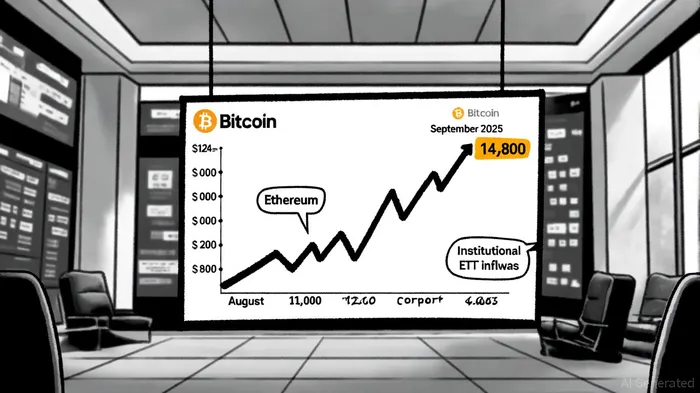
The crypto market in 2025 is a theater of extremes. After years of speculative frenzies and regulatory uncertainty, the landscape has matured—yet volatility remains its defining trait. Recent months have seen a dramatic reallocation of capital, driven by institutional adoption, macroeconomic shifts, and the rise of Ethereum-centric ecosystems. For short-term traders, navigating this environment requires a blend of precision, adaptability, and disciplined risk management.
Institutional Reallocations and Bitcoin's Volatility
August 2025 marked a pivotal shift in professional crypto portfolios. As BitcoinBTC-- scaled record highs above $124,000, asset managers executed strategic trims, locking in gains and redirecting capital toward EthereumETH-- and stablecoin hedges[1]. This move was not a rejection of Bitcoin but a recalibration in response to macroeconomic headwinds. The Federal Reserve's cautious stance on rate cuts and surging bond yields created a perfect storm, triggering a 9% correction in Bitcoin by late September[2].
The lesson here is clear: short-term traders must remain agile. Scalping and day trading—exploiting minute-by-minute price swings—have gained traction as Bitcoin's volatility intensifies[3]. However, the September correction also underscored the risks of overexposure. Traders who failed to set stop-loss orders faced significant liquidations, with $900 million in August alone[1]. Discipline in position sizing and leverage use is no longer optional.
Historical data on Bitcoin's support-level interactions reveals a nuanced picture. Over 1,287 support-level events from 2022 to 2025, a simple buy-and-hold strategyMSTR-- yielded modest cumulative excess returns—rising from +0.12% on day 1 to +3.61% by day 30[4]. While the win rate improved to ~57% by day 30, this marginally outperformed random expectations and failed to generate statistically significant alpha compared to a passive Bitcoin hold[4]. These findings suggest that while support levels may offer psychological anchors, they do not inherently guarantee superior returns in a volatile market.
Ethereum's Rise: Staking, DeFi, and Yield Opportunities
While Bitcoin's dominance dipped to 59.2% in 2025, Ethereum seized the opportunity to redefine itself as a yield-generating asset[1]. A 29.4% staking rate[1] and surging decentralized finance (DeFi) activity—capturing 70% of total value locked (TVL) growth[1]—have made ETHETH-- a cornerstone of short-term strategies. Asset managers are increasingly allocating to Ethereum-based real-world assets (RWAs) and layer-2 solutions, betting on its ability to outperform in a low-interest-rate environment.
For traders, this means diversifying beyond Bitcoin. Swing trading Ethereum's momentum, particularly during staking reward cycles or major DeFi upgrades, offers asymmetric risk-reward profiles. Arbitrage opportunities between Ethereum's on-chain and off-chain markets have also expanded, though execution speed remains critical[3].
Risk Allocation in a Fragmented Market
The 2025 crypto market is no longer a binary bet on Bitcoin. Altcoins like SolanaSOL-- (SOL) and ChainlinkLINK-- (LINK) have shown selective strength, with SOLSOL-- reclaiming $200 and LINK surging 18% on reserve plans[1]. However, this fragmentation demands a nuanced approach to risk allocation.
- Diversification: Traders are advised to cap exposure to any single asset at 10–15% of their portfolio[3]. This mitigates the impact of sudden liquidations, as seen in September's Bitcoin correction[2].
- Stablecoin Hedges: With volatility spikes becoming routine, stablecoins like USDCUSDC-- and DAIDAI-- are being used as liquidity buffers[1].
- Leverage Caution: While leverage can amplify gains, the September liquidations serve as a stark reminder of its risks[2].
The Road Ahead: Balancing Bullish Fundamentals and Bearish Catalysts
Despite short-term turbulence, the long-term outlook for crypto remains bullish. Spot Bitcoin ETFs have unlocked billions in institutional capital[2], and Ethereum's DeFi renaissance shows no signs of slowing[1]. However, traders must balance these fundamentals with tactical agility.
Conclusion
The 2025 crypto market is a mosaic of opportunities and risks. Short-term traders who thrive here will be those who combine technical mastery with a deep understanding of macroeconomic and institutional dynamics. As Bitcoin's price swings and Ethereum's yield potential reshape the landscape, the key to success lies in disciplined risk allocation and a willingness to adapt to shifting momentum.





Comentarios
Aún no hay comentarios