
The Shifting U.S. Housing Market: Strategic Entry Points for Value-Driven Real Estate Investors
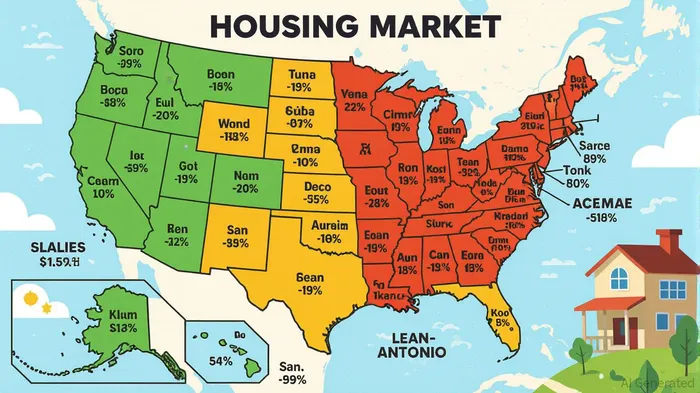
The U.S. housing market in 2025 is a study in contrasts. While national home price growth has slowed to a muted 2.4% year-over-year (YoY), regional divergences are creating fertile ground for value-driven real estate investors. According to a report by Homes.com, the national median home price in August 2025 stood at $389,000, reflecting a modest increase compared to the 7% growth seen in the same period in 2024[1]. This deceleration, coupled with a 6.29% mortgage rate—the lowest since October 2024—has shifted market dynamics toward buyers, particularly in regions where affordability is improving[1]. For investors, this bifurcated landscape offers opportunities to capitalize on localized trends while navigating broader macroeconomic headwinds.
Regional Divergences: Midwest Outperformance and Sun Belt Softness
The Midwest has emerged as a standout performer, driven by affordability and constrained inventory. Cities like Cincinnati, Ohio, and Grand Rapids, Michigan, have seen home price gains of 9.7% and 14%, respectively, in 2025[2]. These gains are not merely cyclical but reflect structural shifts: the Midwest's relatively lower cost of living and proximity to industrial hubs have made it a magnet for domestic migration. Meanwhile, the South and California are grappling with oversupply-driven declines. Tampa, Florida, for instance, has experienced a 2.4% YoY drop in home prices, while Atlanta's median price fell 8.6% to $397,000 in July 2025[2]. These declines are exacerbated by increased inventory, with the South and West seeing 21.8% and 26.7% year-over-year inventory growth, respectively[2].
California's market, though stable in nominal terms, is marked by competitive inventory and price cuts. The median list price in July 2025 rose just 0.5% YoY to $439,450, but 20.6% of listings saw price reductions—a sign of buyer resistance to high mortgage costs[2]. For investors, this suggests that while the Midwest's growth is robust, the South and California's declines may present entry points for long-term value plays, particularly in markets where fundamentals like job growth and population inflows remain intact.
Mortgage Rates as a Catalyst: Easing Affordability and Strategic Positioning
The 6.29% mortgage rate in 2025 is a critical inflection point. While still elevated compared to pre-pandemic levels, this rate represents a floor for affordability improvements. As stated by J.P. Morgan Research, mortgage rates are expected to ease further to 6.7% by year-end 2025, driven by cooling inflation and potential Federal Reserve rate cuts[1]. This trajectory is particularly impactful in the Midwest, where lower rates could amplify demand for homes in cities like Cleveland and Chicago, which are already seeing price gains of 6.1% and 7% YoY[2].
Conversely, the South and California's oversupply dynamics mean that even modest rate declines may not immediately reverse price trends. However, for investors with a long-term horizon, these regions offer discounted entry points. For example, San Antonio's mortgage rate forecast for Q3 2025 anticipates a drop to 6.4% or lower, contingent on inflation cooling[3]. Combined with the city's growing job market in tech and healthcare, this creates a compelling case for selective investments in areas where inventory growth is outpacing price declines.
Strategic Investment Opportunities: Balancing Growth and Value
The key to navigating this market lies in regional specialization. In the Midwest, investors should prioritize markets with strong labor demand and limited inventory, such as Cincinnati and Grand Rapids. These areas are less sensitive to mortgage rate fluctuations due to their affordability and are likely to outperform in a “higher-for-longer” rate environment[2].
In the South and California, the focus should shift to value. Markets like Tampa and Atlanta, where price declines have created price-to-rent ratios that favor buyers, offer opportunities for long-term rental portfolios or fix-and-flip strategies. According to Bankrate, the shift toward buyer-friendly conditions is most pronounced in the Sun Belt, where increased inventory and price reductions are normalizing market dynamics[2]. Investors here must act swiftly, as the window for discounted entry may narrow as inventory stabilizes.
Conclusion: Positioning for a Diversified Future
The 2025 U.S. housing market is neither uniformly bullish nor bearish—it is a mosaic of regional opportunities. For value-driven investors, the path forward requires a dual strategy: capitalizing on the Midwest's outperformance while selectively entering undervalued markets in the South and California. As mortgage rates continue to ease and regional imbalances persist, those who align their portfolios with these divergent trends will be best positioned to weather macroeconomic volatility and capture long-term gains.







Comentarios
Aún no hay comentarios