
Shifting Gears: Traditional Automakers Outpace Tesla Amid Regulatory Uncertainty in the EV Sector
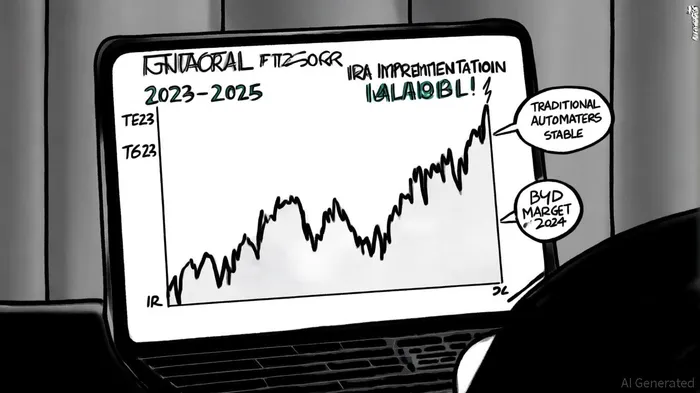
The electric vehicle (EV) sector, once dominated by Tesla's disruptive innovation, is witnessing a seismic shift. Traditional automakers, bolstered by regulatory tailwinds and strategic adaptability, are now outperforming Elon Musk's company in both market share and investor confidence. This transformation, driven by evolving policy landscapes and intensifying competition, raises critical questions for investors navigating the sector's uncertain future.
Market Share and Profitability: A Tale of Two Strategies
Tesla's once-unassailable dominance in the EV market has eroded significantly. A Quanta Intelligence report found that the company reported a 45% decline in net profit for Q2 2024 compared to the same period in 2023, with gross profit margins dropping to 18% from 29.1% in Q1 2022. Meanwhile, traditional automakers like General MotorsGM-- and FordF-- have capitalized on government incentives and robust supply chains. Ford's Mustang Mach-E became the best-selling non-Tesla EV in 2024, while GM's U.S. EV market share surged to 7.5% by year-end, according to that report.
Chinese automakers, particularly BYD, have further disrupted the landscape. BYD sold 1.76 million battery electric vehicles in 2024, leveraging aggressive pricing and a diverse product lineup to capture global market share, the Quanta Intelligence report also noted. This trifecta of competition-traditional automakers, Chinese EV startups, and U.S. EV upstarts-has left TeslaTSLA-- grappling with declining margins and a P/E ratio of 57.94, far exceeding the industry average of 12.79, according to a Nasdaq comparison.
Regulatory Headwinds: Tesla's Achilles' Heel
The Inflation Reduction Act (IRA) of 2022, while designed to accelerate EV adoption, has inadvertently disadvantaged Tesla. The law's Clean Vehicle Tax Credit (Section 30D) imposes strict price caps and sourcing requirements, limiting Tesla's ability to compete on cost, according to a Tesla Accessories analysis. Traditional automakers, with their established dealership networks and access to legacy revenue streams, have adapted more swiftly. For instance, Ford's stock price rose 7% in 2025 as it leveraged IRA incentives to scale its F-150 Lightning production, a trend highlighted in the Nasdaq comparison.
Regulatory uncertainty has also expanded globally. In Europe, Tesla faces the Alternative Fuels Infrastructure Regulation (AFIR), which mandates standardized charging connectors and interoperability. This forces Tesla to open its Supercharger network to competitors, diluting its first-mover advantage in charging infrastructure, the Tesla Accessories analysis observed. Meanwhile, U.S. trade policies, including tariffs on Chinese-made EVs, have created a fragmented market where Tesla's global competitiveness is further strained, according to a NatLawReview analysis.
Strategic Responses and Long-Term Outlook
Tesla's response to these challenges has been twofold: innovation and diversification. The company's gross profit margin, though declining, remains above 20%, outpacing many rivals. Its upcoming $25,000 vehicle aims to reinvigorate demand in price-sensitive markets. However, traditional automakers are not standing still. Toyota's EBITDA of $2464.05 billion in 2025 underscores its ability to balance EV investments with profitable legacy segments, as earlier industry comparisons indicate.
For investors, the key takeaway is clear: the EV sector is no longer a binary race between Tesla and traditional automakers. Chinese EVs, regulatory shifts, and supply chain dynamics have created a multipolar landscape. Diversification across these segments-rather than betting on a single winner-is prudent.
Conclusion
The EV sector's evolution reflects a broader trend: disruptive innovators face diminishing returns as incumbents adapt. Tesla's struggles with profitability and regulatory hurdles highlight the risks of overreliance on a single visionary model. Traditional automakers, by contrast, are leveraging scale, policy incentives, and diversified revenue streams to outperform. For investors, the path forward lies in balancing exposure to Tesla's innovation with the stability of traditional automakers and the growth potential of emerging players like BYD.







Comentarios
Aún no hay comentarios