
Shifting Federal Reserve Policy and Capital Reallocation Opportunities in Fixed-Income Markets
The Federal Reserve's 2025 policy shifts, marked by a 25-basis-point rate cut in September and a recalibrated monetary framework, have reshaped the fixed-income landscape. These changes, driven by slowing labor market growth and persistent inflation, have unlocked capital reallocation opportunities in high-yield bonds and emerging market debt. Investors are now navigating a landscape where falling cash yields and a weaker U.S. dollar are redirecting flows toward higher-risk, higher-return assets.
The Fed's 2025 Framework and Its Implications
The Federal Reserve's August 2025 review of its monetary policy framework reaffirmed a 2% long-term inflation target while shifting from average inflation targeting to a more flexible approach, as outlined in the Fed's 2025 review. This adjustment, aimed at addressing post-pandemic inflation surges and structural challenges like labor supply constraints, has reduced the emphasis on rigid inflation metrics. Simultaneously, the Fed's September rate cut-bringing the federal funds rate to 4.00%–4.25%-signaled a pivot toward easing, with projections of an additional 75 bps of cuts by year-end, according to CNBC.
This policy recalibration has had immediate effects on bond markets. The 10-year Treasury yield fell to 4.2% in August 2025 as investors priced in rate cuts, per the August 2025 review, while high-yield bonds and emerging market debt saw renewed demand. The Bloomberg U.S. Aggregate Bond Index gained 1.2% in August 2025, reflecting broader fixed-income resilience, as noted in the August 2025 review.
High-Yield Bonds: A Magnet for Capital
High-yield bonds have emerged as a key beneficiary of the Fed's easing cycle. With U.S. high-yield yields reaching 7.5% in September 2025-well above 5.33% for investment-grade bonds-investors are increasingly allocating to this sector, according to a Morgan Stanley outlook. Morningstar highlights top-performing high-yield funds, such as the American Funds American High-Income Trust (RITGX), which returned 11.37% over 12 months, and the Artisan High Income Fund (APHFX), up 10.26%, in its fund coverage.
The sector's appeal lies in its combination of income generation and resilience. Corporate fundamentals remain strong, with robust balance sheets and stable credit spreads, as discussed in the Morgan StanleyMS-- outlook. However, caution is warranted. Tight credit spreads and dispersion in performance across credits-exacerbated by macroeconomic uncertainties-require active management. For instance, while high-yield corporates rallied 0.34% in September 2025, outperforming Treasuries by 36 bps (the CNBC report also documented this), late-month GDP and home sales data triggered a bear flattening of the yield curve, pressuring the sector, according to Nuveen commentary.
Emerging Market Debt: A Strategic Reentry
Emerging market debt has also gained traction, driven by a weaker U.S. dollar and lower global interest rates. Emerging market government bonds returned over 15% in dollar terms in 2025, fueled by carry trades and local currency appreciation, per the Morningstar emerging-market outlook. The IMF notes that Fed rate cuts are expected to ease external borrowing costs for developing economies, with net Eurobond issuance reaching $40 billion in early 2024, based on an IMF analysis.
Countries like Brazil, South Africa, and Mexico have emerged as focal points for investors. These markets offer inflation-adjusted yields and resilient growth fundamentals, according to the Morningstar emerging-market outlook. For example, Brazil's 10-year local currency bond yield stood at 12.5% in September 2025, significantly above U.S. Treasuries, while its central bank's rate-cutting cycle has improved debt sustainability, as discussed in the AXA IM outlook. However, geopolitical risks-such as U.S. tariff policies and immigration debates-remain a drag on capital flows, per the Morningstar emerging-market outlook.
Capital Reallocation Strategies
The Fed's easing cycle has created a favorable environment for active portfolio management. Investors are advised to:
1. Extend Duration: The 3- to 7-year segment of the yield curve offers a balance between yield and duration risk, as suggested in BlackRock guidance.
2. Focus on Quality: Prioritize high-rated high-yield bonds and securitized credit products to mitigate default risks, following the Capital Group themes.
3. Diversify into Emerging Markets: Selective exposure to countries with strong growth and proactive monetary policies can enhance returns, according to the Morningstar emerging-market outlook.
For example, the September 2025 rate cut spurred $940 million in inflows into high-yield funds and $869 million into emerging market debt, as reported by CNBC. This trend is expected to accelerate as the Fed's easing cycle continues, with the 10-year Treasury yield projected to decline further, according to the CNBC coverage.
Risks and Considerations
While the outlook is positive, risks persist. Persistent U.S. inflation-projected at 2.6% by late 2026, per CNBC-could delay rate cuts, pressuring high-yield and emerging market debt. Additionally, geopolitical tensions, such as Trump-era trade policies, may disrupt capital flows, as noted in the Morningstar emerging-market outlook. Investors must balance income-seeking strategies with risk management, particularly in volatile sectors like emerging markets.
Conclusion
The Federal Reserve's 2025 policy shifts have redefined fixed-income opportunities. High-yield bonds and emerging market debt are now central to capital reallocation strategies, offering attractive yields in a low-cash environment. However, success hinges on active management, sector selection, and macroeconomic vigilance. As the Fed navigates its new framework, investors who adapt swiftly to evolving conditions will be best positioned to capitalize on these opportunities.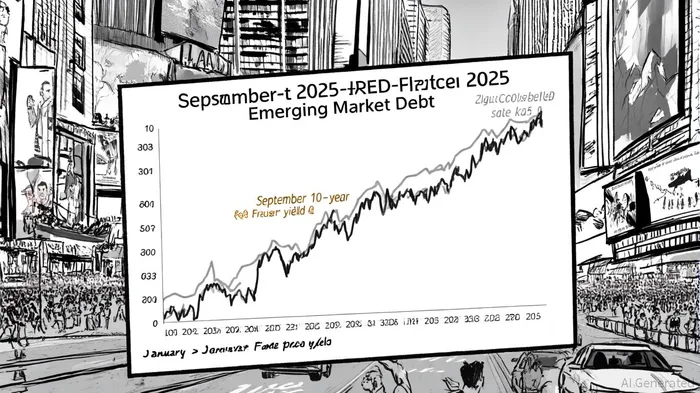





Comentarios
Aún no hay comentarios