
Shifting Dynamics in the U.S. Stock Market: Is the Santa Claus Rally Viable in 2026?
The U.S. stock market has long been a stage for seasonal patterns, with the "Santa Claus rally"-a historical tendency for equities to rise in the final days of December and the first two of January-capturing investor attention. However, as we approach the end of 2025, the interplay of AI-driven volatility, Federal Reserve policy uncertainty, and evolving market fundamentals raises critical questions: Is the Santa Claus rally still a reliable phenomenon in 2026? And what role will macroeconomic and technological forces play in shaping its viability?
Historical Context and 2025 Performance
The Santa Claus rally has historically delivered positive returns for the S&P 500 in 79% of years since 1950, with an average gain of 1.3% during the last five trading days of December and the first two of January. This pattern, often attributed to factors like fund manager "window dressing," year-end bonuses, and the anticipation of the January effect, has persisted for decades. In 2025, the S&P 500 closed the year with a 15% gain, though below the 23% surge in 2024. The Nasdaq Composite surged over 18%, reflecting the sector's dominance.
Despite these gains, December 2025 began with uneven performance, as the S&P 500 dipped 0.48% in the first half of the month. Morningstar's analysis noted that the U.S. equity market was trading at a 3% discount to fair value as of November 28, 2025, with value and small-cap stocks outperforming. This suggests that while the market's valuation may support a rally, investor sentiment and liquidity dynamics remain pivotal.
AI Volatility and Sectoral Shifts
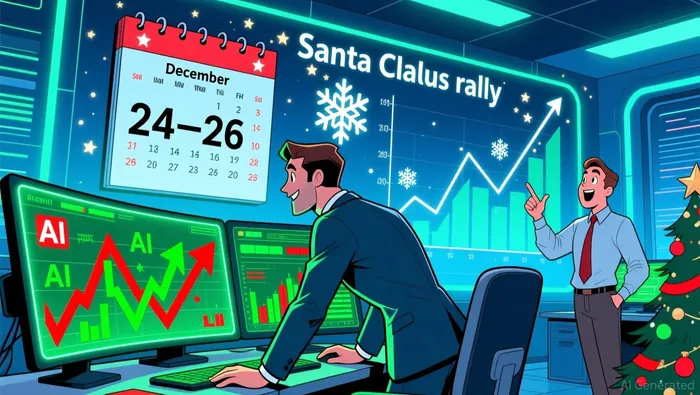 The AI boom has been a double-edged sword for the market. While AI-related capital expenditures are projected to reach $520 billion in 2026, reinforcing momentum in the technology sector, concerns about overvaluation and sector exhaustion have emerged. November 2025 saw signs of AI stock exhaustion, though mega-cap tech stocks remain undervalued and could attract renewed demand as the year ends.
However, structural headwinds persist. Analysts warn that AI infrastructure challenges, such as depreciation practices and hyperscale spending sustainability, could create a bearish bias in early 2026. Additionally, the market's reliance on a narrow set of AI-driven stocks risks volatility if the narrative falters. J.P. Morgan and UBS project a 13–15% increase for the S&P 500 in 2026, but these forecasts hinge on a broaderening of gains across all 11 sectors of the index.
Fed Policy and Liquidity Dynamics
Monetary policy remains a critical variable. The Federal Reserve's anticipated rate cuts in 2026, albeit at a slower pace than in 2025, are expected to provide a tailwind for equities. However, the central bank's cautious approach to cutting rates-avoiding "emergency" measures-introduces uncertainty. As one analyst noted, "The Fed's non-emergency rate cuts may not be enough to offset structural risks in the AI sector or global liquidity shifts."
Historically, the Santa Claus rally has thrived in environments of strong corporate earnings and global liquidity. In 2025, these conditions were partially met, with the S&P 500 posting modest gains after December 15. For 2026, the alignment of rate cuts with improved earnings and liquidity could enhance the rally's likelihood, but thin holiday liquidity and geopolitical risks remain potential obstacles.
The Case for and Against the 2026 Santa Claus Rally
Bullish Indicators:
- Valuation Discounts: The U.S. equity market's 3% discount to fair value suggests undervaluation could attract bargain hunters.
- Historical Patterns: The Santa Claus rally has historically gained strength in the final days of December, a trend that could repeat if fund managers engage in window dressing.
- AI Momentum: Undervalued mega-cap tech stocks may see a rebound as year-end demand increases.
Bearish Risks:
- AI Volatility: A divergence in the AI narrative or infrastructure challenges could trigger sector-specific selloffs.
- Policy Uncertainty: Slower Fed rate cuts may fail to provide sufficient stimulus for a broad-based rally.
- Liquidity Constraints: Thin trading volumes during the holidays could amplify volatility and limit the rally's scope.
Conclusion: A Cautious Optimism
While the Santa Claus rally's historical success rate (79% since 1950) offers a compelling case for optimism, 2026's viability hinges on navigating AI-driven volatility and Fed policy nuances. Morningstar's assertion that the U.S. market is "trading at a slight discount to fair value" supports a bullish outlook, but analysts caution against overreliance on historical trends. Investors should remain vigilant, balancing the potential for a late-December rally with hedging strategies to mitigate AI sector risks and liquidity constraints.
In the end, the 2026 Santa Claus rally may materialize, but its strength will depend on whether the market can harmonize AI-driven growth with macroeconomic stability-a challenge that underscores the evolving dynamics of today's investment landscape.







Comentarios
Aún no hay comentarios