
Shifting Capital Flows and Global Portfolio Reallocation: Navigating U.S. Political Uncertainty
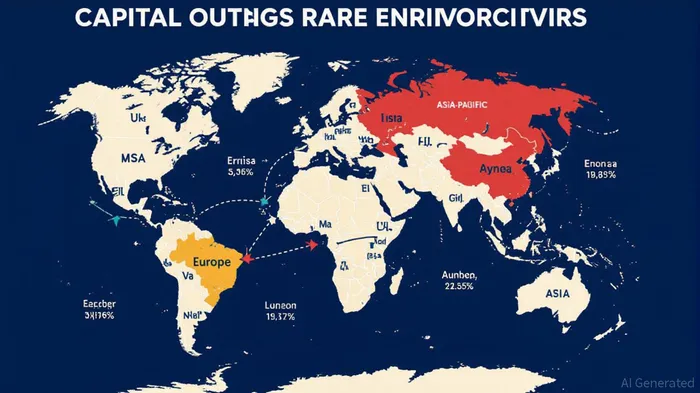
The United States has long been the gravitational center of global capital flows, a position reinforced by its robust economic fundamentals and the dollar's status as the world's dominant reserve currency. However, recent developments suggest a subtle but significant recalibration. Between 2023 and 2025, the U.S. accounted for 41% of global gross capital inflows, a testament to its enduring appeal as a safe haven [3]. Yet, by April 2025, U.S. equity funds faced outflows of $15 billion over three consecutive weeks, signaling a shift in investor sentiment toward Europe and the Asia-Pacific (APAC) [4]. This article examines the drivers of this reallocation and offers strategic insights for investors navigating a rapidly evolving geopolitical and economic landscape.
The Drivers of Capital Outflows
Political uncertainty has emerged as a key catalyst. Under President Trump's administration, trade policy volatility—including the imposition of “Liberation Day” tariffs and abrupt policy reversals—has created market instability [4]. These actions, coupled with broader geopolitical realignments, have eroded confidence in U.S. fiscal stability. For instance, cross-regional real estate investments saw North America attract $9 billion in H2 2024, while Europe and APAC recorded inflows of $21.63 billion and $6.3 billion, respectively [4].
Valuation disparities further amplify the trend. U.S. tech stocks, once the bedrock of global growth strategies, now trade at premiums compared to undervalued markets in Europe and APAC, where accommodative monetary policies persist [4]. This has prompted investors to rebalance portfolios toward regions offering higher risk-adjusted returns.
Sector-Specific Impacts and Strategic Implications
Geopolitical risks are not uniformly distributed across industries. A firm-based analysis of over 240,000 earnings call transcripts reveals stark contrasts: sectors like Agriculture and Pharmaceuticals have expressed positive sentiment, capitalizing on increased demand during conflicts [1]. Conversely, industries reliant on global supply chains—such as Aircraft and Fabricated Products—have shown strongly negative sentiment, reflecting operational disruptions and declining demand [1].
For investors, this underscores the importance of sector diversification. While U.S. markets remain attractive for defensive sectors, exposure to global equities and bonds can mitigate risks tied to domestic policy volatility. For example, European bonds and APAC real estate have gained traction as alternatives to U.S. Treasuries and equities [4].
Portfolio Reallocation Strategies
In this environment, proactive portfolio management is critical. Diversification across geographies and asset classes—such as pairing U.S. equities with European sovereign debt or APAC infrastructure—can hedge against political and economic shocks [3]. Additionally, investors should prioritize liquidity and flexibility, given the potential for sudden shifts in capital flows.
Hedging strategies, including currency derivatives and inflation-linked securities, can further insulate portfolios from volatility. For instance, the recent depreciation of the U.S. dollar against the euro and yen has made foreign assets more accessible to U.S. investors, offering both diversification and currency gains [4].
Conclusion
The U.S. remains a pivotal player in global capital markets, but its dominance is no longer unchallenged. Political uncertainty, valuation imbalances, and sector-specific vulnerabilities are driving a strategic reallocation of assets. Investors who adapt by diversifying geographically, hedging risks, and monitoring geopolitical developments will be better positioned to thrive in this new era. As the Fed and market analysts emphasize, the future belongs to those who balance caution with opportunity [1][3].







Comentarios
Aún no hay comentarios