
The Shift to Open-Source Innovation in the Auto Industry and Its Investment Implications
The automotive industry is undergoing a seismic transformation as software-defined vehicles (SDVs) redefine the boundaries of innovation, collaboration, and cost-efficiency. At the heart of this shift lies open-source software (OSS), which is enabling automakers to break free from the constraints of proprietary systems and embrace a more agile, collaborative, and scalable approach to development. For investors, this transition represents not just a technological evolution but a strategic repositioning of the industry-one that demands a nuanced understanding of how open-source innovation is reshaping competitive dynamics and unlocking new value.
Strategic Collaboration: A New Paradigm for SDV Development
The rise of SDVs has forced automakers to rethink their traditional hardware-centric models. By prioritizing software as the core of vehicle functionality, companies are now competing on the speed and quality of their code rather than just mechanical engineering. Open-source strategies have emerged as a critical enabler of this shift, fostering cross-industry collaboration and accelerating the development of standardized frameworks.
Mercedes-Benz, for instance, has embraced open-source innovation through its MB.OS platform, which standardizes hardware and software across vehicle domains. By integrating over 3,166 open-source components into its 2023 E-class-up from 794 in the 2018 A-class-the automaker has significantly reduced development time while maintaining flexibility to customize solutions for specific needs according to Tietoevry. This approach mirrors broader industry trends, as alliances like AUTOSAR and COVESA work to harmonize software standards, reducing fragmentation and enabling shared infrastructure according to Tietoevry.
Strategic partnerships are further amplifying the impact of open-source adoption. In November 2024, Panasonic Automotive Systems and Arm collaborated to standardize automotive architecture, shifting from hardware-first to software-first development models according to BCC Research. Similarly, the Eclipse Foundation's April 2025 report revealed that 79% of automotive software professionals are leveraging open-source tools and in-vehicle software, underscoring the industry's growing reliance on shared platforms according to BCC Research. These collaborations are not merely cost-saving measures; they are foundational to building ecosystems where automakers, tech firms, and startups can co-create solutions at scale.
Cost-Efficiency: The Financial Case for Open-Source
The financial benefits of open-source innovation are equally compelling. Nearly 70% of industry professionals cite cost efficiency as a primary motivator for adopting OSS, with decision-makers projecting up to a 25% reduction in operational expenditures over the lifecycle of SDV projects according to Eclipse. By avoiding redundant development efforts and leveraging modular, reusable code, automakers can accelerate time-to-market while minimizing reliance on expensive proprietary solutions.
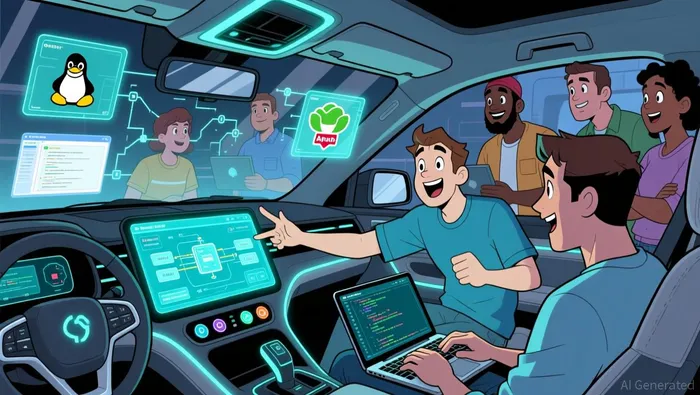
For example, the Scalable Open Architecture for Embedded Edge (SOAFEE) industry group is developing an open-source vehicle platform using cloud-native architecture, which promises to streamline development and reduce costs further according to BCC Research. Open-source adoption also supports sustainability goals, with 53% of decision-makers ranking it among the top three benefits-likely due to reduced resource consumption and environmental impact according to Eclipse.
The Eclipse SDV Working Group exemplifies how open-source collaboration drives efficiency. By pooling resources to address shared challenges-such as cybersecurity, data management, and interoperability-the group is building scalable solutions that individual automakers could not achieve alone according to BCC Research. This collective approach not only lowers costs but also mitigates risks associated with the complexity of SDV development.
Investment Implications: A $733 Billion Opportunity
The financial potential of open-source innovation in SDVs is staggering. The global SDV market is projected to grow from $134.73 billion in 2025 to $733.93 billion by 2032, with a compound annual growth rate (CAGR) of 27.4% according to SP Global. By 2030, the market could reach $1.2 trillion, driven by AI, cloud computing, and over-the-air (OTA) updates according to Electrive. Open-source software is central to this growth, enabling automakers to collaborate with third-party developers and startups to enhance vehicle functionality and create new revenue streams according to SP Global.
Investors should focus on three key areas:1. Centralized Computing and Service-Oriented Architectures: Platforms like Volkswagen Group's CARIAD and Mercedes-Benz's MB.OS are redefining vehicle software, enabling advanced features such as OTA updates and subscription-based services according to Yahoo Finance.2. Startups and Niche Innovators: Specialized firms like Apex.AI and Eatron Technologies are gaining traction in areas such as vehicle operating systems and data management, offering high-growth opportunities according to Yahoo Finance.3. Industry Consortia and Standards: Groups like AUTOSAR and Eclipse SDV are standardizing interfaces and protocols, reducing development barriers and fostering interoperability according to Yahoo Finance.
However, challenges remain. Cybersecurity risks, regulatory hurdles, and semiconductor supply chain constraints could slow adoption according to Electrive. Investors must also weigh the strategic importance of partnerships-Volkswagen's shift to in-house software development, for instance, highlights the need to balance collaboration with intellectual property protection according to SP Global.
Conclusion: A Software-First Future
The shift to open-source innovation in the auto industry is not a passing trend but a fundamental reimagining of how vehicles are built and monetized. By prioritizing strategic collaboration and cost-efficiency, automakers are not only accelerating SDV development but also creating ecosystems where innovation thrives. For investors, the key lies in identifying players-whether established automakers, tech giants, or agile startups-that are best positioned to leverage open-source frameworks and capitalize on the $733 billion market opportunity.
As the industry moves toward a future where vehicles are "smartphones on wheels," the ability to harness open-source software will separate leaders from laggards. Those who recognize this shift early-and invest accordingly-stand to reap substantial rewards in the decades ahead.







Comentarios
Aún no hay comentarios