
The Shift in Institutional Capital: Why Solana ETFs Outperform Bitcoin and Ethereum in Times of Market Stress
Performance Divergence: Solana ETFs vs. Bitcoin and Ethereum
Data from Phemex reveals that Solana ETFs attracted $476 million in institutional inflows as of November 19, 2025, despite broader crypto market declines according to reports. By contrast, Bitcoin ETFs lost $566.4 million in a single week, and Ethereum ETFs saw $108.3 million in outflows during the same period according to market data. This divergence underscores a critical shift in institutional appetite. Solana's robust infrastructure, including its high throughput (65,000 transactions per second) and real-world applications in decentralized finance (DeFi) and tokenization, has positioned it as a preferred asset class for capital preservation and growth.
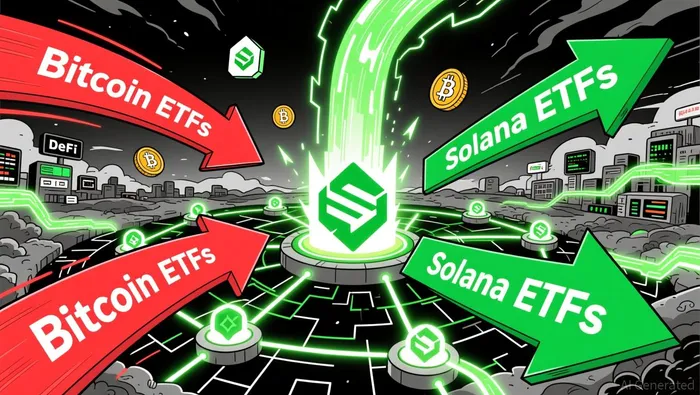
The contrast is even more pronounced when examining cumulative outflows. Over five consecutive trading days, Bitcoin and Ethereum ETFs collectively lost over $3.25 billion, while Solana ETFs added $2 billion in assets. This resilience is attributed to Solana's staking yields-offering approximately 7% annualized returns-which appeal to traditional finance investors seeking passive income in a low-yield environment according to comparative analysis.
Yield-Seeking Behavior: The Institutional Magnet for Solana
Institutional investors are increasingly prioritizing yield generation amid macroeconomic uncertainty. Solana ETFs, such as Bitwise's BSOLBSOL-- and 21shares' TSOLTSOL--, have leveraged staking mechanisms to deliver competitive returns. For instance, BSOL alone recorded $388.1 million in assets within 13 trading days, driven by its ability to generate staking rewards. This contrasts sharply with Bitcoin and Ethereum ETFs, which lack native staking capabilities and rely solely on price appreciation-a less attractive proposition during market downturns according to market analysis.
The appeal of Solana's yield model is further amplified by its lower fees and energy-efficient proof-of-stake (PoS) consensus mechanism. As noted by ETF Trends, Solana's staking structures, including those in the Grayscale Solana Trust ETF (GSOL), offer institutional investors a diversified income stream while mitigating exposure to the volatility of proof-of-work (PoW) assets like Bitcoin.
Strategic Reallocation: Solana's Infrastructure as a Competitive Edge
Institutional reallocation toward Solana ETFs is not merely yield-driven but also rooted in the network's technical and strategic advantages. Solana's infrastructure upgrades, such as the Firedancer client optimization, have enhanced scalability and reduced latency, making it a viable solution for enterprise-grade applications according to market analysis. Additionally, initiatives like Solana Pay and real-estate tokenization projects have demonstrated the network's utility beyond speculative trading, aligning with institutional demand for tangible use cases according to market analysis.
This strategic edge is evident in the sustained inflows into Solana ETFs. Despite a 14% price decline in a single week, Solana ETFs continued to attract capital, with daily inflows peaking at $58 million. Analysts attribute this to Solana's positioning as a "blue-chip" Layer-1 asset bridging traditional finance and decentralized ecosystems according to market reports.
Conclusion: A New Paradigm in Institutional Crypto Allocation
The 2023–2025 market stress period has accelerated a paradigm shift in institutional capital allocation. Solana ETFs, with their yield-generating capabilities, scalable infrastructure, and real-world applications, have outperformed Bitcoin and Ethereum ETFs by offering a more balanced risk-return profile. As macroeconomic uncertainty persists, institutions are likely to continue reallocating toward assets that combine growth potential with passive income-a trend that positions Solana as a cornerstone of the next phase in crypto adoption.







Comentarios
Aún no hay comentarios