
The Shift in Crypto Investor Sentiment Amid Fading March Rate Cut Hopes
The Federal Reserve's December 2025 rate cut-its third reduction since September 2024-brought the federal funds rate to a range of 3.50% to 3.75%, signaling a broader pivot toward accommodative monetary policy. However, as 2026 approaches, the market's optimism about further rate cuts has begun to wane. While forecasts suggest the Fed may reduce rates to nearNEAR-- 3% by year-end, economists remain divided, with some predicting only 50 basis points of cuts in 2026 and none in 2027. This uncertainty has left crypto investors in a state of cautious indecision, with key metrics like Bitcoin's Open Interest and active address counts stagnating despite the Fed's dovish stance.
The Paradox of Dovish Policy and Crypto Caution
Lower interest rates typically incentivize capital to flow from low-yielding assets like bonds into riskier alternatives such as crypto. Yet, as of December 2025, the broader crypto market has not responded with renewed vigor. The Crypto Fear & Greed Index remains entrenched in "fear" territory, reflecting lingering concerns about macroeconomic headwinds and regulatory risks. Analysts attribute this hesitancy to the timing of rate cuts: while a December reduction provided temporary optimism, the market is now waiting for clearer signals from the Fed, particularly after the May 2026 chair appointment. This delay has created a "wait-and-see" environment, where investors are reluctant to commit capital until the Fed's 2026 roadmap becomes clearer.
Strategic Allocation to Resilient Altcoins
In this climate of uncertainty, strategic allocation to resilient altcoins-those with strong fundamentals and defensible use cases-has emerged as a compelling strategy. According to Michaël van de Poppe, projects that demonstrate a disconnect between price performance and on-chain growth are most likely to endure macroeconomic downturns. This logic is evident in the performance of Layer-2 solutions like ArbitrumARB-- and DeFi protocols like AaveAAVE--, which have maintained robust metrics despite weak token prices.
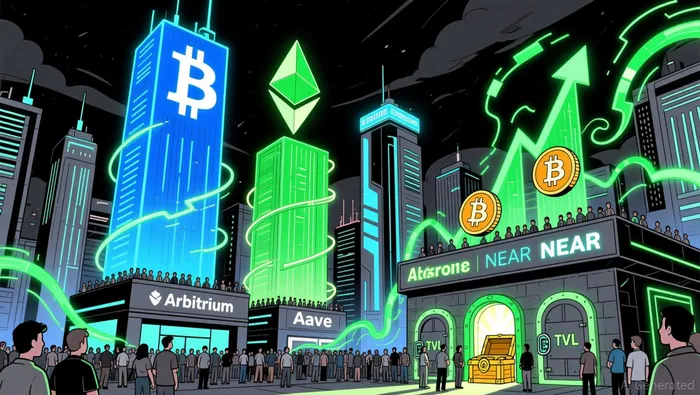
Arbitrum (ARB), for instance, has solidified its position as the leading EthereumETH-- Layer-2 network. As of June 2025, Arbitrum One's Total Value Locked (TVL) reached $8.6 billion, driven by derivatives (30% of TVL), decentralized exchanges (22% of TVL), and lending protocols. The network processes over 50 million monthly transactions, with daily active addresses nearing 500,000. Despite these fundamentals, ARB's price remains under pressure, creating a compelling risk-rebalance opportunity for investors seeking exposure to a high-utility project at a discount.
Aave (AAVE), a dominant DeFi lending protocol, has also shown resilience. Its TVL of $24 billion as of late 2025 reflects consistent demand for decentralized leverage, with the protocol maintaining a stable market share in the lending space. While Aave's token price has lagged, its role in the DeFi ecosystem-particularly its governance and liquidity functions-positions it as a critical infrastructure asset in a post-2026 rate-cut environment.
NEAR Protocol (NEAR), meanwhile, has quietly surged in Q4 2025. Its cross-chain trading platform generated over $400,000 in daily fees in November 2025, with cumulative fees exceeding $10 million. The protocol processed $969 million in weekly trading volume during the same period, and projections suggest this could expand to $10 billion by mid-2026. Despite these metrics, NEAR's token price remains range-bound, underscoring the market's tendency to undervalue utility-driven projects during downturns.
Privacy Coins: A Structural Shift in Demand
Beyond infrastructure-focused altcoins, privacy coins have emerged as another category of resilient assets. In Q4 2025, Zcash (ZEC) surged nearly 800% year-to-date, outperforming BitcoinBTC-- and Ethereum amid a broader market downturn. This outperformance reflects a structural shift in investor psychology: as blockchain integration into traditional finance accelerates, demand for privacy tools has surged. Zcash's shielded transaction features, for example, have gained traction among users seeking to protect financial data from increasing surveillance. Research indicates privacy tokens may extend their outperformance into 2026.
Monero (XMR) and DashDASH-- (DASH) also saw strong relative performance, with Grayscale data highlighting privacy coins as top performers in the quarter. Analysts argue this trend is not cyclical but structural, driven by regulatory pressures and the growing need for financial privacy in a digitized world. For investors, this suggests that privacy coins could serve as a hedge against macroeconomic volatility, particularly in a 2026 environment where rate cuts may not fully restore risk-on sentiment.
Conclusion: Positioning for the Next Cycle
As the Fed's 2026 rate-cut timeline remains ambiguous, crypto investors must adopt a dual strategy: hedging against macroeconomic risks while positioning for the next bull cycle. Resilient altcoins like Arbitrum, Aave, and NEAR offer exposure to high-utility infrastructure at discounted valuations, while privacy coins provide a unique hedge against regulatory and surveillance risks. The key to success lies in identifying projects with strong on-chain fundamentals and defensible use cases-those that can endure the current downturn and thrive in the next upturn.
In the coming months, the market will likely see a significant shakeout, with only a few altcoins emerging as leaders. For investors willing to navigate the noise, the current environment presents a rare opportunity to allocate capital to projects with long-term viability.






Comentarios
Aún no hay comentarios