
Shibarium's Security and Governance Framework as a Catalyst for Shiba Inu's Long-Term Value
In the volatile landscape of decentralized finance (DeFi), resilience and adaptability often define the success or failure of blockchain ecosystems. Shiba Inu's Shibarium, a layer-2 scaling solution, has faced both technical and security challenges since its launch, yet its response to these crises and evolving governance mechanisms position it as a compelling case study for institutional and retail investors. By analyzing Shibarium's recent security breaches, its governance framework centered on the BONE token, and the broader implications for Shiba Inu's (SHIB) long-term value, this article assesses how the project's strategic adjustments could mitigate risks and foster sustainable growth in 2025 and beyond.
Shibarium's Security Resilience: Lessons from a Sophisticated Attack
Shibarium's initial launch in August 2023 was marred by a flash loan exploit that allowed attackers to gain control of validator signing keys, triggering a temporary halt in transactions and trapping millions of dollars in funds on the bridge[1]. The attack exploited a vulnerability in the proof-of-participation (PoP) consensus model, where validators with significant BONE token holdings could manipulate network state transitions[2]. However, the Shiba InuSHIB-- team's swift response—freezing 4.6 million BONE tokens, pausing staking operations, and transferring validator funds to a 6-of-9 multisig hardware wallet—demonstrated a commitment to prioritizing user security[3].
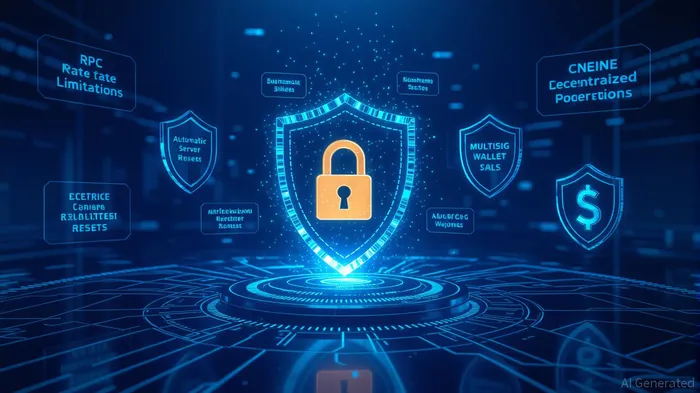
According to a report by CoinPaper, the team also offered to negotiate with the attacker, proposing a non-legal recourse in exchange for the return of stolen assets[3]. This proactive approach not only minimized financial losses but also reinforced trust in the ecosystem. To prevent future incidents, Shibarium implemented infrastructure upgrades, including a 1500% scaling of server capacity, RPC-level rate limitations, and automatic server reset mechanisms[4]. These measures, combined with a $2 million insurance policy secured to address fund retrieval challenges[6], underscore the project's maturation in risk management.
BONE's Dual Role: Governance and Security
The BONE token, with a capped supply of 250 million, serves as the backbone of Shibarium's decentralized governance and security framework. Holders use BONE to vote on proposals, while validators must lock 10,000 BONE tokens to participate in the PoP consensus model[1]. This design incentivizes long-term commitment to the network's stability, as validators' rewards are tied to their holdings.
A critical innovation is the token-burning mechanism, where a portion of transaction fees is used to permanently remove SHIBSHIB-- tokens from circulation[1]. This deflationary strategy, coupled with BONE's governance utility, creates a flywheel effect: increased transaction volume leads to higher token burns, potentially boosting SHIB's scarcity and value. As CoinTelegraph noted, this model aligns with broader DeFi trends where tokenomics drive network sustainability[5].
However, the flash loan exploit highlighted vulnerabilities in BONE's governance structure. The attacker leveraged a flash loan to acquire 4.6 million BONE tokens, achieving majority validator power and executing fraudulent transactions[2]. While the team's immediate response mitigated damage, this incident exposed the risks of concentrated token ownership in PoP models. To address this, Shibarium has since emphasized decentralization through expanded validator participation and community-driven governance proposals[4].
Strategic Implications for Investors
For institutional and retail investors, Shibarium's evolution offers both opportunities and cautionary lessons. The project's ability to recover from a sophisticated attack—while implementing robust security upgrades—signals a maturing infrastructure capable of scaling for mass adoption. The integration of ShibaSwap on Shibarium, with enhanced features like discovery charts and a new dashboard[5], further diversifies the ecosystem's utility, potentially attracting a broader user base.
From a risk-mitigation perspective, the BONE token's dual role in governance and security provides a buffer against centralized control. By distributing validator power and incentivizing community participation, Shibarium reduces reliance on a single entity, a critical factor for institutional adoption. Additionally, the token-burning mechanism creates a deflationary tailwind for SHIB, which could stabilize its value during market downturns.
Yet, challenges remain. The flash loan exploit underscores the need for continuous auditing and the potential for regulatory scrutiny in DeFi. Investors must weigh these risks against Shibarium's progress, including its 100,000+ wallet milestone and 420,897 transactions recorded post-relaunch[3]. The project's transparency in addressing vulnerabilities—such as publicizing insurance coverage and collaborating with security firms like Hexens and Seal 911[1]—further bolsters confidence.
Conclusion
Shibarium's journey—from a flash loan exploit to a fortified security framework—reflects the broader maturation of the Shiba Inu ecosystem. While the BONE token's governance model and token-burning strategy present long-term value drivers, investors must remain vigilant about the inherent risks of decentralized systems. For those willing to navigate these complexities, Shibarium's resilience and strategic adaptability could position Shiba Inu as a formidable player in the evolving DeFi landscape.






Comentarios
Aún no hay comentarios