
Shiba Inu vs. TRON: Which Meme-Driven Crypto Has Long-Term Utility?
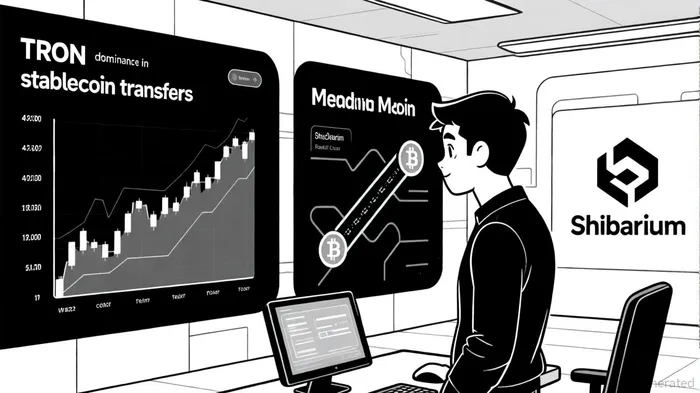
In the volatile world of cryptocurrency, investors often grapple with the tension between speculative hype and sustainable utility. Shiba InuSHIB-- (SHIB) and TRONTRX-- (TRX) exemplify this dichotomy. While both emerged with meme-driven narratives, their trajectories diverge sharply in terms of ecosystem development, technical fundamentals, and long-term value creation. This analysis evaluates which asset holds stronger potential for investors seeking the next “millionaire-maker.”
Market Cap and Utility: A Tale of Two Models
TRON's market capitalization of $31.62 billion in 2025 dwarfs Shiba Inu's $7.1 billion, reflecting its entrenched role as a stablecoin infrastructure provider. TRON dominates 51% of USDTUSDT-- (Tether) transactions, generating recurring fees from high-volume transfers[1]. This utility-driven model contrasts with Shiba Inu's reliance on token burns and community-driven momentum. While SHIB's circulating supply has shrunk significantly due to burns, its lack of a clear economic model—such as fee generation—leaves its value proposition speculative[3].
Price targets further highlight this gap. Analysts project TRON could reach $1–$2 by 2025, driven by sustained demand for its stablecoin infrastructure[3]. Shiba Inu, meanwhile, faces a more uncertain path, with optimistic targets of $0.000043–$0.000100 contingent on ecosystem growth and real-world adoption[4].
Ecosystem Development: Structure vs. Ambition
TRON's ecosystem thrives on structured innovation. Its Delegated Proof-of-Stake (DPoS) consensus enables 2,000 transactions per second (TPS) and minimal fees, making it ideal for global remittances and merchant transactions[1]. Key dApps like SunSwap and JustLend, coupled with partnerships with MoonPay and ChainlinkLINK--, reinforce its utility. TRON's 2025 roadmap includes gas-free USDT transfers and a Layer-2 integration with BitcoinBTC--, aiming to position itself as a hub for cross-chain assets[5].
Shiba Inu's ecosystem, by contrast, remains fragmented. While Shibarium—a Layer-2 solution—aims to reduce transaction costs and enable DeFi integration[3], the project has faced setbacks, including a $2.4 million bridge exploit in September 2025[6]. The team's focus on real-world use cases, such as accepting SHIBSHIB-- for freelance work on platforms like Upwork and Fiverr, is promising but unproven at scale[7].
Technical Fundamentals: Security and Scalability
TRON's technical roadmap emphasizes security and scalability. Upgrades to its P2P network layer in Q3 2025 address vulnerabilities like traffic amplification attacks[5], while state expiry mechanisms aim to manage growing data loads[5]. These improvements align with institutional adoption, including a $1 billion fundraising to expand its treasury[5].
Shiba Inu's technical reliance on Ethereum's infrastructure exposes it to scalability risks. While Shibarium offers Ethereum-compatible speed, its security remains untested against sophisticated attacks. The recent bridge exploit underscores the need for rigorous audits and decentralized governance—a challenge for a project still navigating its identity beyond memeMEME-- coin status[6].
Risk Factors and Institutional Legitimacy
TRON's centralized governance model, dominated by founder Justin Sun, has drawn criticism. However, its shift toward a decentralized TRON DAO and institutional partnerships (e.g., Nasdaq listing plans) signal growing legitimacy[1]. Shiba Inu, meanwhile, faces skepticism about its ability to transition from speculative hype to functional utility. Adoption metrics, such as a 12.73% adoption rate for SHIB in 2025, remain stagnant[7].
Conclusion: Utility Over Hype
For investors prioritizing long-term value creation, TRON's structured ecosystem, fee-generating model, and institutional backing present a more credible case. Its dominance in stablecoin transfers and strategic Bitcoin integration align with broader trends in blockchain infrastructure. Shiba Inu, while ambitious, remains a high-risk bet dependent on successful ecosystem execution and overcoming security challenges.
In the race for the next millionaire-maker, TRON's utility-driven approach offers a clearer path to sustained growth.





Comentarios
Aún no hay comentarios