
Will Shiba Inu (SHIB) Crash? 2 Bullish and 1 Bearish Scenario
Shiba Inu (SHIB), the Ethereum-based memeMEME-- coin that once captured the imagination of retail investors, finds itself at a crossroads in September 2025. With on-chain metrics painting a mixed picture and whale activity intensifying, the token's trajectory hinges on a delicate balance of risk and reward. This analysis explores two bullish scenarios and one bearish scenario, grounded in on-chain sentiment and market dynamics.
Bullish Scenario 1: Technical Breakout and Accumulation Patterns
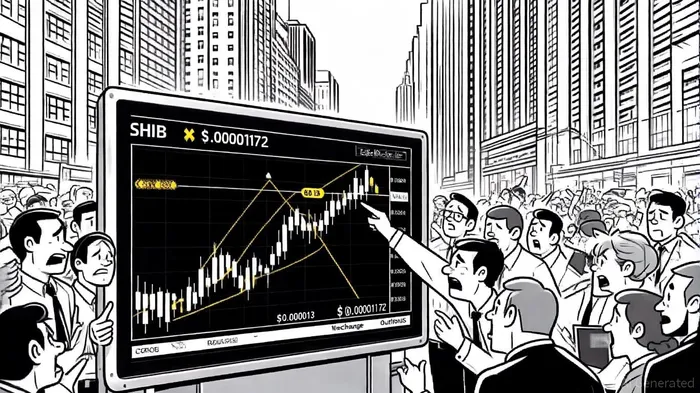
SHIB's price action has recently formed a symmetrical triangle pattern, a classic technical indicator of potential upward momentum. A “golden cross” — where the 50-day moving average crosses above the 200-day moving average — further reinforces this narrative, suggesting a possible rally toward $0.00023 [1]. While the token currently trades at $0.0000127, a breakout above the $0.000013 resistance level could trigger a surge in retail buying, particularly if short-term volatility remains low.
On-chain data also reveals a 283 trillion SHIB outflow from exchanges, signaling reduced short-term selling pressure and increased long-term holding confidence [2]. This trend aligns with historical patterns where reduced exchange liquidity precedes price consolidation and eventual breakouts. If buyers manage to push SHIBSHIB-- above key resistance levels, the token could see a 16.22% return on investment (ROI) by year-end, assuming it stabilizes within a $0.00001172–$0.00001411 trading range [2].
Bullish Scenario 2: Ecosystem Upgrades and Narrative Resilience
Despite recent challenges, SHIB's ecosystem is undergoing critical upgrades that could bolster its long-term viability. A security breach on Shibarium, which resulted in $4.1 million in stolen assets, prompted developers to pause staking operations and implement network-wide security patches [2]. If these upgrades restore trust and attract institutional interest, SHIB could reposition itself as a more robust platform within the EthereumETH-- meme coin space.
Additionally, SHIB's narrative strength remains intact. While whales have rotated into newer projects like Little PepePEPE-- (LILPEPE), the token's massive circulating supply (over 1 quadrillion tokens) ensures liquidity for retail investors [1]. A resurgence in community-driven initiatives — such as partnerships with decentralized exchanges or NFT integrations — could reignite bullish sentiment and drive adoption.
Bearish Scenario: Overvaluation and Whale-Driven Sell Pressure
The most pressing risk for SHIB lies in its Network Value to Transactions (NVT) ratio, which has spiked to historically bearish levels. This metric indicates that SHIB's market cap is growing faster than the value transacted on its blockchain, a red flag for overvaluation [1]. Analysts warn that a 20% price correction to $0.000010 is likely if SHIB fails to break above $0.000013, with the NVT ratio acting as a leading indicator of a potential “price trap” [2].
Whale activity compounds this risk. Over 74% of SHIB's supply remains concentrated in whale wallets, and recent movements — including a 7 trillion token transfer — suggest large holders are accumulating or distributing [2]. If these whales decide to offload their holdings, the resulting sell pressure could trigger a cascading decline, especially given SHIB's low realized volatility (64% as of September 2025) and lack of strong support levels [2].
Risk-Reward Asymmetry and Investor Takeaway
SHIB's risk-reward profile is highly asymmetric. A bullish breakout could yield a 4500% gain if the golden cross and accumulation patterns hold [1], but a bearish scenario risks a 20% drop to $0.000010 [2]. Investors must weigh these extremes against SHIB's structural weaknesses, including its centralized liquidity structure and reliance on speculative narratives.
For those considering SHIB, the key is to monitor on-chain whale activity, NVT ratio trends, and ecosystem developments. A successful breakout would require sustained buying pressure and positive sentiment, while a crash would likely be triggered by whale dumping or a failed technical pattern.






Comentarios
Aún no hay comentarios