
Shiba Inu (SHIB) Burn Surge Amid Price Downturn: Is This a Catalyst or a Mirage?
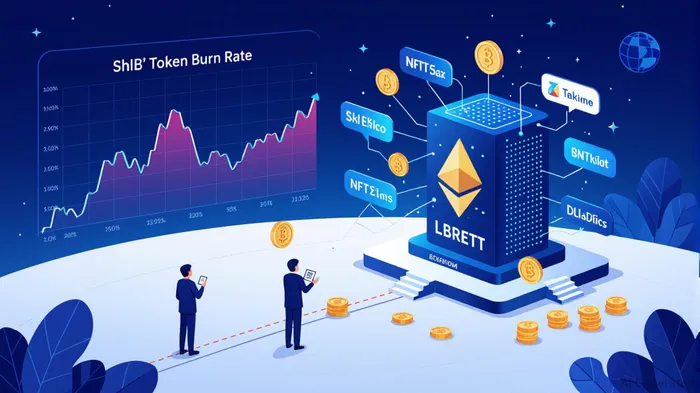
The cryptocurrency market in 2025 is witnessing a pivotal shift in investor priorities. While Shiba InuSHIB-- (SHIB) has long relied on its deflationary burn strategy to drive value, a new breed of projects like Layer Brett (LBRETT) is challenging the narrative by offering tangible utility and actionable returns. As SHIB's token burn rate surged by 4474.42% in a single day—despite a concurrent 2.75% price drop—investors are left questioning whether this aggressive deflationary model can sustain long-term growth or if it's being outpaced by yield-driven alternatives.
The SHIBSHIB-- Burn Surge: A Deflationary Mirage?
Shiba Inu's recent burn activity, which removed 3.625 billion tokens from circulation in 24 hours, highlights the project's commitment to reducing supply. However, this surge occurred against a backdrop of declining weekly burn rates (down 73.21%) and a total supply of 589.247 trillion tokens. While token burning theoretically increases scarcity, the market's muted response—SHIB's price fell to $0.00001289—raises doubts about the strategy's efficacy.
The deflationary model's limitations are further exposed by SHIB's ecosystem. Despite Shibarium's Layer-2 upgrades and a 41% reduction in circulating supply since launch, the token remains largely speculative. Real-world utility is still nascent, with ShibaSwap and Shib Paymaster struggling to gain traction. Analysts argue that without meaningful adoption in decentralized finance (DeFi) or cross-chain applications, SHIB's value proposition remains unproven.
Layer Brett (LBRETT): The Utility-Driven Counterpoint
In contrast, Layer Brett (LBRETT) has captured investor attention with its EthereumETH-- Layer 2 infrastructure and 3,000% staking rewards. By combining meme coin virality with scalable blockchain technology, LBRETT offers immediate value through low-cost transactions (as low as $0.01 per transaction), gamified staking, and NFT-based incentives. Its flywheel model—where high APYs attract liquidity, which in turn fuels network growth—creates a self-sustaining ecosystem.
LBRETT's roadmap includes cross-chain bridges, DeFi integrations, and partnerships with major platforms, positioning it as a utility-driven alternative to passive deflationary models. Early stakers, who can earn up to 20,000% APY, are incentivized to lock tokens for long-term growth. This contrasts sharply with SHIB's reliance on sporadic burn events, which lack the same level of user engagement or economic incentives.
Market Trends: From Scarcity to Scarcity + Utility
The broader market is shifting toward tokens that deliver both scarcity and utility. SHIB's deflationary strategy, while effective in reducing supply, fails to address the demand side of the equation. Investors are increasingly prioritizing projects that offer actionable returns, such as LBRETT's staking rewards or Solana-based platforms with high throughput.
This trend is evident in capital reallocation. Traders are diversifying portfolios, holding SHIB for long-term potential while allocating capital to high-yield ecosystems like LBRETT. The result is a bifurcation: deflationary tokens like SHIB face pressure to demonstrate real-world adoption, while utility-driven projects gain traction through immediate value creation.
Investment Implications: Reassessing Exposure
For investors, the key question is whether SHIB's burn strategy can evolve into a sustainable value driver. While the token's supply reduction is mathematically sound, its price performance suggests market skepticism. The risk of volatility—exacerbated by a 41% supply concentration in a single wallet—further complicates the outlook.
Conversely, LBRETT's model offers a clearer path to utility-driven growth. Its Ethereum Layer 2 infrastructure and staking incentives align with the market's demand for scalable, actionable solutions. However, investors must remain cautious: high APYs often come with liquidity risks, and the project's long-term viability depends on execution.
Conclusion: A Deflationary Mirage or a Catalyst?
SHIB's burn surge may be a short-term catalyst for sentiment, but it lacks the structural advantages of utility-driven projects like LBRETT. While deflationary mechanics can create scarcity, they do not inherently generate demand. In a market increasingly focused on tangible returns, SHIB's future hinges on its ability to integrate real-world use cases and institutional adoption.
For now, the data suggests a cautious approach. Investors should consider diversifying exposure, allocating to projects that combine deflationary principles with actionable utility. As the crypto landscape evolves, the tokens that thrive will be those that bridge the gap between scarcity and value creation.






Comentarios
Aún no hay comentarios