
Shiba Inu's Growing Risks Amid Rising Exchange Inflows and Active Addresses
The Paradox of SHIB: Inflows, Outflows, and a Market on Edge
Shiba Inu (SHIB) has become a case study in crypto's most confounding dynamics. On one hand, massive whale inflows and declining exchange reserves suggest institutional-grade accumulation. On the other, active address counts have plummeted to 2025 lows, and retail participation has evaporated. This divergence—between bullish on-chain signals and bearish sentiment metrics—creates a volatile cocktail for investors.
Whale Accumulation vs. Retail Retreat
In March 2025, SHIBSHIB-- saw a 2025% spike in large holder inflows, with whales transferring 6.26 trillion tokens into cold storage [1]. This move, often interpreted as a vote of confidence, was followed by a massive 2.6 trillion SHIB outflow from centralized exchanges in late 2025 [2]. While some analysts argue this signals long-term accumulation, others warn it could reflect profit-taking after a short-lived rally.
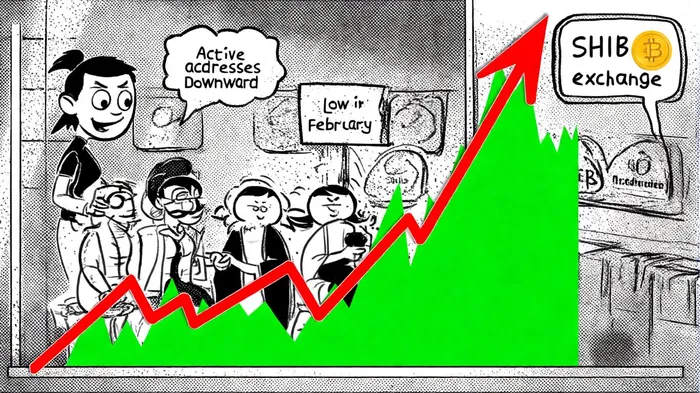
Meanwhile, mid-sized investors (holding 0.1%–1% of the supply) have quietly accumulated 7.63 trillion SHIB since late 2024, while whale and retail holdings have declined [3]. This shift suggests a transition from speculative retail-driven demand to more strategic, institutional-grade positioning. Yet, the collapse in active addresses—down 62% in February 2025 to just 1,814 new wallets—raises a critical question: Who is actually buying?
Active Addresses: A Contrarian Canary in the Coal Mine
The decline in SHIB's active addresses is a red flag for contrarian investors. By February 2025, daily active addresses had fallen to 4,690, a 53% drop from January's peak of 9,928 [3]. This trend persisted through September 2025, with SHIB's price stagnating near $0.0000122 despite whale activity.
Low active addresses typically indicate waning retail interest and reduced liquidity—a dangerous combination for tokens reliant on speculative momentum. Yet, open interest hit $212 million in January 2025, signaling strong institutional optimism [4]. This dissonance between retail apathy and institutional bullishness creates a fragile equilibrium. If whale accumulation stalls, the market could face a liquidity vacuum.
Price Projections and the Illusion of a Breakout
Optimists point to Q3 2025 as a potential inflection pointIPCX--, with ROI forecasts of 340.53% and 326.56% for August and September, respectively [2]. These projections hinge on catalysts like platform integrations or burn mechanisms. However, SHIB remains under a key descending trendline as of September 2025, with price action failing to break above $0.0000130 despite growing open interest [3].
The disconnect between technical indicators and on-chain data is telling. While whales and mid-sized investors are buying, the broader market lacks the conviction to push SHIB beyond its bearish confines. This creates a high-risk scenario: a breakout could trigger a parabolic rally, but a breakdown might accelerate the token's descent toward $0.0000080.
The Contrarian Play: Caution Amid Chaos
For investors, the lesson is clear: Don't trust the crowd. SHIB's whale activity and declining exchange reserves are bullish, but the collapse in active addresses and stagnant price action suggest a market in limbo. The token's future depends on whether mid-sized investors can bridge the gap between institutional optimism and retail apathy.
If SHIB's ecosystem delivers a tangible catalyst—say, a major DeFi integration or a surprise burn event—it could ignite a short-term rally. But until then, the risks of a liquidity crunch and sentiment-driven sell-off remain elevated. In crypto, the most dangerous signals are the ones everyone ignores.






Comentarios
Aún no hay comentarios