
SHIB: The Meme Coin Meltdown – Worst-Case Scenario Analysis and Risk Mitigation Strategies
The Bear Market's Poster Child: SHIB's Perfect Storm
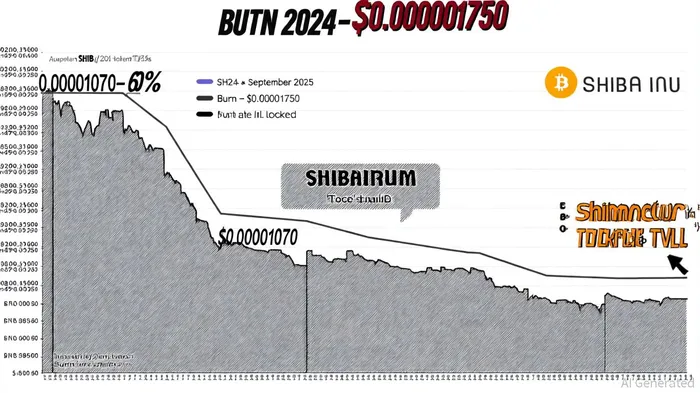
Shiba Inu (SHIB), once the darlings of the memeMEME-- coin universe, has become a cautionary tale in 2025. After a meteoric rise in 2024, the token has lost over 60% of its value from November 2024 highs, trading in a bearish flag pattern between $0.00001070 and $0.00001750 [3]. This collapse is not a random market fluctuation—it's the result of a confluence of technical, on-chain, and macroeconomic factors.
According to a report by Crypto News, SHIB's price is now at risk of a further crash as key metrics crumble. The token's burn rate, a critical deflationary mechanism, has plummeted by 72% on August 12, 2025, burning just 181,928 tokens (worth $2) [4]. Meanwhile, Shibarium, the project's Layer 2 solution, has seen its total value locked (TVL) drop by 10% in 30 days to a paltry $1.75 million [4]. These metrics signal a lack of utility and adoption, leaving SHIBSHIB-- vulnerable to further depreciation.
Worst-Case Scenario: A $0.00001 Floor?
If current trends persist, SHIB could test the $0.00001 level—a 90% drop from its November 2024 peak. Historical data from 2021 to 2025 reveals a pattern of volatility, with SHIB's price swinging between euphoric highs and devastating lows [5]. A case study by BitParse underscores the risks: a $3,000 investment in mid-2024 would have depreciated to $2,209 by mid-2025, a 26% loss [1].
The bearish flag pattern, combined with weak on-chain activity, suggests that SHIB's technical indicators are aligning for a breakdown. As stated by Capwolf, the coin's trading range and declining investor interest—evidenced by shrinking trading volumes—point to a potential cascade into sub-$0.00001 territory [3].
This scenario would mirror the 2022-2023 bear market, where meme coins lost 90%+ of their value.
Risk Mitigation: Diversify or Die
Given SHIB's speculative nature, investors must adopt evidence-based strategies to mitigate downside risks. Diversification is non-negotiable. Allocating a portion of the portfolio to blue-chip cryptocurrencies (e.g., BTC, ETH) or traditional assets (e.g., gold, stocks) can cushion losses if SHIB collapses [3].
Another critical tactic is monitoring on-chain metrics. For instance, tracking whale activity and Shibarium's TVL could provide early warnings of further declines [2]. If Shibarium's TVL continues to erode, it may signal a lack of developer and user interest, accelerating SHIB's depreciation.
For those seeking alternatives, projects like Remittix—a PayFi-based altcoin with real-world utility—offer a more robust value proposition. Remittix enables crypto-to-bank transfers in 30+ countries and has attracted institutional interest, making it a compelling hedge against SHIB's volatility [1].
Stress Testing: Preparing for the Inevitable
A worst-case scenario analysis demands stress testing. Assume SHIB loses 50% of its market value in a single quarter. How would your portfolio hold up? By simulating such extremes, investors can identify vulnerabilities and adjust allocations accordingly [2]. For example, a diversified portfolio with 10% in SHIB and 90% in safer assets would limit losses to ~5% in this hypothetical scenario.
Conclusion: SHIB's Long-Term Outlook is Bleak
SHIB's future hinges on its ability to transition from a meme-driven narrative to a utility-based ecosystem. However, with a stagnant burn rate, a struggling Shibarium, and waning investor interest, this seems unlikely. For now, SHIB remains a high-risk, high-reward asset—suited only for those with a stomach for volatility and a plan to mitigate it.
As the crypto market enters a new phase of consolidation, investors must ask: Is SHIB a speculative gamble or a cautionary tale? The answer may lie in how quickly the project can innovate—or how fast investors flee to more promising alternatives.






Comentarios
Aún no hay comentarios