
SHIB's Massive Burn Event and Its Implications for Long-Term Value and Investor Strategy
The Burn Event: A Deflationary Gamble
On May 23-24, 2025, the Shiba InuSHIB-- (SHIB) community executed a record-breaking token burn, destroying 38 million SHIB-equivalent to a 22,662% surge in the daily burn rate, as reported by an OnTheNode analysis. This event marked a pivotal moment in SHIB's ongoing deflationary strategy, which aims to reduce its staggering circulating supply of over 584 trillion tokens, and automated burns via the Shibarium layer-2 network have accelerated this effort, with over 1.1 billion tokens burned in the preceding week. While such aggressive supply reduction theoretically increases scarcity, the immediate market response was mixed: SHIB's price fell nearly 10% during the event, driven by broader market volatility, including Bitcoin's correction.
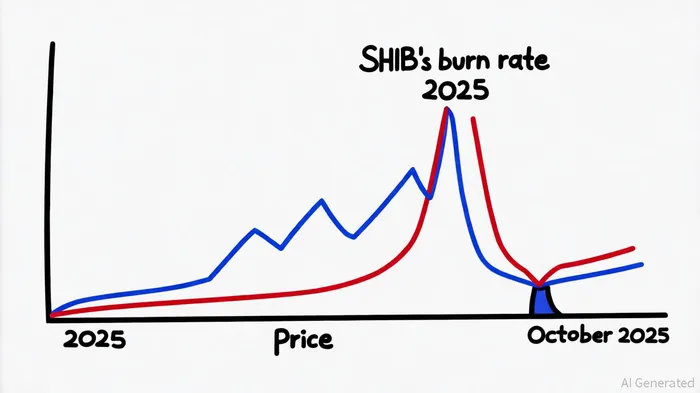
Market Dynamics: Burn Activity vs. Price Volatility
The disconnect between SHIB's burn activity and its price performance underscores the complexities of token economics. For instance, a 27,000% spike in transaction activity followed a prior burn event, signaling heightened community interest, as Bitzo reported. Similarly, a 2,033% surge in the burn rate was recorded on a single day, with 5.7 million tokens destroyed, according to a Benzinga article. Yet, these metrics have not translated into sustained price appreciation. Analysts attribute this to two factors:
1. Technical indicators already reflecting prior burns: The market may have priced in earlier deflationary efforts, reducing the marginal impact of subsequent burns.
2. Lack of real-world utility: Despite Shibarium's potential to drive adoption, SHIB's utility remains limited compared to its supply. As the CoinEdition piece notes, "SHIB's price may require a substantial increase in usage and real-world utility to see a meaningful valuation re-rating" (CoinEdition).
Token Economics: The Math of Scarcity and Valuation
SHIB's token economics present a paradox. While deflationary mechanisms reduce supply, the sheer scale of its circulating supply makes traditional valuation models inapplicable. For example, a $1 SHIBSHIB-- would imply a $589 trillion market cap-far exceeding the combined value of all cryptocurrencies and global GDP, according to a Coin Bureau analysis. Achieving such a target would require an unrealistic 99.999% reduction in supply, a feat impossible at current burn rates. This highlights a critical truth: burns alone cannot drive value without utility.
Investor Strategy: Navigating the Burn-Price Disconnect
For investors, SHIB's burn events raise strategic questions. Here's a framework for decision-making:
- Long-Term Holders: If Shibarium gains traction and SHIB becomes a functional utility token (e.g., for gasGAS-- fees or decentralized apps), the reduced supply could eventually support higher value. However, this hinges on execution, not just burns.
- Short-Term Traders: The recent 10% price dip amid a major burn event suggests that SHIB remains highly sensitive to macro trends. Positioning here requires hedging against Bitcoin's volatility and broader market sentiment, as highlighted earlier.
- Risk Management: Given SHIB's speculative nature, investors should treat it as a high-risk, high-reward asset. Diversification and strict stop-loss strategies are essential.
Conclusion
SHIB's massive burn event demonstrates the community's commitment to deflationary principles, but it also exposes the limitations of supply-side mechanics in isolation. While the 38 million tokens burned in May 2025 are a symbolic win for scarcity, they cannot offset the lack of tangible utility or macroeconomic headwinds. For SHIB to achieve long-term value, the focus must shift from "burns for the sake of burns" to building a robust ecosystem. Until then, investors should approach with caution-and a clear understanding of the math.






Comentarios
Aún no hay comentarios