
Sherwin-Williams' Struggles in a DIY-Driven Market: A Warning Sign for Paint and Home Improvement Stocks?
The post-pandemic economic landscape has reshaped industries in profound ways, and the home improvement sector is no exception. Once buoyed by a surge in DIY enthusiasm during lockdowns, companies like Sherwin-WilliamsSHW-- (SHW) now face a recalibration of demand. For investors, the challenges facing the paint and coatings giant raise critical questions: Are these struggles a temporary blip, or a harbinger of broader structural shifts in the DIY market? And what does this mean for the broader industrial and retail sectors tied to home improvement?
Macroeconomic Headwinds: Housing, Interest Rates, and Consumer Sentiment
Sherwin-Williams' Q2 2025 results reveal a sector under pressure. Consolidated net sales rose just 0.7% to $6.31 billion, while the Consumer Brands Group—a key DIY segment—saw a 4.1% revenue decline. These figures reflect a broader slowdown in residential construction and remodeling, driven by a cooling housing market and rising borrowing costs. The Federal Reserve's aggressive interest rate hikes, though easing in 2025, have left a lingering impact. Mortgage rates remain elevated, deterring homeowners from undertaking large-scale renovations.
The housing market's softening is particularly concerning for Sherwin-Williams, as residential repaint and new construction account for a significant portion of its revenue. In Q2 2025, commercial and new residential markets remained under pressure, while DIY demand in North America weakened. This aligns with a broader trend: home improvement spending, once a pandemic-era boom, is now trending toward normalization. For investors, this signals a shift from high-growth tailwinds to a more defensive, margin-focused environment.
Consumer Behavior: Sustainability, Digital Tools, and a New DIY Ethos
Consumer preferences are evolving rapidly, adding complexity to the market. The DIY segment is no longer driven solely by cost savings or project urgency—it is increasingly shaped by sustainability and technological engagement. Sherwin-Williams has responded by expanding its low-VOC and eco-friendly product lines, a move that aligns with the growing demand for green home solutions. However, these products often carry higher price points, limiting their adoption among price-sensitive consumers.
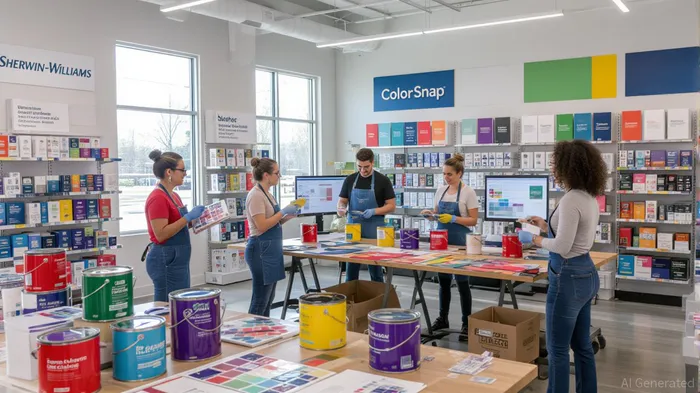
Digital innovation has also become a battleground. Sherwin-Williams' ColorSnap app and Instant Paint AR technology aim to enhance the customer experience by enabling virtual color visualization. While these tools are impressive, they face stiff competition from rivals like Benjamin Moore and PPG IndustriesPPG--, who are similarly investing in digital engagement. The result is a race to differentiate in a market where margins are shrinking.
Strategic Responses: Restructuring, Buybacks, and Global Diversification
Sherwin-Williams has not stood idly by. The company accelerated restructuring initiatives in Q2 2025, incurring $59 million in pre-tax expenses, and expanded its global footprint through the $1.15 billion acquisition of BASF's Suvinil business in Brazil. This move taps into high-growth markets where DIY demand remains resilient. However, the company's premium valuation—trading at a P/E of 33x versus an industry average of 21.7x—raises questions about whether these efforts justify the current price.
The company's financial discipline remains a strength. It returned $1.27 billion to shareholders in the first half of 2025 through dividends and buybacks, leveraging robust cash flow (net operating cash of $1.05 billion). Yet, with full-year 2025 earnings guidance cut to $10.11–$10.41 per share, the market is pricing in caution. For long-term investors, the company's 24% payout ratio and strong balance sheet offer some comfort, but near-term volatility is likely.
Investment Implications: Caution in a Defensive Sector
Sherwin-Williams' struggles highlight a broader inflection point for the home improvement sector. While the company remains a defensive play with a history of dividend growth, its premium valuation and exposure to macroeconomic risks warrant caution. Investors should monitor two key indicators:
- Housing Market Resilience: A rebound in residential construction and remodeling could reignite DIY demand. Track homebuilder sentiment indices and new housing permits.
- Consumer Sentiment Shifts: Rising inflation and wage stagnation may force DIY consumers to prioritize affordability over sustainability. Watch for shifts in product mix (e.g., low-VOC vs. standard paints).
For now, Sherwin-Williams appears best suited for a long-term, income-focused portfolio. However, investors seeking growth should consider whether the company's current valuation adequately discounts its exposure to macroeconomic and consumer behavior risks. The DIY market's evolution—from a pandemic-driven boom to a more measured recovery—demands a balanced approach, combining patience with vigilance.
In conclusion, Sherwin-Williams' challenges are a microcosm of a sector navigating post-pandemic realities. While its strategic agility and financial strength provide a buffer, the broader macroeconomic and behavioral trends suggest a period of recalibration. For investors, the key lies in distinguishing between cyclical pressures and structural shifts—a distinction that will shape the future of not just Sherwin-Williams, but the entire home improvement industry.







Comentarios
Aún no hay comentarios