
Shenzhen's AI-Driven Industrial Transformation and Its Strategic Implications for Global Investors
Shenzhen, China's southern tech powerhouse, has emerged as a pivotal force in the global AI and robotics revolution. By 2025, the city's strategic alignment with national priorities, coupled with its hyper-competitive innovation ecosystem, has positioned it as a high-conviction investment hub. For global investors, understanding Shenzhen's trajectory requires dissecting its policy frameworks, capital flows, and comparative advantages against traditional tech centers like Silicon Valley.
Government Policy and Capital Inflows: A Catalyst for Growth
Shenzhen's 14th Five-Year Plan (2021–2025) explicitly targets AI and robotics as cornerstones of its economic transformation, aiming to elevate the city's digital economy to 10% of GDP by 2025. This ambition is underpinned by a state-backed venture capital fund, part of China's broader $140 billion initiative over two decades to bolster cutting-edge technologies. Locally, Shenzhen has launched the Deep Venture Capital Artificial Intelligence and Embodied Robotics Industry Private Equity Fund, injecting RMB 1.55 billion to accelerate commercialization and attract global talent.
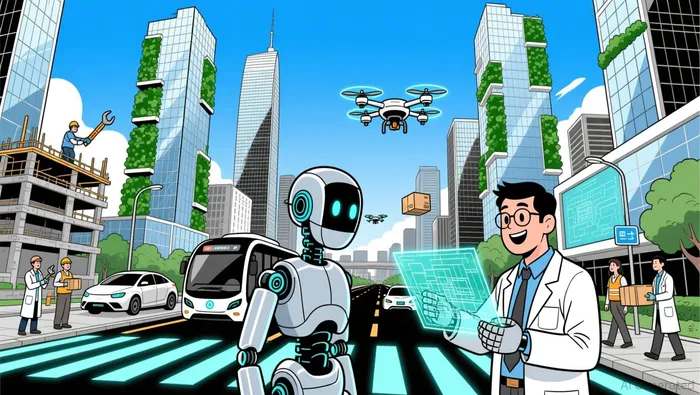
The results are striking. In Q4 2025 alone, Shenzhen-based AI2 Robotics reached a $1 billion valuation after nine fundraising rounds, while EngineAI secured nearly RMB 1 billion in Pre-A++ and A1 rounds to scale production. These figures underscore investor confidence in Shenzhen's ability to translate policy into market-ready solutions. By 2025, the city's robotics sector output value surpassed RMB 200 billion, with ambitions to expand the embodied intelligent robotics industry to RMB 100 billion by 2027.
Global Partnerships and Strategic Advantages
Shenzhen's rise is not solely driven by domestic capital. The cityCITY-- has cultivated international partnerships that amplify its global relevance. For instance, Pony.ai's collaboration with Shenzhen Xihu Corp. to deploy 1,000 robotaxis exemplifies how local firms are integrating autonomous driving technology into urban mobility networks. Meanwhile, Shenzhen's "Robot Valley" moniker reflects its dominance in humanoid robotics, with companies like UBTech and Unitree eyeing international markets.
The city's strategic advantages lie in its vertically integrated ecosystem. Unlike Silicon Valley's focus on foundational research and IP protection, Shenzhen thrives on rapid prototyping, cost efficiency, and hardware-software synergy. By 2025, China's investment in robotics and embodied intelligence had already exceeded the full-year 2024 total, with $3.4 billion poured into new ventures in Q1–Q2 2025 alone-42% more than the U.S. and five times Europe's total. This agility is further supported by subsidized computing resources, streamlined regulatory approvals, and real-world testing environments.
Comparative Edge Over Global Hubs
While Silicon Valley remains a beacon of disruptive innovation, Shenzhen's model offers distinct advantages for investors seeking scalable, cost-effective solutions. The city's "farmer's market of entrepreneurs" culture enables rapid iteration and niche product development, contrasting with Silicon Valley's longer development cycles and high IP costs. For example, Shenzhen's robotics firms are advancing toward mass production of humanoid robots, with some targeting 10,000 units in 2025.
However, challenges persist. Shenzhen's ecosystem faces commercialization hurdles, as many humanoid robots remain in pilot stages. Infrastructure bottlenecks, such as power and land constraints, also mirror those in the U.S., though China's "East Data, West Compute" strategy is mitigating some pressures. Regulatory risks, including fragmented global AI rules, require careful navigation.
Strategic Implications for Investors
For global investors, Shenzhen represents a dual opportunity: leveraging China's national AI strategy while capitalizing on the city's localized innovation engine. The 2025 Encouraged Catalogue for Foreign Investment explicitly supports foreign capital in advanced manufacturing, including robotics components, signaling a policy environment conducive to cross-border collaboration.
Yet, success hinges on mitigating risks. Investors must prioritize firms with clear commercialization pathways and robust governance frameworks to address reputational and regulatory challenges. Shenzhen's ecosystem, however, offers a unique blend of speed, scale, and cost efficiency that few competitors can match.
Conclusion
Shenzhen's AI-driven industrial transformation is not merely a regional phenomenon but a global inflection point. By 2025, the city has demonstrated its capacity to bridge policy, capital, and innovation, creating a fertile ground for high-conviction investments. For those willing to navigate its complexities, Shenzhen's robotics and AI sectors present a compelling case for long-term value creation.







Comentarios
Aún no hay comentarios