
Why Shell's Shareholder Yield Strategy Outperforms ESG Skepticism in Energy Transition
In the evolving energy landscape of 2025, the tension between shareholder yield and ESG (Environmental, Social, and Governance) commitments has become a defining debate for investors. Royal Dutch Shell's strategy—prioritizing robust capital returns while navigating the energy transition—has drawn both praise and criticism. For contrarian value investors, however, Shell's approach offers a compelling case: its shareholder yield strategy, anchored in disciplined capital allocation and operational efficiency, outperforms the skepticism surrounding its ESG alignment.
Shell's Shareholder Yield: A Contrarian Edge
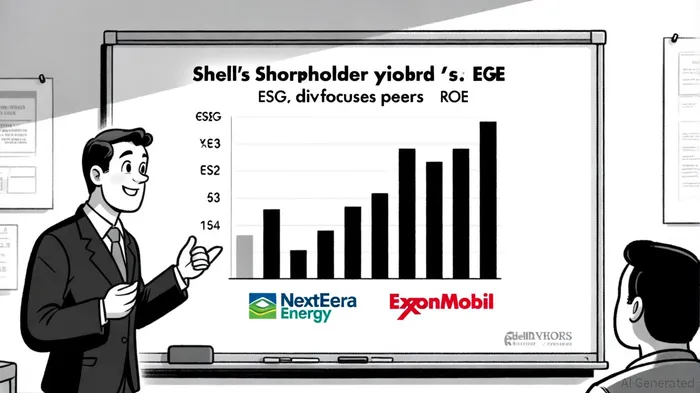
Shell's 2025 financial performance underscores its commitment to rewarding shareholders. The company announced a $3.5 billion share repurchase program in Q2 2025 and maintains a quarterly dividend of $0.3580 per share, translating to a 3.93% yield, according to Shell statistics. This yield outpaces ESG-focused peers like NextEra Energy (3.58%) and ExxonMobil (3.2%), according to the 2025 energy stocks roundup. Shell's capital return framework—allocating 40–50% of operating cash flow to shareholders—reflects a disciplined approach to value creation, even as it faces scrutiny for scaling back low-carbon investments to 10% of capital expenditure, according to a BIC Magazine report.
Critics argue that Shell's reduced emphasis on renewables undermines its net-zero pledge. However, the company's Q1 2025 adjusted earnings of $5.6 billion and a forward P/E ratio of 11.12, as ShellSHEL-- statistics indicate, suggest strong near-term profitability. By prioritizing liquidity and debt reduction (gearing increased to 19.1% but remains manageable, per Shell statistics), Shell positions itself to weather regulatory and market volatility—a critical advantage in a sector grappling with decarbonization costs.
ESG Skepticism vs. Strategic Realism
Shell's energy transition strategy has faced pushback from activist shareholders, particularly over its LNG expansion plans. A 2024 shareholder resolution demanding clarity on LNG's alignment with net-zero goals garnered only 19% support, while 78% endorsed the company's broader strategy, according to BIC Magazine. This divide highlights the tension between idealistic ESG targets and operational pragmatism. Shell's CEO, Wael Sawan, has emphasized balancing energy security with decarbonization, a stance that resonates with investors prioritizing stability over ideological purity, as reported by BIC Magazine.
Comparatively, ESG-focused peers like NextEra Energy and ExxonMobil have made significant low-emission investments. ExxonMobil, for instance, plans to spend $30 billion on carbon capture and hydrogen projects, noted in the 2025 energy stocks roundup, while NextEra Energy leads in wind and solar capacity. Yet, these companies' ROEs (8.1% for NextEra, 9.8% for Exxon) contrast with Shell's 7.54%, per Shell statistics, suggesting that aggressive ESG commitments may come at the expense of immediate profitability.
The Contrarian Case for Shell
For value investors, Shell's strategy embodies a contrarian playbook: leveraging its integrated gas and LNG expertise to capitalize on near-term demand while hedging against long-term risks. The company's 60% progress toward halving operational emissions by 2050, as reported by BIC Magazine, demonstrates measurable ESG progress, even as it tempers renewable investments. This pragmatic approach allows Shell to maintain a competitive ROACE (9.4% in Q2 2025, per Shell statistics) and a 5.26% 52-week stock price gain, according to Shell statistics, outperforming peers like Avangrid and Eversource Energy, which, while ESG-aligned, offer lower yields and slower growth (as noted in the 2025 energy stocks roundup).
Moreover, Shell's strategic recalibration—such as the $1.5–$3 billion impairment charge for reduced LNG production forecasts—signals a willingness to adapt to market realities, a point highlighted by BIC Magazine. This flexibility contrasts with ESG-focused firms that may face regulatory or operational headwinds if their renewable projects underperform.
Conclusion: Balancing Profitability and Transition
While ESG metrics will increasingly shape the energy sector, Shell's shareholder yield strategy offers a counterpoint to the prevailing narrative. By prioritizing capital returns and operational efficiency, the company addresses immediate investor concerns while maintaining a path to decarbonization. For contrarian value investors, Shell's approach—criticized for its perceived ESG compromises—proves that profitability and transition can coexist, particularly in a market where energy security and affordability remain paramount.







Comentarios
Aún no hay comentarios