
Shell's Q4 Warning: Tactical Mispricing Ahead of February 5 Catalyst
The catalyst is clear and immediate. Shell's shares fell 1.8% on Thursday after the company delivered a multi-pronged warning that fourth-quarter earnings would be notably lower than the prior quarter. This isn't a broad miss; it's a targeted alert on specific, temporary pressures that are creating a tactical mispricing ahead of the full results on February 5.
The two main financial pressures flagged are distinct and largely non-core. First, the chemicals and products division is forecast to post an adjusted loss. This stems from a sharp $20/ton drop in indicative margin to $140/ton from the third quarter, coupled with a (non-cash) deferred tax adjustment in a joint venture. Second, trading and optimization results for the quarter are expected to be significantly lower than in Q3, with integrated gas trading in line with the previous quarter.
Viewed together, this creates a classic setup for a market overreaction. The warning correctly identifies severe headwinds in two peripheral segments-chemicals trading and a tax adjustment. Yet it does so against a backdrop where the core operations remain stable. Upstream production is expected to hold steady, and integrated gas trading is in line. The company also noted a refining margin improvement to $14 per barrel. The market's 1.8% pop down suggests it's overstating the severity of these temporary, segment-specific issues while overlooking the resilience in Shell's core cash-generating engine.
Quantifying the Impact: The Drag and the Offset
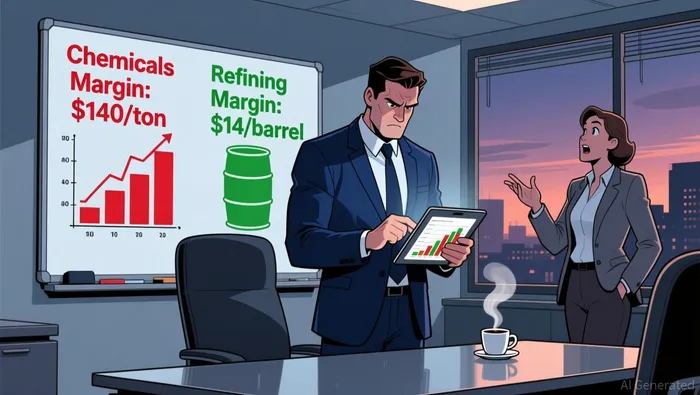
The warning creates a clear earnings drag, but it's not a blanket negative. The primary pressure is a sharp sequential decline in the chemicals margin, which fell to $140 per metric ton from $160 in the third quarter. This drop, combined with significantly lower trading results in that segment, is the core of the issue. The company expects the chemicals and products division to post a significant loss, driven by this margin compression and a non-cash deferred tax adjustment.
Yet, this headwind is partially offset by a positive development in refining. The company forecasts its indicative refining margin to improve, rising to $14 a barrel in the fourth quarter from $12 previously. This uptick provides a tangible counterweight to downstream pressures and suggests some operational improvement in that business line.
Crucially, the core operations are stable and provide a floor. Upstream production is expected to hold steady at 1.84 to 1.94 million boe/d, and integrated gas output is forecast in a range of 930,000 to 970,000 boe/d. Integrated gas trading is also expected to be in line with the third quarter result. This stability in the cash-generating heart of the business means the earnings drag is largely confined to specific, non-core segments. The market's reaction appears to be pricing in a broader deterioration, overlooking this resilience.
The Near-Term Catalyst: February 5 Earnings Release
The event that will resolve the current uncertainty is the full earnings release scheduled for February 5, 2026. This report is the definitive catalyst that will separate temporary accounting noise from lasting operational damage.
The release will confirm two key points. First, it will quantify the magnitude of the chemicals loss and the sustainability of the higher refining margin. The market needs to see the final numbers for the $20/ton drop in indicative margin to $140/ton and the significant loss in the chemicals and products division. At the same time, it will validate the positive signal from the refining margin improvement to $14 per barrel. This will show whether the refining uptick is a one-quarter bounce or the start of a trend.
The primary risk is that the chemicals and trading headwinds persist into the first quarter. The warning already notes that trading results in that segment are expected to be significantly lower than in Q3. However, the market should treat the non-cash deferred tax adjustment as a one-time accounting item, not a recurring operational drag. The real test will be whether Shell's core production base and stable gas output can provide a floor for earnings.
The setup is clear. The market is pricing in a significant earnings miss based on the warning. Yet the core operations remain stable, with upstream production expected to hold steady and integrated gas trading in line. The February 5 release will be the event that forces a recalibration. If the chemicals loss is contained and the refining margin holds, the stock's recent dip may prove to be a tactical mispricing ahead of a more accurate valuation.
Tactical Takeaway: The Setup
The event has created a clear tactical mispricing. The market's reaction-a 1.8% slide in Shell's shares-is based on headline losses in the chemicals and products division, ignoring the stable core and the partial offset from refining. This is a classic overreaction to temporary, segment-specific pressures.
The key watchpoint for resolution is the February 5 earnings release. Investors must see two things confirmed: first, the realization of the $20/ton drop in indicative chemicals margin to $140/ton and the resolution of the (non-cash) deferred tax adjustment in a joint venture. Second, they need to see whether the refining margin improvement to $14 per barrel holds, which would signal operational strength in a key downstream business.
A re-rating is possible if the Q4 results show the losses were contained and the higher refining margin persists. The core operations provide a floor: upstream production is expected to hold steady and integrated gas trading is in line. If the chemicals and marketing losses are one-time or accounting-driven, the stock's recent dip may prove to be a tactical mispricing ahead of a more accurate valuation.
The setup is a clear event-driven opportunity. Buy the dip ahead of the catalyst, with the February 5 results as the trigger for a re-rating. The risk is that the chemicals and trading headwinds persist, but the market is already pricing in a significant miss. The potential reward is a correction of that overreaction.





Comentarios
Aún no hay comentarios