
Shell and INEOS Strike Oil in the Gulf of America: A Strategic Bet on Energy Security
The Nashville discovery is more than a single well; it is a validation of a new strategic era for U.S. offshore energy. This find arrives at a critical juncture where domestic policy, corporate strategy, and energy security are converging. The rebranding of the U.S. Federal Offshore to the "Gulf of America" (GOA), codified in the One Big Beautiful Bill Act (OBBBA) signed in July 2025, is not mere semantics. It is a deliberate effort to reframe the region's narrative, positioning it as a cornerstone of American energy independence. The Gulf already contributes a significant 14% to the U.S. crude oil supply, and this discovery reinforces its role as a source of high-margin, lower-carbon barrels.
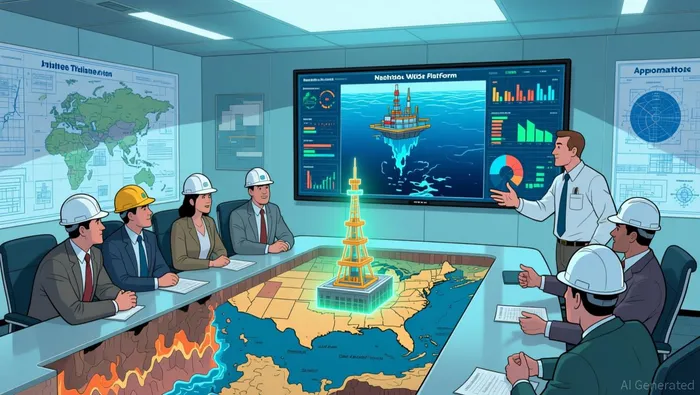
This strategic pivot is being powered by a shift in corporate exploration economics. The Nashville find validates the "infrastructure-led exploration" (ILX) model, which focuses on discovering new resources near existing hubs to minimize development time and costs. The partnership plans to develop the reservoir as a subsea tie-back to the nearby Appomattox platform, a strategy that directly leverages existing infrastructure. This approach is not new, but the success at Nashville provides a powerful "proof of concept" that is likely to boost the valuation of nearby leases and encourage further investment in the region. It represents a move from frontier exploration to efficient resource recovery, a model that ChevronCVX-- has also championed with projects like Ballymore, which reduced development costs by using its existing Blind Faith facility.
The bottom line is that the Gulf of America is being repositioned as a strategic asset for both national security and corporate profitability. The discovery demonstrates that the region's deepwater assets, once seen as high-risk frontiers, are now a reliable engine of growth. This validates the ILX model, which reduces development costs by leveraging existing hubs like Appomattox. For majors like ShellSHEL-- and Chevron, it means a path to producing more oil with a lower carbon footprint per barrel, a critical advantage in a transitioning energy landscape. The challenge now is to translate this discovery into a scalable development plan, with a Final Investment Decision targeted for late 2026 and first oil potentially flowing by 2028. The strategic context is clear: the Gulf of America is no longer just a source of oil; it is a central pillar of a new, infrastructure-driven energy strategy.
The Mechanics: Economics of a Deepwater Tie-Back
The discovery of oil at the Nashville well is a geological event. Its transformation into a profitable project hinges entirely on economics. The key driver is the tie-back model. Instead of building a costly, standalone platform, the companies plan to connect the new reservoir to Shell's existing Appomattox platform. This strategic move is not a minor cost-cutting exercise; it is a fundamental lever that makes the project viable. Projects that can utilise existing platform infrastructure, such as tie-backs to established facilities, reduce capital requirements by 40-60% compared to standalone developments. In a deepwater Norphlet play where drilling costs for a single well can range from $150-200 million, this cost reduction is decisive. It directly lowers the break-even oil price, which typically requires $45-55 per barrel for commercial viability, and dramatically improves the project's financial profile.
The financial math is compelling. Historical performance data from similar Gulf of America discoveries shows that successful Norphlet projects generate internal rates of return between 15-25% at oil prices above $55 per barrel. This range represents a strong, investment-grade return profile, but it is entirely contingent on the tie-back model. Without leveraging existing infrastructure, the capital expenditure would likely push the project into negative IRR territory at current price levels. The tie-back, therefore, is the economic catalyst that turns a high-cost exploration play into a bankable asset.
This model is only possible through sophisticated partnership structures that distribute the immense risk. The ownership split-Shell with a 79% interest operating the well and INEOS with a 21% working interest-is a textbook example of joint venture risk-sharing. Shell, as the majority partner, assumes operational control and a larger share of the capital burden, but also captures the lion's share of the returns. INEOS, the minority partner, gains exposure to a high-potential deepwater discovery without bearing the full $200+ million project cost. This structure allows both companies to participate in the economics according to their respective capabilities and risk tolerances. Historical analysis shows that such joint ventures achieve 30-40% higher success rates compared to single-operator projects, a testament to the value of shared technical expertise and broader financial resources in navigating the extreme challenges of deepwater exploration.
The bottom line is that the Nashville discovery's fate is not sealed by the presence of oil. It is determined by the execution of a complex financial and operational plan. The tie-back to Appomattox is the critical economic enabler, slashing costs and boosting returns. The joint venture structure is the necessary risk management framework that allows two major players to fund and operate this high-capital, high-risk endeavor. The project's viability now rests on technical evaluations confirming the reservoir's size and the commercial negotiations to finalize the tie-back agreement.
The Valuation and Risk Spine: Assessing the Market's Take
Shell's current valuation suggests the market is pricing in steady, capital-light growth, not a transformative discovery. With a forward P/E of 12.6 and a forward dividend yield of 3.9%, the stock trades at a discount to its historical averages. This reflects a market that expects disciplined returns from a mature, cash-generative business rather than explosive expansion from a single new find. The discovery at the Nashville well, while a positive step, appears to be priced as a modest addition to Shell's long-cycle deepwater portfolio, not a game-changer for its financial profile.
The primary risk to the project's economic promise is the fundamental uncertainty around its size and quality. The company has confirmed the presence of high-quality oil more than 26,000 feet below the seabed, but it has not disclosed estimated recoverable volumes or a development timeline. This gap is critical. The true value of a deepwater discovery is determined by its ultimate recoverable reserves, which will only be known after costly and time-consuming appraisal work in 2026. Until then, the find remains a promising geological prospect, not a proven economic asset.
Execution risk is the second major constraint, and it is amplified by the challenging environment. The discovery is in the high-pressure Norphlet formation, a technically demanding reservoir known for extreme pressure and temperature conditions. Developing such formations requires advanced engineering, specialized materials, and careful risk management, all of which increase costs and the potential for operational delays. Shell, as a major operator with a long track record in the Gulf, has the expertise, but the HPHT environment introduces a persistent friction that can derail schedules and budgets.
The bottom line is that Shell's valuation provides a clear guardrail. The market is not betting on a miracle from the Nashville well; it is betting on Shell's ability to execute its existing, lower-risk portfolio. For the discovery to move the needle, it must not only prove large enough to justify a major capital investment but also be developed successfully in a high-pressure environment. The next 18 months, with the appraisal work due, will test whether this geological success translates into a commercially viable asset or remains a costly footnote in a mature basin.
Catalysts and Scenarios: What Moves the Needle
The immediate catalyst for Shell is the 2026 appraisal program. This is the critical next step that will transform a promising discovery into a bankable project. The partnership must drill additional wells to confirm the reservoir's size and boundaries, moving from a single well success to a quantified resource. A positive appraisal could lead to a Final Investment Decision by late 2026, with first oil potentially flowing through the existing Appomattox hub by 2028. This timeline is the primary near-term event that will move the needle on valuation, providing the concrete data needed to justify development costs and secure financing.
The long-term scenario, however, hinges on a broader structural shift: the effectiveness of the "Gulf of America" rebranding and the One Big Beautiful Bill Act (OBBBA). The OBBBA, signed in July 2025, is designed to stimulate deepwater investment through new tax incentives and streamlined permitting. If this policy framework successfully lowers the cost and risk of Norphlet development, it could trigger a new wave of leasing activity in the eastern Gulf. This would boost the value of nearby leases held by Shell and other majors, creating a virtuous cycle where one discovery validates the entire basin and attracts more exploration.
The Nashville discovery acts as a powerful proof of concept for the OBBBA's goals. It demonstrates that high-margin, lower-carbon production is still possible in the deepwater Gulf, a narrative that aligns with the act's focus on energy security and domestic manufacturing. The success of this model will determine whether the region becomes a sustained growth engine or remains a sporadic source of isolated finds. For Shell, the bottom line is that the 2026 appraisal is the immediate test, but the long-term payoff depends on whether the company can leverage this discovery to capture a larger share of a reinvigorated deepwater frontier.





Comentarios
Aún no hay comentarios