
Sharplink Gaming's Strategic Expansion in Share Capital: Assessing Capital Flexibility and Growth Ambition in the Gaming Sector
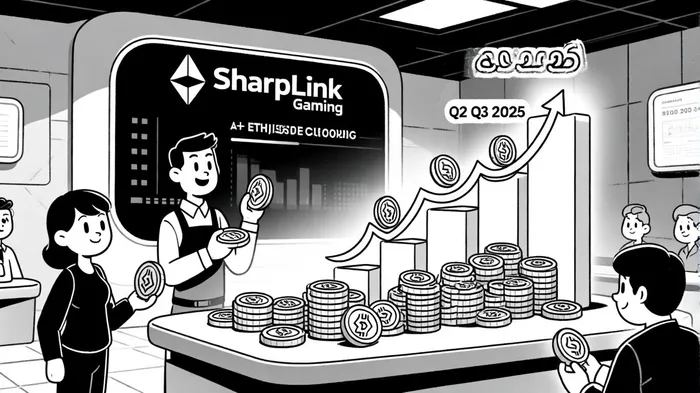
In the rapidly evolving intersection of gaming and blockchain, SharpLink GamingSBET--, Inc. (NASDAQ: SBET) has emerged as a bold experiment in corporate finance. The company's 2025 share capital expansion—raising $425 million through a private placement—marks a pivotal shift in its strategic trajectory, transforming it from a traditional gaming operator into a corporate EthereumETH-- (ETH) treasury player[1]. This move, led by Consensys Software Inc. and bolstered by institutional crypto investors, underscores a calculated bet on Ethereum's role in reshaping global finance.
Capital Flexibility: Liquidity as a Strategic Lever
SharpLink's capital-raising efforts have created a multi-layered liquidity buffer. The $425 million private placement in May 2025[1] was swiftly followed by a $400 million registered direct offering in Q3 2025[2], with institutional partners including ParaFi Capital and Pantera Capital[1]. These infusions, combined with a $200 million at-the-market (ATM) facility[3], have positioned the company to aggressively accumulate ETHETH--. By August 2025, SharpLink's ETH holdings had surged to 837,230, with staking rewards compounding to 2,318 ETH[4]. This liquidity flexibility is critical for navigating Nasdaq's compliance requirements, as the company races to meet minimum bid price and equity thresholds by May 2025[5].
The strategic pivot to ETH as a primary treasury asset[1] has also introduced a novel form of capital efficiency. By staking its holdings, SharpLinkSBET-- generates yield—approximately 1,799 ETH in staking rewards by Q3 2025[3]—effectively transforming its balance sheet into a self-reinforcing mechanism. This approach contrasts sharply with traditional gaming companies, which often rely on revenue streams from user engagement or advertising.
Growth Ambition: Ethereum as a Corporate Foundation
SharpLink's growth ambition is anchored in Ethereum's long-term potential. The company's “ETH Concentration” metric, which measures accumulation efficiency, rose 98% in Q3 2025[3], signaling a disciplined approach to scaling its digital treasury. This strategy aligns with broader institutional trends: Ethereum's adoption as a reserve asset by corporations has surged in 2025, driven by its role in decentralized finance (DeFi) and the rise of staking yields[6].
The appointment of Joseph Lubin, Ethereum co-founder, as Chairman[1], and Joseph Chalom, a BlackRock veteran, as Co-CEO[4], further legitimizes SharpLink's vision. These moves, coupled with a $1.5 billion stock buyback plan[3], aim to stabilize investor sentiment amid a 39.6% stock price surge following the August 2025 capital raise[4]. However, the company's financials remain a mixed picture: while 2024 saw a net income of $10.1 million after a revenue decline[5], Q2 2025 reported a $103.4 million net loss due to market volatility and non-cash impairments[1].
Risks and Realities
SharpLink's strategy is not without risks. The company's reliance on ETH's price performance exposes it to crypto market volatility. A $4,462 average acquisition price for ETH in August 2025[3] could become a liability if Ethereum's value dips below this threshold. Additionally, Nasdaq compliance remains a looming challenge, with the company's $4.5 million equity offering and $361.84 million capital-raising plans[5] serving as stopgap measures rather than long-term solutions.
Yet, the company's aggressive capital allocation—prioritizing ETH accumulation over traditional gaming operations—reflects a high-stakes bet on the future of digital capital. By August 2025, SharpLink's total ETH holdings were valued at $3.7 billion[3], dwarfing its gaming revenue streams. This suggests a strategic pivot where the company's value proposition is increasingly tied to Ethereum's institutional adoption rather than its core gaming business.
Conclusion: A High-Volatility, High-Reward Proposition
SharpLink Gaming's capital expansion and Ethereum treasury strategy exemplify a radical reimagining of corporate finance in the blockchain era. While the company's liquidity and institutional backing provide a buffer against short-term volatility, its long-term success hinges on Ethereum's trajectory as a reserve asset. For investors, the key question is whether SharpLink's bet on Ethereum's “foundational layer of the decentralized economy”[1] will outpace the risks of regulatory scrutiny, market swings, and Nasdaq compliance hurdles.
In a sector where innovation often outpaces stability, SharpLink's approach is both a testament to the disruptive potential of blockchain and a cautionary tale about the perils of speculative capital allocation.





Comentarios
Aún no hay comentarios