
O'Shares FTSE Russell Small Cap Quality Dividend ETF: A Monthly Income Play in a Volatile Sector
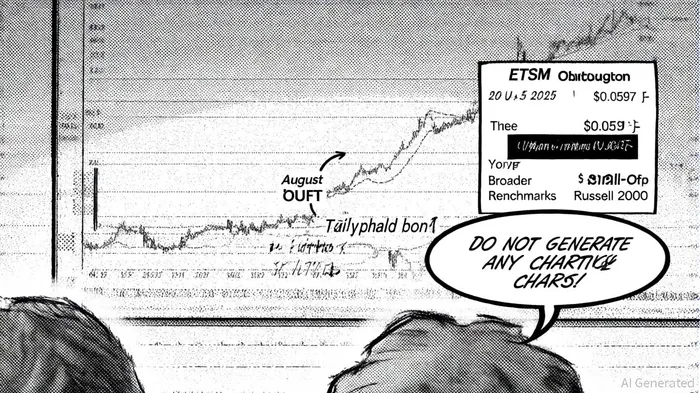
In the small-cap dividend space, where earnings volatility often overshadows income stability, the O'Shares FTSE Russell Small Cap Quality Dividend ETF (OUSM) has emerged as a compelling case study. Launched just 14 months ago, this ETF has already attracted $121 million in assets under management, leveraging its focus on high-quality, low-volatility small-cap stocks with robust dividend yields[4]. For income-oriented investors, OUSM's monthly distribution model—most recently paying $0.0945 per share[1]—presents a unique opportunity to balance growth potential with consistent cash flow.
Dividend Stability: A Mixed Picture
OUSM's trailing twelve-month (TTM) dividend yield of 1.88%[2] outperforms broader small-cap benchmarks like the Russell 2000 and S&P SmallCap 600, which average 1.2%[4]. However, the ETF's dividend history reveals a nuanced narrative. Over the past year, OUSM's total dividend growth reached 39.99%[3], a figure that starkly contrasts with its 1.72% annualized growth rate and a negative three-year growth rate of -1.24%[2]. This discrepancy, as explained by New York University's dividend fundamentals research, stems from the metrics' differing time horizons: the 39.99% figure reflects a single anomalous year of growth (potentially driven by special dividends or concentrated stock performance), while the 1.72% rate represents a smoothed average over multiple years[5].
Strategic Design for Quality and Resilience
OUSM's dividend policy is anchored to its underlying index, the FTSE USA Small Cap Qual/Vol/Yield 3% Capped Factor Index[2], which prioritizes companies with strong profitability, low volatility, and sustainable payout ratios. This design mitigates exposure to “value traps”—high-yield stocks in decline—by emphasizing firms with durable financial health. The ETF's portfolio, spanning over 300 stocks, is weighted toward real estate, industrials, and consumer discretionary sectors[4], which historically exhibit varying degrees of earnings resilience. While this diversification reduces sector-specific risk, it also introduces complexity: small-cap stocks are inherently more sensitive to macroeconomic shifts, and OUSM's focus on quality does not guarantee immunity to broader market corrections.
Risks and Rewards in a Small-Cap Context
The ETF's recent performance underscores both its potential and its challenges. A 39.99% total dividend growth in a single year[3] suggests aggressive reinvestment or strategic reallocation within its holdings, but this pace is unlikely to be sustained long-term. Conversely, the -1.24% three-year growth rate[2] highlights the cyclical nature of small-cap dividends, which can fluctuate with economic cycles and sector-specific downturns. For investors, this duality presents a critical question: Is OUSM's dividend model a reliable income source, or a growth-driven anomaly?
Conclusion: A Balanced Approach to Income
OUSM's monthly distribution model, combined with its quality-screened portfolio, positions it as a hybrid option for investors seeking both income and moderate growth. While its TTM yield of 1.88%[2] and recent $0.0945 payout[1] signal short-term appeal, the ETF's long-term viability as a dividend play depends on its ability to maintain earnings consistency amid small-cap sector volatility. For those willing to tolerate near-term fluctuations in pursuit of a yield premium over traditional small-cap benchmarks, OUSM offers a compelling, if imperfect, solution.







Comentarios
Aún no hay comentarios