
Share Repurchase Programs: A Strategic Lens for Uncovering Undervalued Stocks in 2025
In the ever-evolving landscape of corporate finance, share repurchase programs have emerged as a critical tool for unlocking shareholder value. From 2023 to Q1 2025, S&P 500 companies authorized a staggering $750 billion in buybacks, a 25% increase compared to the same period in 2024. This surge, driven by robust cash flows and strategic capital allocation, has created a unique opportunity for investors to identify undervalued stocks by analyzing execution trends.
The Sectoral Drivers of Buyback Momentum
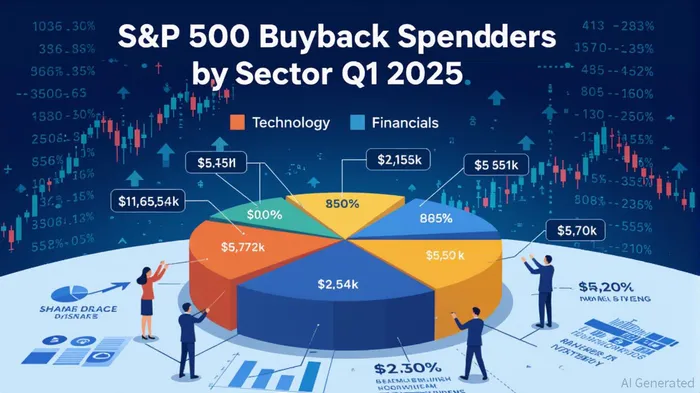
The Communication Services, Financials861076--, and Technology sectors have dominated repurchase activity, accounting for over 60% of total buybacks in 2025. For instance, the Technology sector alone executed $80.2 billion in Q1 2025 repurchases, with AppleAAPL-- (AAPL) and NVIDIANVDA-- (NVDA) leading the charge. Apple's $26.2 billion in Q1 buybacks—part of its $106.9 billion 12-month program—has reduced its share count by over 4%, directly inflating its earnings per share (EPS) and P/E ratio. Similarly, Financials like JPMorgan ChaseJPM-- (JPM) and Bank of AmericaBAC-- (BAC) repurchased $18 billion in shares, leveraging their strong balance sheets to reward shareholders.
However, not all sectors are equally active. Energy, Materials, and Utilities have lagged, with buyback authorizations remaining below $50 billion combined. This disparity reflects sector-specific cash flow dynamics and strategic priorities, offering a roadmap for investors to focus on high-conviction areas.
The Buyback-Performance Link: Data-Driven Insights
Historical data underscores the correlation between aggressive buybacks and stock outperformance. The S&P 500 Buyback Index, which tracks the top 100 companies with the highest buyback ratios, has delivered a 1,000% total return since 2000—far outpacing the S&P 500's 310%. This outperformance is not coincidental. Buybacks reduce share counts, enhance EPS, and signal management confidence in a stock's intrinsic value. For example, Meta PlatformsMETA-- (META) increased its Q1 2025 buybacks by 446% compared to Q4 2024, spending $17.6 billion to signal its belief in undervaluation.
Academic research further validates this trend. A 2021 U.S. Chamber of Commerce study found that buybacks improve liquidity, reduce volatility, and provide cost savings for investors. Meanwhile, S&P Global's analysis shows that companies with consistent repurchase programs tend to have stronger fundamentals, including high cash flow margins and clean balance sheets.
Regulatory and Tax Headwinds: A Balancing Act
The Inflation Reduction Act's 1% excise tax on buybacks has introduced a drag on corporate earnings, reducing S&P 500 operating profits by 0.5% in Q1 2025. While manageable for now, this tax could shift capital allocation strategies toward dividends or growth investments. For instance, AmazonAMZN-- (AMZN) has redirected $104 billion in capex toward AI infrastructure since 2022, pausing buybacks entirely. Investors must weigh these regulatory risks against the potential for sustained repurchase activity.
Identifying Undervalued Opportunities: A Framework
To pinpoint undervalued stocks, investors should combine buyback trends with financial metrics and insider activity. Key criteria include:
1. High Buyback Ratios: Prioritize companies with buyback spending exceeding 5% of market cap annually.
2. Strong Free Cash Flow: Ensure companies have sufficient liquidity to sustain repurchases without compromising growth.
3. Insider Buying: Look for executives and board members purchasing shares, signaling confidence.
4. Low P/E Relative to Buyback Activity: A low price-to-earnings ratio paired with aggressive buybacks often indicates undervaluation.
Case studies like Greene County Bancorp (GCBC) and National Research Corporation (NRC) exemplify this approach. GCBC's 12.8x P/E ratio and 42% net income margin, coupled with insider purchases of $163,760 in July 2025, suggest a compelling value proposition. Similarly, NRC's $5.71 million in insider repurchases during a challenging earnings period highlights management's conviction.
The Road Ahead: Balancing Growth and Value
While buybacks remain a powerful tool, their effectiveness hinges on broader economic and regulatory trends. Rising AI investments and potential tax hikes could divert capital from repurchase programs. However, for companies with strong cash flows and disciplined management, buybacks will continue to drive shareholder value.
Investors should adopt a dual strategy:
- Short-Term: Target sectors with high buyback momentum (e.g., Technology, Financials) and strong insider activity.
- Long-Term: Monitor regulatory shifts and sector-specific capital allocation trends to avoid overexposure to companies prioritizing growth over shareholder returns.
In conclusion, share repurchase programs offer a strategic lens for identifying undervalued stocks in 2025. By analyzing execution trends, sector dynamics, and regulatory risks, investors can uncover opportunities where management confidence aligns with financial strength. As the market navigates macroeconomic uncertainties, a disciplined approach to buyback-driven value creation will remain a cornerstone of successful investing.





Comentarios
Aún no hay comentarios