
SFY: A Low-Cost, High-Efficiency Large-Cap Growth ETF for Long-Term Investors
In the ever-evolving landscape of passive investing, the Schwab Fundamental U.S. Large Company ETF (FNDX)-formerly known as SFY-has emerged as a compelling option for investors seeking a balance between cost efficiency and growth potential. With an expense ratio of 0.25%, FNDXFNDX-- ranks among the most affordable large-cap ETFs, while its performance metrics over recent years underscore its ability to deliver competitive returns. This analysis explores how FNDX's unique methodology, low costs, and alignment with fundamental metrics position it as a strategic choice for long-term investors.
Cost Efficiency: A Cornerstone of Competitive Advantage
The fund's expense ratio of 0.25% places it in the lower quartile of large-cap ETFs, a critical factor for investors prioritizing cost discipline. This low-cost structure is particularly advantageous in a market where even minor fee differentials can compound significantly over time. For instance, data from Schwab Asset Management indicates that FNDX's expense ratio has remained stable post-its 2024 index update, ensuring that investors continue to benefit from minimal drag on returns. By comparison, traditional market-cap-weighted alternatives like VOOV or IUSV often carry higher fees, making FNDX an attractive alternative for cost-conscious portfolios.
Performance: Tracking Fundamentals, Delivering Growth
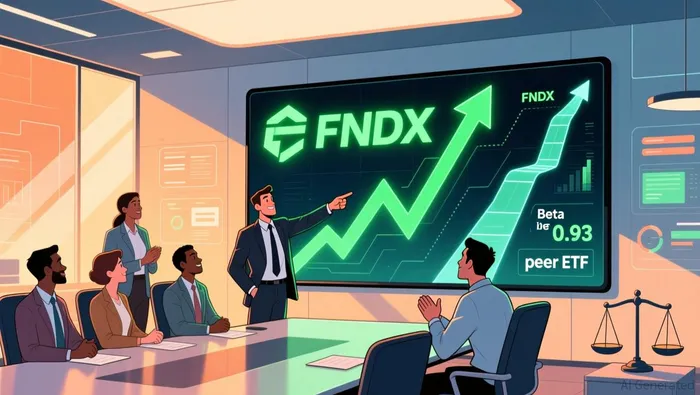 . FNDX's performance in 2023 and early 2025 highlights its ability to balance growth and efficiency. As of November 2025, the fund delivered a year-to-date (YTD) return of 16.54%, closely mirroring the 16.97% return of its benchmark. This tight tracking is a testament to the fund's passive management approach, which prioritizes replicating the performance of an index designed to weight companies based on fundamental metrics such as adjusted sales, retained operating cash flow, and dividends plus buybacks. Over a three-year horizon, FNDX has posted an annualized return of 20.46%, outpacing many peers in the large-cap growth segment.
The fund's outperformance relative to similar ETFs, such as the Schwab U.S. Large-Cap Growth ETF (SCHG), further underscores its efficiency. While SCHG recorded a 23% gain in 2023 through August 15, FNDX's diversified portfolio of 730 holdings-spanning sectors like technology, healthcare, and industrials-has mitigated company-specific risks while maintaining exposure to growth drivers. This diversification, combined with a top-10 holdings concentration of 22.12%, ensures broad-based participation in market trends without overreliance on individual stocks.
Methodology: Beyond Market Cap to Fundamental Metrics
FNDX's index update in 2024-from the Russell RAFI US Large Company Index to the RAFI Fundamental High Liquidity US Large Index-reflected Schwab's commitment to enhancing liquidity and reducing turnover. This shift has not only preserved the fund's core philosophy of fundamental weighting but also improved its operational efficiency. By prioritizing companies with strong liquidity profiles, FNDX reduces transaction costs and slippage, further amplifying its cost-performance edge.
The fund's beta of 0.93 and standard deviation of 15.15% over three years indicate a moderate risk profile, aligning with its focus on large-cap value stocks. This makes FNDX particularly appealing to investors seeking growth without excessive volatility, especially in a macroeconomic environment marked by uncertainty.
Conclusion: A Strategic Fit for Long-Term Portfolios
For long-term investors, FNDX represents a rare convergence of low costs, robust performance, and fundamental-driven strategy. Its ability to consistently track its benchmark while outperforming peers like SCHG and VOOV demonstrates its efficacy in capitalizing on market opportunities without sacrificing efficiency. As the U.S. equity market continues to evolve, FNDX's focus on liquidity, diversification, and fundamental metrics positions it as a resilient and scalable solution for those prioritizing both growth and cost discipline.
In an era where passive strategies dominate, FNDX's blend of affordability and performance reaffirms the value of thoughtful index design and operational rigor. For investors seeking to build a foundation of reliable, long-term returns, this ETF offers a compelling case for inclusion.





Comentarios
Aún no hay comentarios