
SES AI's CES Debut: A $1,000 Bet on a Temporary Mispricing?
The CES 2026 event served as a high-profile platform for SES AISES--, but it was not a material catalyst for its near-term financials. The company used the global showcase to promote its Molecular Universe AI platform, aiming to increase brand awareness for its core software product. This appearance, alongside other tech leaders unveiling new hardware, provided a stage to reinforce the narrative of AI-driven battery and energy storage technologies. Yet, the event itself did not change the fundamental investment thesis.
Crucially, SES AI did not unveil new hardware or announce major customer contracts at CES. The company's primary focus remains squarely on winning paying customers for its AI software and energy storage systems, a process that is expected to take time. The event acted as a supporting narrative tool, not a driver of immediate revenue or cash flow. As one analysis noted, the CES showcase "raises visibility" but "does not materially change the near term focus on winning paying ESS and EV customers."
The bottom line is that CES 2026 was a neutral visibility boost. It amplified the story of the Molecular Universe platform, which remains the core catalyst for the company's growth narrative. However, the investment impact hinges entirely on whether this software can gain real-world traction and convert trials into commercial adoption. The event itself, while useful for branding, does not accelerate that timeline. For investors, the focus must remain on the execution of customer wins, not the stage on which the story is told.
The Real Engine: Software Growth vs. Hardware Drag
The story for SES AI is a classic tension between two engines: a high-margin software platform racing ahead, and a capital-intensive hardware business pulling it down. The catalyst is clear. The company's Molecular Universe service platform, launched in 2025, is the core growth driver, aiming to accelerate battery material discovery. Its recent updates and new on-premise deployment options are designed to boost adoption from automotive OEMs. This software segment is where the real value is being built, with a gross margin of 78%.
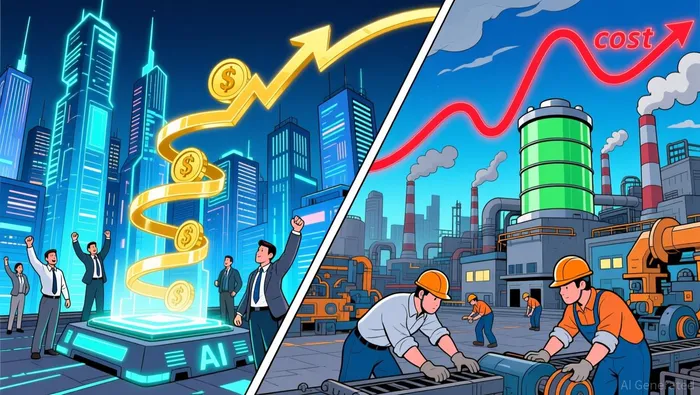
The problem is scale. To capture the broader energy storage market, SES acquired UZ Energy in September 2025. That deal is the key driver behind the product revenue surge, which now accounts for nearly half of the company's total sales. But this hardware push comes at a steep cost. The product revenue segment carries a gross margin of just 15%. This creates a direct tension: rapid growth in low-margin products dilutes the overall profitability that the high-margin software business promises.
The financials highlight this trade-off starkly. In Q3 2025, total revenue doubled sequentially to $7.1 million, a strong beat. Yet the company still posted a GAAP net loss of $20.9 million for the quarter. The cash burn required to fund this growth is significant, with operating cash flow dipping to -$14.3 million. While the company's $214 million in cash and equivalents provides runway, the path to profitability hinges on the software segment's ability to grow faster than the hardware drag.
The bottom line is that the software platform is the more likely near-term value driver. It represents the company's unique AI capability and higher-margin future. The hardware business, while expanding the addressable market, is a dilutive force that requires heavy investment. For investors, the setup is about watching which engine gains more power. If Molecular Universe adoption accelerates, it could eventually offset the product margin drag. Until then, the stock's trajectory will be shaped by the battle between these two forces.
The $1,000 Bet: Price Targets, Volatility, and Near-Term Catalysts
For a small, speculative bet, the setup here is classic high-risk, high-reward. The stock is up over 400% in the past 12 months but has given up all those gains, trading near $1.87. This elevated implied volatility reflects the market's struggle to price in a future where the company's massive total addressable market-potentially exceeding $500 billion by 2032-translates into real revenue. The risk/reward hinges on near-term catalysts that can bridge the gap between hype and reality.
The next key catalyst is a definitive agreement with Top Material to triple Korean battery capacity for drones. This collaboration, which has already set its primary terms in a non-binding deal, is targeted for a definitive agreement in Q1 2026. For a speculative bet, this is a tangible signal. It moves the needle from potential to planned capacity expansion, directly addressing the scaling challenge that has plagued the company. Success here could provide a much-needed validation of its manufacturing partnerships and a concrete step toward commercial production, potentially offering a near-term floor for the stock.
The primary risk, however, is slower-than-expected customer validation and contract ramp-up for both its AI software, Molecular Universe, and its energy storage hardware. Revenue remains modest at just $7.1 million for the third quarter, and the company is still burning significant cash. If the Top Material deal fails to materialize on schedule or if early drone production doesn't attract the anticipated customer orders, the stock could face renewed volatility as the gap between its lofty market potential and current financials becomes harder to ignore. For a $1,000 bet, the volatility is the point; the trade is about catching the stock on the move as these catalysts unfold.
Takeaway: A Tactical Play on the Next Catalyst
For a $1,000 bet, the thesis is that the CES event created a temporary mispricing by boosting visibility without changing the company's fundamental path to profitability. The definitive catalyst that will drive a re-rating is the definitive agreement with Top Material, targeted for Q1 2026. Until then, the setup requires tolerance for high volatility and a short-term horizon.
The CES showcase was a neutral visibility boost, not a material catalyst. It validated the company's technology but did nothing to alter the core financial reality. The path to profitability remains long and capital-intensive, as evidenced by the GAAP net loss of $20.9 million in Q3 2025. The company's cash position of $214 million provides runway, but the quarterly cash burn from operations is a constant reminder of the capital needed to scale.
This creates a clear event-driven opportunity. The stock's recent flat performance suggests the market is waiting for a concrete deal to move the needle. The Top Material agreement is the next catalyst that could provide the commercial validation needed to shift sentiment. For a tactical investor, the play is to position for that event, understanding the risk is high and the time horizon is short. The setup is binary: a successful deal could spark a pop, while a delay would likely see the stock drift.







Comentarios
Aún no hay comentarios