
ServiceNow's Stock Dip: A Strategic Buying Opportunity Amid AI-Driven Growth
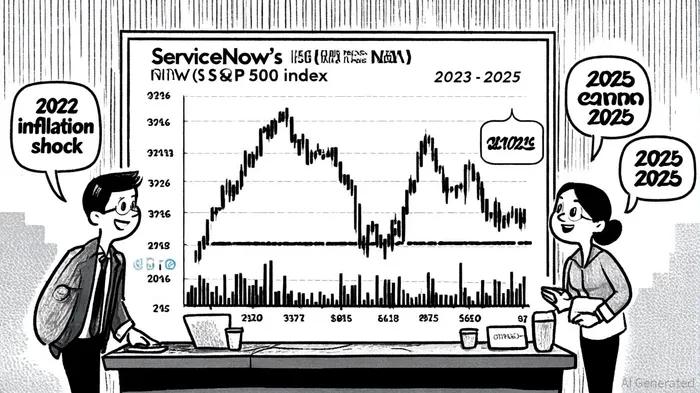
ServiceNow (NOW) has experienced a sharp decline in 2025, with its stock down 14.03% year-to-date compared to the S&P 500's 10.72% gain[1]. This underperformance has sparked debate among investors: is the dip a warning sign of overvaluation and macroeconomic headwinds, or a strategic entry point for a company poised to dominate the AI-driven enterprise software market?
Financial Resilience and AI-Driven Momentum
ServiceNow's Q2 2025 results underscore its financial resilience. Subscription revenue grew 22.5% year-over-year to $3.113 billion, with non-GAAP operating margins hitting 29.5%—well above guidance[2]. The company raised full-year subscription revenue forecasts to $12.775–$12.795 billion, reflecting confidence in its AI initiatives. CEO Bill McDermott emphasized that “agentic AI is refactoring business processes across all industries,” a vision supported by products like Now Assist and Agentic AI[3].
The company's AI strategy is gaining traction. For instance, ServiceNow's shift to usage-based pricing for AI tools has boosted adoption rates, even if it temporarily slowed revenue growth[4]. Its 15 industry-specific AI models for healthcare and finance, coupled with partnerships with AWS and NVIDIA, position it to capture high-margin vertical opportunities[5]. Analysts at Monexa AI note that ServiceNow's R&D spending—$2.54 billion in FY2024—fuels innovation, ensuring its platform remains competitive against rivals like Microsoft[6].
Valuation Concerns and Market Realities
Despite strong fundamentals, ServiceNow's valuation remains a hurdle. Its P/E ratio of 129x as of June 2025 far exceeds peers like Microsoft (36.38x) and the Technology sector average (32.17x)[7]. Similarly, its price-to-sales ratio of 18.52x is nearly double the industry average of 9.46x[8]. These metrics suggest the market is pricing in aggressive long-term growth, leaving little margin for error.
However, this premium may be justified. ServiceNow's 22.44% revenue growth in FY2024 and 40% international expansion target demonstrate scalability[9]. Its $5.76 billion cash reserves and 30%+ year-over-year growth in large enterprise clients (ACV > $20M) highlight financial flexibility and customer stickiness[10]. Analysts at MarketBeat argue that the current price of $933.50 offers a 19.7% upside to the $1,115.20 average price target, reflecting optimism about AI-driven monetization in 2026[11].
Navigating Short-Term Headwinds
The recent dip follows a 0.62% post-earnings decline, driven by caution over near-term challenges. These include:
1. Renewal Timing: A larger-than-average customer cohort renewing contracts in Q4 2025 could slow Q3 growth by 2 percentage points[12].
2. Federal Sector Constraints: Budget uncertainties in the U.S. government segment may dampen performance[13].
3. Pricing Model Transition: The shift to consumption-based AI pricing, while beneficial for adoption, has created short-term revenue volatility[14].
Historical data from 11 earnings releases between 2022 and 2025 reveals mixed signals. On average, ServiceNow's stock gained +0.74% on the day of earnings and reached a peak mean excess return of +4.20% by day +23. Win rates fluctuated between 55–65%, peaking at 73% on day +1 and day +19. However, performance typically reverted after day +30. This suggests that while short-term volatility is common, the stock has historically shown a tendency to recover and outperform within a month. The recent 0.62% post-earnings decline appears to be an outlier, as the average one-day excess move has historically been positive.
Yet these risks appear manageable. ServiceNow's 90%+ subscription renewal rates and 29.5% operating margin provide a buffer against cyclical pressures[15]. Moreover, its Sovereign AI platform in Singapore and localized AI models address data-sensitive markets, countering international expansion hurdles[16].
Conclusion: A Strategic Buy for the Long-Term
ServiceNow's stock dip reflects a mix of overcorrection and legitimate concerns about valuation. While its P/E and P/S ratios are elevated, they align with its track record of 20%+ revenue growth and AI-driven differentiation. The company's ability to raise guidance post-Q2 earnings and its leadership in Gartner's AI Applications for ITSM[17] reinforce its competitive edge.
For investors with a multi-year horizon, the current price offers an opportunity to access a company that is redefining enterprise workflows through AI. The risks—while non-trivial—are mitigated by ServiceNow's financial strength, strategic agility, and the transformative potential of its platform. As the AI enterprise SaaS market matures, ServiceNow's “Moderate Buy” rating[18] may prove prescient.







Comentarios
Aún no hay comentarios