
Seritage Growth Properties: Navigating the Office Sector's Meltdown with Debt Discipline and Contrarian Vision
The U.S. office market is in freefall. Vacancy rates have surged to 19.7%, cap rates have skyrocketed, and once-hot markets like San Francisco and Austin are drowning in overbuilt inventory. Yet within this chaos, one company—Seritage Growth Properties (SRI)—is positioning itself as a contrarian buyer of distressed assets. By aggressively reducing debt and preserving liquidity, Seritage is primed to profit from a sector others are fleeing. Here's why this REIT could be a rare value play in today's office apocalypse.
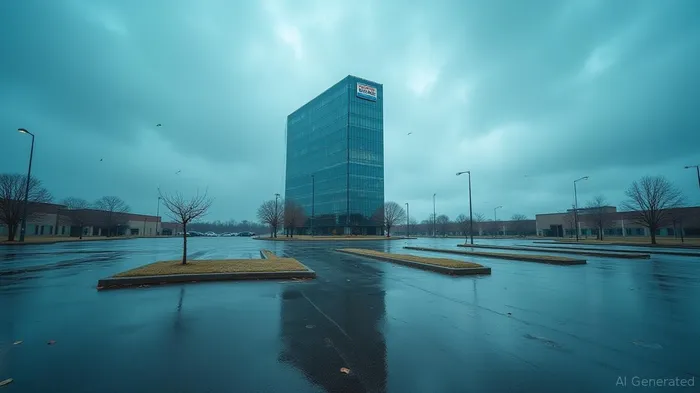
The Office Sector's Perfect Storm: Valuation Collapse and Structural Shifts
The office market's collapse is both broad and brutal. National vacancy rates have surged to 19.7% as hybrid work patterns and corporate downsizing erode demand. In tech hubs like the Bay Area, office values have plummeted 50% from 2021 peaks, while San Francisco's vacancy rate hit 29%, a record high. Even Manhattan, the last bastion of premium office rents, now faces a 16.2% vacancy rate—up 200 basis points since 2020.
The pain isn't just in pricing. Cap rates—a key valuation metric—are expanding rapidly. Class A office properties now trade at over 8%, while Class C assets in struggling markets like Detroit or Austin face cap rates in the low teens. This bifurcation reflects a market where only the strongest locations (e.g., Manhattan's prime CBDs) retain investor interest, while suburban and secondary markets face existential threats.
Seritage's Debt Reduction: A Strategic Play to Capitalize on Chaos
While most office REITs are scrambling to refinance maturing debt (over $1 trillion comes due in 2025), Seritage has taken a different path. Its recent $40 million prepayment of its $1.6 billion Berkshire Hathaway-backed term loan reduced annual interest costs by $2.8 million and slashed the remaining balance to $200 million. Since 2021, Seritage has repaid $1.4 billion of this facility, saving $99.4 million in cumulative interest.
This discipline buys Seritage two critical advantages:
1. Liquidity: With $99.9 million in cash as of March 2025, it can act decisively in a distressed market.
2. Bargaining Power: Its conservative leverage ratio (post-repayments) and Berkshire's backing allow it to negotiate fire-sale prices for undervalued assets others can't touch.
The Contrarian Opportunity: Buying Cheap Office Assets with a Long-Term View
Seritage's strategy isn't just about cutting costs—it's about turning the office sector's collapse into an acquisition engine. Consider:
- Undervalued Assets: Properties in secondary markets (e.g., Phoenix's $18.3% vacancy) or tech-correlated markets (e.g., Austin's 28.9% vacancy) are trading at $137–$139 per square foot—a fraction of Manhattan's $439/sq ft premium.
- Strategic Focus: Seritage's Plan of Sale prioritizes selling non-core assets while retaining high-quality properties in demand-driven markets. This mirrors its 2020–2025 track record of $1.3 billion in dispositions, often at distressed discounts.
- Lease Resets: As existing leases expire, Seritage can renegotiate terms in stabilized markets or reposition underperforming assets (e.g., converting office space to life sciences or mixed-use).
The Nvidia purchase of a San Francisco lab campus for $123 million highlights how strategic buyers can profit in distressed markets. Seritage's balance sheet gives it the flexibility to do the same.
Risks: Vacancy Plateaus and Interest Rate Volatility
No bet on the office sector is without risk. Key concerns include:
1. Prolonged Vacancy: If vacancies in struggling markets like Austin (28.9%) or San Francisco (29%) don't stabilize by 2027, Seritage's acquisitions could become stranded assets.
2. Rate Uncertainty: While Seritage's fixed-rate debt shields it from rising interest costs, broader Fed policies could delay the sector's recovery.
3. Execution Risk: Buying distressed assets requires precision—overpaying or misreading a market's long-term potential could backfire.
Investment Thesis: A High-Reward, High-Conviction Play
Seritage's stock trades at a discount to its net asset value (NAV), reflecting market skepticism about the office sector's future. However, its $2.8 million annual interest savings, $99.9 million cash hoard, and access to Berkshire's capital make it uniquely positioned to:
- Acquire undervalued assets at cap rates high enough to generate outsized returns.
- Benefit from eventual sector recovery—forecasted by 2027—as demand for prime CBD space rebounds.
For investors with a 5+ year horizon, SRI offers asymmetric upside. The downside is capped by its liquidity and Berkshire's financial strength, while the upside includes potential NAV revaluation as office values normalize.
Conclusion: Seritage's Debt Discipline Meets the Office Market's Bottom
The office sector's meltdown has created a once-in-a-generation opportunity to buy high-quality real estate at bargain prices. Seritage's aggressive debt reduction and cash-rich balance sheet position it to capitalize on this chaos. While risks remain, the combination of its financial strength, Berkshire's backing, and a sector nearing its cyclical low makes SRI a compelling contrarian bet. For investors willing to look beyond today's headlines, this could be the start of a multi-year turnaround story.





Comentarios
Aún no hay comentarios