
Serbia's Crossroads: Navigating Turbulence and Transformation in the Balkans
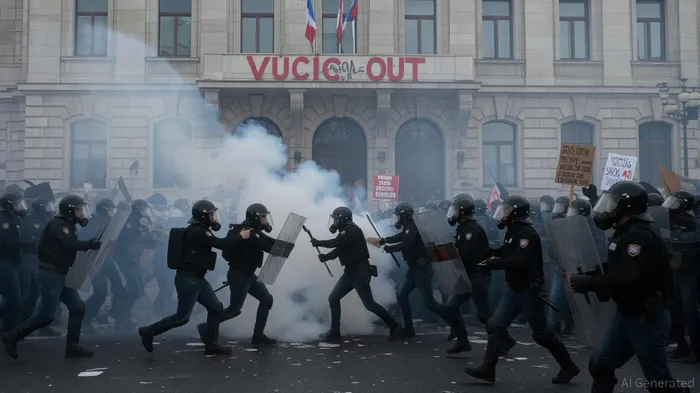
Serbia is a high-stakes chessboard for emerging market investors. On one side, political instability and violent crackdowns threaten to derail economic progress. On the other, strategic reforms and a prime geographic location offer tantalizing opportunities for those willing to navigate the turbulence. Let's break it down.
The Storm: Political Instability as a Double-Edged Sword
Since the Novi Sad train station collapse in late 2024, Serbia has been gripped by protests that have morphed from peaceful demonstrations into full-blown confrontations. President Aleksandar Vucic's government has responded with a heavy hand, deploying riot police and alleged “men in black” to suppress dissent. The result? A fractured society, a 67.5% drop in foreign direct investment (FDI) in early 2025, and a public trust crisis in both institutions and the EU accession process.
But here's the twist: instability isn't always a red flag. History shows that markets often bottom out in chaos, only to rebound when reforms follow. Consider Turkey in 2016 or Argentina in 2001—both faced political turmoil but eventually rewarded investors who stayed the course. Serbia's situation isn't identical, but the pattern is familiar: a government clinging to power, a population demanding change, and a global economy watching closely.
The Reforms: A Fragile Foundation for Growth
Despite the unrest, Serbia's economic fundamentals are being reshaped. The government has committed to a 3.0% fiscal deficit cap under the IMF's Policy Coordination Instrument (PCI), a move that signals discipline. Foreign currency reserves remain robust, and inflation is under control. The IMF's 3% growth forecast for 2025 hinges on these reforms, but the real test lies in execution.
The key sectors to watch? Manufacturing—particularly automotive components—and infrastructure. Serbia's strategic location between Europe and the Balkans makes it a logistics hub, and the upcoming EXPOEXPO-- 2027 could catalyze a wave of investment. But here's the catch: protests have already disrupted retail and tourism, sectors that contribute 12% of GDP. Investors must hedge against this volatility.
The EU Factor: A Lifeline or a Liability?
The EU's role is a paradox. It's Serbia's largest trading partner, accounting for 60% of exports, and has pledged €1.6 billion in aid by 2027. Yet its reluctance to enforce democratic reforms has eroded public trust. A recent survey shows only 40% of Serbians support EU membership—a sharp decline from 2020. This duality creates a unique risk: if the EU softens further, Vucic's government may double down on repression, worsening instability. If it toughens its stance, Serbia could face a funding freeze.
The Playbook: How to Position for Serbia's Future
- Sectoral Focus: Prioritize companies in manufacturing and infrastructure. Look for firms with EU-backed projects or those benefiting from the EXPO 2027 infrastructure boom.
- Diversification: Avoid overexposure to retail or tourism. Instead, allocate a small portion to regional ETFs that include Serbia but balance it with more stable Balkan economies.
- Hedging: Use political risk insurance or short-term options to protect against sudden policy shifts.
- Long-Term Vision: If the EU cracks down on Vucic's government, Serbia could face a short-term slump but long-term gains from democratic reforms.
The Bottom Line: A High-Risk, High-Reward Proposition
Serbia isn't for the faint of heart. The protests, repression, and geopolitical juggling act make it a volatile bet. But for investors with a stomach for risk, the rewards could be substantial. The country's reforms, geographic clout, and EU ties create a foundation for growth—if the government survives the current storm.
In the end, Serbia's story is one of contradictions: a leader who clings to power while the world pushes for change, a population that's both angry and resilient, and an economy that's caught between chaos and opportunity. For those who can navigate the noise, the Balkans' next chapter could be a goldmine. Just don't forget to wear a helmet—and a seatbelt.







Comentarios
Aún no hay comentarios