
Sequans' Bitcoin Treasury Strategy: A Paradigm Shift for Corporate Resilience and Value Creation
The corporate treasury is undergoing a seismic shift. Once the domain of cash, bonds, and short-term securities, it is now embracing BitcoinBTC-- as a strategic asset. SequansSQNS-- Communications' $384 million capital raise—dedicated to acquiring over 3,000 Bitcoin—epitomizes this evolution. By marrying its IoT semiconductor business with a Bitcoin treasury, Sequans has positioned itself at the forefront of a trend that could redefine corporate finance. This article explores how this move signals a transformative strategy, assesses its risks, and evaluates its implications for investors.
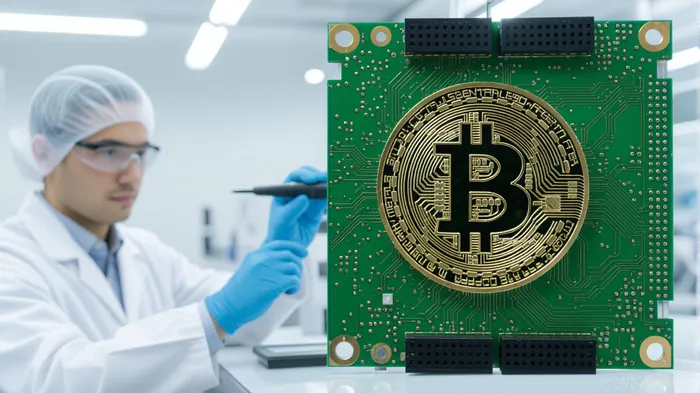
The Capital Raise: A Dual-Purpose Lever
Sequans' financing structure is a masterclass in hybrid financing. The $384 million raise combines a $195 million equity private placement (PIPE) and $189 million in convertible debentures, with an additional $57.6 million potential from warrant exercises. The proceeds are entirely allocated to Bitcoin purchases, signaling an unambiguous commitment to this strategy. The convertible debentures, issued at a 4% discount and convertible at $2.10 per ADS, offer Sequans flexibility to manage its balance sheet while aligning shareholder incentives with Bitcoin's price trajectory.
Initial purchases of 370 BTC have already been executed, with plans to expand holdings to over 3,000 BTC. This allocation represents a bold diversification: at current prices (~$100,000/BTC), Bitcoin could account for over 90% of Sequans' total assets within two years. For a company with a market cap of $32.5 million, this is a high-stakes bet—but one that CEO Georges Karam argues is necessary to insulate against fiat currency volatility and macroeconomic uncertainty.
Strategic Rationale: Bitcoin as the New Corporate "Safe Asset"
Sequans' move reflects a growing recognition of Bitcoin's store-of-value properties. Unlike traditional treasuries, Bitcoin offers scarcity, transparency, and resistance to inflation—a critical hedge for companies exposed to cyclical industries like IoT semiconductors. The IoT market, while growing, faces headwinds from supply chain disruptions and commoditization. By allocating capital to Bitcoin, Sequans aims to transform its financial resilience, ensuring liquidity and value preservation even if its core business falters.
The synergies with IoT operations are subtle but strategic. Bitcoin's decentralized infrastructure aligns with the trustless, secure networks that IoT devices increasingly rely on. Moreover, institutional Bitcoin adoption by peers like MicroStrategyMSTR-- has demonstrated that such treasuries can command equity premiums. Sequans' partnership with Swan Bitcoin—a platform offering custodial and governance services—ensures execution rigor, minimizing operational risks.
Comparison with MicroStrategy: Scale vs. Ambition
While Sequans is a newcomer, MicroStrategy (MSTR) has long been the gold standard for corporate Bitcoin ownership. With 555,450 BTC, MicroStrategy's holdings represent 2.7% of Bitcoin's total supply and a market value of $61 billion. Its strategy, however, carries distinct risks: over 90% of its assets are tied to Bitcoin, and its recursive leverage model—issuing debt/equity to buy more BTC—has led to $13 billion in debt.
Sequans' smaller scale allows it to pivot more nimbly. Unlike MicroStrategy's debt-heavy model, Sequans' convertible debentures and equity warrants provide a more balanced capital stack. However, its core IoT business—revenue down 27% sequentially in Q1 2025—poses execution risks. MicroStrategy's proven track record of gains (e.g., a $4.4 billion Bitcoin appreciation in Q2 2025) contrasts with Sequans' unproven ability to navigate Bitcoin's volatility.
Risks: Volatility, Regulation, and Core Business Challenges
- Bitcoin Volatility: A 30% price drop would erase ~$115 million of Sequans' capital, potentially triggering liquidity crises.
- Regulatory Uncertainty: U.S. regulators could classify Sequans as an “investment company” under the 1940 Act, forcing asset liquidation.
- Core Business Struggles: IoT revenue declined sequentially in Q1 2025, raising questions about cash flow sustainability. A misstep here could force Sequans to divert Bitcoin holdings to fund operations.
- Market Perception: Despite a 43% stock surge post-announcement, SQNSSQNS-- remains down 56% YTD, reflecting investor skepticism about execution.
Investment Implications: A High-Risk, High-Reward Catalyst
Sequans' Bitcoin strategy is a speculative play on two fronts: Bitcoin's price trajectory and its ability to stabilize its IoT business. For investors, the catalysts are clear:- Bitcoin Bull Case: A price rise to $150,000/BTC would increase the Bitcoin portion of SQNS' assets to $450 million, potentially tripling its market cap. - IoT Turnaround: A rebound in IoT design wins (e.g., smart meters, telematics) could stabilize revenue, reducing reliance on Bitcoin's performance.
However, the risks are existential. A Bitcoin bear market or regulatory crackdown could collapse the stock, which already trades at a 50% discount to its 2024 highs. Analysts' 12-month price target of $7.50 (vs. $1.81 pre-announcement) hinges on both Bitcoin appreciation and IoT recovery.
Conclusion: An Inflection Point for Institutional Bitcoin Adoption
Sequans' move marks a pivotal moment for corporate treasury management. By adopting Bitcoin as a core asset, it challenges traditional models and invites scrutiny from regulators and investors alike. While the strategy is fraught with risk—especially for a company with a volatile core business—the potential rewards for long-term holders are asymmetric. For investors willing to bet on Bitcoin's enduring narrative and Sequans' execution, this could be a generational opportunity. For others, it remains a high-stakes gamble.
The market will decide whether Bitcoin's rise justifies this leap of faith—or whether Sequans' pivot becomes a cautionary tale in the annals of corporate finance.





Comentarios
Aún no hay comentarios