
September Crypto Momentum: DOGE, SOL, and the Rise of BlockDAG Technologies
September Crypto Momentum: DOGEDOGE--, SOL, and the Rise of BlockDAG Technologies
As September 2025 unfolds, the cryptocurrency market is witnessing a striking divergence in momentum. While traditional altcoins like DogecoinDOGE-- (DOGE) and SolanaSOL-- (SOL) continue to defy the "Red September" bearish narrative, a new contender—BlockDAG (BDAG)—is reshaping sector rotation dynamics. This analysis explores strategic entry points and the interplay of macroeconomic pressures, technical indicators, and technological innovation in high-growth crypto assets.
DOGE and SOL: Defying the "Red September" Curse
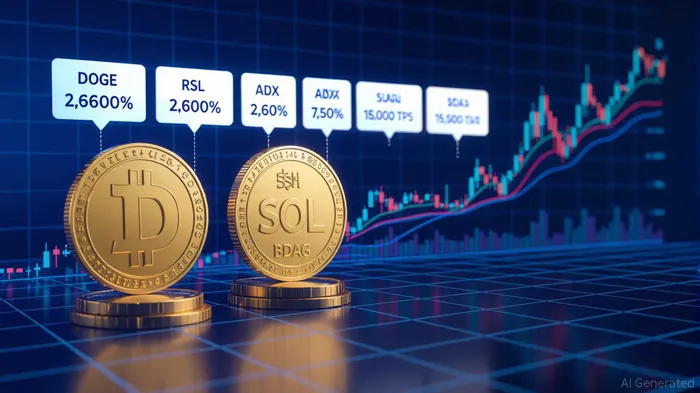
Dogecoin and Solana have surged by 11% and 10%, respectively, in early September 2025, driven by speculative fervor and bullish technical indicators [1]. DOGE's Relative Strength Index (RSI) and Average Directional Index (ADX) suggest strong upward momentum, with the token trading at $0.2649. Similarly, SOL's price action at $232 reflects robust demand, fueled by its role in decentralized finance (DeFi) and Web3 infrastructure.
However, caution is warranted. Analysts warn of a potential 15-20% correction ahead of the Federal Reserve's rate cut decision, as traders may "sell the news" to lock in profits [2]. Liquidations of $240 million in long positions further underscore near-term volatility. For strategic entry, investors should consider buying dips during pullbacks, particularly if the Fed's dovish stance materializes, which could reignite risk-on sentiment in crypto.
BlockDAG: The Sector Rotation Catalyst
While DOGE and SOL dominate headlines, BlockDAG is quietly redefining the 2025 crypto cycle. Leveraging Directed Acyclic Graph (DAG) technology, BDAG combines Proof-of-Work (PoW) security with parallel transaction processing, achieving 15,000 transactions per second (TPS) [1]. This hybrid model positions it as a scalable Layer-1 competitor to EthereumETH-- and Solana.
BDAG's presale has raised $383 million, with 25.4 billion tokens sold and a user base of 2.5 million mobile miners [3]. Its projected launch price of $0.05 (a 31x return from the presale price of $0.0016) has attracted institutional and retail attention [1]. Strategic partnerships with sports franchises like Borussia Dortmund and Borussia Dortmund further amplify its real-world utility, though delayed exchange listings have raised scrutiny [5].
The project's EVM compatibility and smart contract framework are critical for developer adoption, enabling seamless integration with DeFi and NFT ecosystems [2]. As sector rotation shifts toward DAG-based solutions, BDAG's infrastructure advantages—such as low-cost transactions and high throughput—make it a compelling long-term play.
Strategic Entry Points and Sector Rotation Dynamics
The 2025 crypto cycle is marked by a migration from speculative assets to projects with tangible utility. DOGE and SOL remain relevant due to their established ecosystems, but their volatility necessitates careful timing. For DOGE, a pullback below $0.25 could present a low-risk entry, while SOL's correction to $200 might align with broader market optimism post-Fed decision.
BlockDAG, meanwhile, offers asymmetric upside for early-stage investors. Its presale is currently in its final phase, with a deployment event in Singapore slated for Q3 2025 [1]. Given its 2,660% presale gain and institutional-grade infrastructure, allocating capital to BDAG's presale or early exchange listings could yield outsized returns.
Risks and Mitigation Strategies
- DOGE/SOL: Short-term corrections and macroeconomic uncertainty (e.g., Fed policy) pose risks. Diversifying across altcoins and hedging with stablecoins can mitigate drawdowns.
- BDAG: Delays in exchange listings and regulatory scrutiny could dampen momentum. Investors should prioritize projects with transparent roadmaps and active community engagement.
Conclusion
September 2025 is a pivotal month for crypto investors. While DOGE and SOL capitalize on short-term momentum, BlockDAG represents a structural shift toward DAG-based scalability. By leveraging technical indicators, sector rotation trends, and strategic entry points, investors can balance risk and reward in this dynamic market.






Comentarios
Aún no hay comentarios