
Sentiment-Driven Financial Markets: How Perpetual Sentiment Markets Are Redefining the Value of Opinion as a Tradable Asset
In the evolving landscape of financial markets, the concept of "opinion" is no longer a qualitative abstraction but a quantifiable asset. Perpetual sentiment markets-built on mechanisms like funding rates, sentiment derivatives, and prediction platforms-are redefining how collective psychology is monetized. These markets allow traders to directly buy and sell the value of public sentiment, transforming narratives, cultural trends, and even geopolitical events into tradable instruments. This shift is not just a technical innovation but a philosophical one: it acknowledges that human perception, once dismissed as noise, is now a cornerstone of market value.
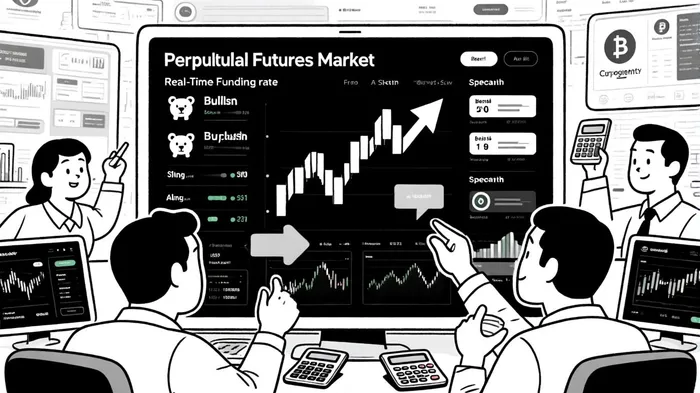
The Mechanics of Perpetual Sentiment Markets
At the heart of perpetual sentiment markets lies the funding rate mechanism, a unique feature of perpetual futures contracts. Unlike traditional futures, which expire on fixed dates, perpetuals use funding rates to align their prices with the spot market. These rates are periodic payments between long and short positions, determined by the disparity between perpetual and spot prices. For example, if the perpetual price of BitcoinBTC-- is above its spot price, longs pay shorts to maintain leveraged positions, signaling bullish sentiment, according to Coinbase's guide. Conversely, when perpetual prices fall below spot prices, shorts pay longs, reflecting bearish bias, according to HighStrike's guide.
This mechanism acts as a real-time barometer of market psychology. Elevated positive funding rates often indicate overbought conditions, while deeply negative rates suggest panic or oversold scenarios, as explained in Cryptowisser's guide. Traders use these signals to adjust strategies, hedge risks, or anticipate reversals. For instance, a $100,000 long position in a perpetual contract with a 0.05% funding rate would incur $10 in payments every 8 hours, compounding over time and influencing profitability, as that guide notes. Such granular data allows investors to monetize sentiment shifts before they manifest in traditional price charts.
Sentiment as a Tradable Asset: Beyond Funding Rates
While funding rates provide a structural framework, the broader ecosystem of sentiment derivatives and prediction markets has turned opinion into a direct asset class. Platforms like Polymarket and Kalshi enable users to trade on the probability of real-world events, from economic data releases to political outcomes. These markets aggregate millions of opinions into price signals, effectively creating a "stock market for ideas." For example, during the 2024 U.S. presidential election, Polymarket contracts on candidate outcomes attracted institutional attention, with Goldman Sachs reportedly using the platform to gauge public sentiment, according to ChiniMandi coverage.
Decentralized platforms are further democratizing access. Based, a blockchain-based opinion market, allows users to trade on cultural trends, such as the popularity of memes or social media influencers, as explained in Based's primer. By tokenizing sentiment, these platforms reduce reliance on centralized intermediaries and enable global participation. Meanwhile, Permutable and RavenPack offer institutional-grade sentiment analytics, leveraging AI and natural language processing to parse news, social media, and macroeconomic data, according to Permutable's comparison. These tools provide real-time heatmaps and correlation analysis, helping traders identify hidden patterns in sentiment flows.
The Disruption of Traditional Markets
Perpetual sentiment markets differ fundamentally from traditional financial systems. Traditional futures markets rely on the basis model, where prices are determined by supply-demand imbalances and storage costs, as Parifi's study explains. In contrast, perpetual markets use funding rates to maintain price alignment, creating a more liquid and continuous trading environment. This structure reduces the "roll yield" risks associated with expiring contracts and allows for perpetual speculation without liquidity cliffs, the study notes.
Moreover, sentiment-driven markets are less anchored to fundamentals. While traditional markets are influenced by earnings reports, interest rates, and macroeconomic data, perpetual sentiment markets thrive on behavioral dynamics. For example, the Fear and Greed Index-which aggregates put/call ratios, VIX levels, and social media sentiment-often predicts market tops and bottoms before traditional indicators react, as the Chartswatcher guide finds. This behavioral edge is particularly pronounced in crypto markets, where retail participation and social media virality amplify sentiment-driven price swings, per Investopedia's definition.
The Future of Sentiment as a Financial Primitive
As AI and blockchain technologies mature, sentiment derivatives are poised to become a core asset class. Tokenized sentiment contracts could allow investors to hedge against cultural or geopolitical risks, much like traditional insurance. For instance, a trader might buy a contract that pays out if a specific meme goes viral, or if a country's political stability index drops below a threshold.
Regulatory challenges remain, particularly in jurisdictions where prediction markets are restricted. However, the rise of decentralized autonomous organizations (DAOs) and self-executing smart contracts is creating a parallel ecosystem where sentiment trading can thrive without centralized oversight, according to Mentobile's blog. Platforms like Probo in India and Deutsche Börse's Eurex Open Interest are already experimenting with hybrid models that blend traditional derivatives with sentiment analytics, as noted in a Markets Media article.
Conclusion
The commodification of opinion marks a paradigm shift in finance. Perpetual sentiment markets are not just redefining how we trade-they are redefining what we trade. By monetizing collective psychology, these markets empower individuals and institutions to profit from narratives, cultural trends, and even geopolitical events. As the line between "information" and "asset" blurs, the next frontier of financial innovation will belong to those who can quantify and trade sentiment with precision.





Comentarios
Aún no hay comentarios