
Senegal's Energy Boom and Fiscal Leverage: Investing in Africa’s High-Growth Hydrocarbon-Driven Economy
Senegal is emerging as a pivotal player in Africa’s energy landscape, driven by a confluence of hydrocarbon discoveries, strategic fiscal reforms, and international investment. With the commencement of production from the Grand Tortue Ahmeyim (GTA) and Sangomar projects, the country is poised to transform its economic trajectory, offering investors a unique opportunity to capitalize on a resource-driven growth story.
A New Era of Hydrocarbon Production
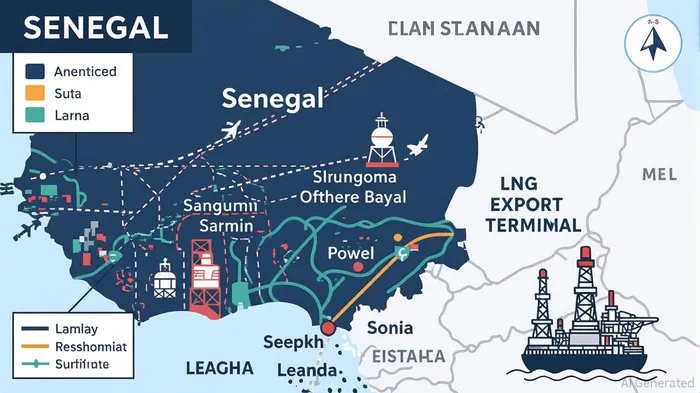
Senegal’s offshore oil and gas reserves, particularly in the shared Senegal-Mauritania basin, have unlocked unprecedented potential. The GTA project, operated by BPBP--, and the Sangomar field, led by Woodside EnergyWDS--, are set to begin production by late 2023 and mid-2024, respectively. These projects are projected to generate $1.5 billion in export revenues annually from 2023 to 2025, with the Sangomar field alone expected to produce 100,000 barrels of oil per day by mid-2025 [1]. The Yakaar-Teranga block, another key discovery, is anticipated to see a final investment decision by early 2024, further solidifying Senegal’s position as a regional energy hub [2].
The economic impact is already evident. In Q1 2025, Senegal’s GDP surged by 12.1% year-on-year, with the hydrocarbon sector contributing over 1% of GDP annually during the production phase (2024–2045) [3]. This growth is not merely a short-term spike but a structural shift, as hydrocarbon exports are expected to reduce the current account deficit and bolster fiscal stability [4].
Fiscal Reforms and Strategic Incentives
To harness the benefits of its energy boom, Senegal has implemented a suite of fiscal and policy reforms. The government’s 2025–2029 SEN-FINTRAC program, supported by a $115 million World Bank loan, aims to modernize public financial management, enhance tax collection, and phase out energy subsidies [5]. These measures align with the West African Economic and Monetary Union’s (WAEMU) goal of maintaining a 3% fiscal deficit by 2025, ensuring macroeconomic stability amid rising hydrocarbon revenues [6].
For foreign investors, Senegal’s updated Investment Code offers tailored incentives. Customs duty exemptions, VAT suspension, and tax credits for qualifying investments in hydrocarbons and renewables are designed to attract capital. Additionally, the government has renegotiated energy contracts to secure a larger share of profits, emphasizing local content and technology transfer [7]. These reforms mirror broader regional efforts in the MSGBC (Mauritania, Senegal, Gambia, Guinea-Bissau, and Guinea-Conakry) zone to maximize resource value while fostering sustainable development [8].
Attracting Global Capital
Foreign direct investment (FDI) in Senegal’s hydrocarbon sector has gained momentum, driven by Europe’s quest for alternative gas suppliers and global demand for energy security. While specific FDI figures for 2023–2025 remain undisclosed, continent-wide inflows to Africa stabilized at $53 billion in 2023, with a growing share directed toward extractives and infrastructure [9]. Senegal’s strategic location and political stability further enhance its appeal, particularly as the GTA and Sangomar projects attract major international operators.
The government’s focus on transparency and fiscal governance has also bolstered investor confidence. For instance, hydrocarbon revenues generated 45.79 billion CFA francs in the first half of 2024, partly due to exceptional payments from Woodside Energy [10]. Such transparency aligns with global best practices and reduces perceived risks for capital allocation.
Balancing Growth and Sustainability
While hydrocarbons offer a clear growth engine, Senegal’s leadership is mindful of long-term challenges. The country aims to diversify its economy, with renewable energy and infrastructure projects complementing its fossil fuel ambitions. Green and blue bonds are being explored to fund low-carbon initiatives, ensuring that the energy transition does not undermine economic gains [11].
Moreover, the phasing out of energy subsidies—projected to save 0.7% of GDP annually—will free up resources for social programs and infrastructure, addressing inequality and enhancing resilience against external shocks [12]. This balanced approach underscores Senegal’s commitment to leveraging its hydrocarbon wealth for inclusive development.
Conclusion
Senegal’s energy boom represents a rare convergence of resource abundance, strategic policy, and international investment. For investors, the country offers a compelling mix of high-growth potential and fiscal discipline, supported by a government committed to transparency and long-term stability. As production ramps up and reforms take root, Senegal is not just unlocking its hydrocarbon potential—it is redefining its economic future.
Source:
[1] Petrosen: Our ambition is to make Senegal an oil and gas giant [https://african.business/2023/04/dossier/petrosen-our-ambition-is-to-make-senegal-an-oil-and-gas-giant]
[2] Senegal - IMF eLibrary [https://www.elibrary.imf.org/downloadpdf/view/journals/002/2023/250/002.2023.issue-250-en.pdf]
[3] Senegal: Growth Estimated at 12.1% in Quarter 1 Amid Debt and Fiscal Pressures [https://www.ecofinagency.com/news/2708-48190-senegal-growth-estimated-at-12-1-in-quarter-1-amid-debt-and-fiscal-pressures-strains]
[4] Senegal-Joint-World-Bank-IMF-Debt-Sustainability-Analysis [https://documents1.worldbank.org/curated/en/367151626688891372/txt/Senegal-Joint-World-Bank-IMF-Debt-Sustainability-Analysis.txt]
[5] World Bank Approves $115 Million to Support Senegal’s Fiscal Reforms [https://www.worldbank.org/en/news/press-release/2025/06/24/world-bank-approves-115-million-to-support-senegal-fiscal-reforms-and-strengthen-public-financial-management]
[6] West African Economic and Monetary Union - IMF eLibrary [https://www.elibrary.imf.org/view/journals/002/2024/090/article-A001-en.xml]
[7] Senegal’s Energy Strategy: Lessons from the Gulf and Persian Resource [https://www.linkedin.com/pulse/senegals-energy-strategy-lessons-from-gulf-persian-resource-wamere-xzt6e]
[8] Senegal Charts Path to Economic Sovereignty and Sustainable Development [https://bowergroupasia.com/senegal-charts-path-to-economic-sovereignty-and-sustainable-development/]
[9] Foreign Investment in Africa: 2025 Outlook & Key Sectors [https://www.tcadi.com/2025/05/24/foreign-investment-in-africa-2025-outlook-key-sectors/]
[10] Senegal Espouses Transparency, Sovereignty in Oil Governance [https://apanews.net/senegal-espouses-transparency-sovereignty-in-oil-governance-1-3/]
[11] Senegal’s 2025–2029 SEN-FINTRAC Program [https://www.worldbank.org/en/news/press-release/2025/06/24/world-bank-approves-115-million-to-support-senegal-fiscal-reforms-and-strengthen-public-financial-management]
[12] IMF eLibrary: Senegal’s Fiscal Consolidation Measures [https://www.elibrary.imf.org/downloadpdf/view/journals/002/2023/250/002.2023.issue-250-en.pdf]





Comentarios
Aún no hay comentarios