
Senate Crypto Clash: CFTC Expansion vs. SEC Securities Framework
Congressional efforts to resolve the long-standing jurisdictional dispute between the Securities and Exchange Commission (SEC) and the Commodity Futures Trading Commission (CFTC) over crypto assets are accelerating as federal agencies resume operations post-shutdown. Two competing Senate drafts-backed by the Agriculture and Banking Committees-propose divergent frameworks for regulating digital assets, while the nomination of Mike Selig adds urgency to the debate.
The Senate Agriculture Committee's draft, spearheaded by Republicans John Boozman and Democrats Cory Booker, expands the CFTC's authority to oversee "digital commodities" and their spot markets. This would require crypto exchanges, brokers, and dealers to register with the CFTC, adhere to capital and custody rules, and segregate customer assets. While the bill leaves room for joint rulemaking with the SEC, it sidesteps thorny issues like decentralized finance (DeFi), positioning the CFTC as the primary regulator for BitcoinBTC-- spot markets. 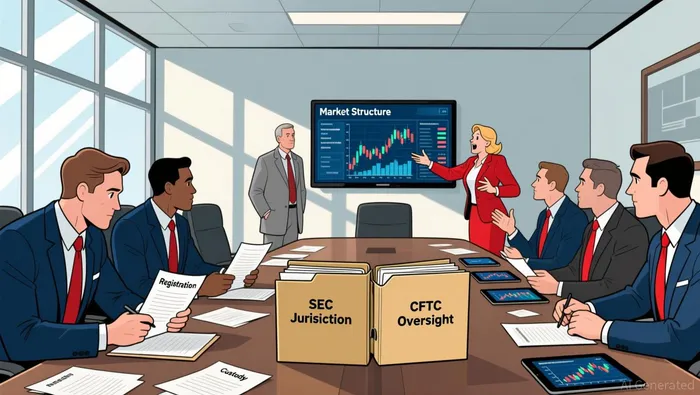 ETFs would remain under SEC jurisdiction.
In contrast, the Senate Banking Committee's Responsible Financial Innovation Act grants the SEC explicit oversight of "ancillary assets"-fungible digital commodities tied to investment contracts. This framework allows tokens to "graduate" from securities treatment once governance becomes sufficiently decentralized, offering a potential pathway for projects like EthereumETH-- to transition regulatory classifications. The bill also mandates a two-year rulemaking period for the SEC to define "investment contracts," addressing industry calls for clarity.
The competing drafts intersect with the nomination of Mike Selig, currently chief counsel of the SEC's Crypto Task Force, to head the CFTC. His Senate confirmation hearing, scheduled for Nov. 19, 2025, comes as lawmakers push to finalize market structure legislation. Selig's background in crypto policy-highlighted in a 2024 CoinDesk op-ed advocating for rule-based regulation-suggests he may support the CFTC's expanded role in spot markets. His appointment follows the controversial withdrawal of former CFTC commissioner Brian Quintenz, whose nomination was derailed by high-profile lobbying from the Winklevoss twins as reported by Forbes.
The resumption of federal operations after a record 43-day shutdown has also reignited regulatory momentum. Agencies like the SEC and CFTC, which had paused rulemaking and ETF approvals during the shutdown, are now resuming reviews. This has spurred optimism for the approval of spot XRPXRP-- ETFs, with Canary Funds and other firms poised to list products as early as November 12–13. Analysts note that over 130 crypto ETFs await SEC clearance, and the agency's return to full capacity could accelerate their approvals.
Meanwhile, crypto markets have shown tentative signs of recovery, with Bitcoin rebounding above $102,000 after hitting weekly lows during the shutdown as reported by Business Standard. Traders and analysts attribute the bounce to renewed regulatory clarity and the potential for dovish Federal Reserve policies post-shutdown. Ethereum also saw strong demand, trading near $3,533, while altcoins like XRP and DogecoinDOGE-- surged amid ETF-related speculation as Business Standard reports.
The Senate proposals, though still in draft form, signal a critical phase in the regulatory tug-of-war. For exchanges and token projects, the choice between CFTC and SEC oversight will shape custody requirements, market structure, and compliance costs. As Selig's nomination hearing approaches and the Senate debates its path forward, the industry awaits a resolution that could redefine the U.S. crypto landscape for years to come.






Comentarios
Aún no hay comentarios