
Semiconductor Supply Chain Risks and Blockchain Mining: A Looming Investment Crisis
The blockchain mining industry, once a symbol of decentralized innovation, now faces a critical juncture shaped by vulnerabilities in the global semiconductor supply chain. As demand for advanced chips surges-driven by artificial intelligence, hyper-scale cloud computing, and cryptocurrency operations-the sector's reliance on a fragile, geopolitically charged supply network has become a double-edged sword. For investors, the intersection of semiconductor risk exposure and blockchain infrastructure presents a complex landscape of volatility, strategic dependencies, and long-term uncertainty.
Semiconductor Supply Chain Vulnerabilities: A Globalized Weakness
The semiconductor supply chain is a labyrinth of interdependencies, with components crossing borders up to 70 times before reaching end users. China's near-monopoly on critical minerals-such as rare earth elements-exacerbates this fragility. The country controls 60% of global rare earth mining and 90% of processing and refining, creating a strategic chokepoint for the U.S. and its allies. This concentration of control is compounded by geopolitical tensions, such as the U.S.-China trade war and export restrictions on semiconductorON-- technology, which have fragmented supply conditions and heightened risks of disruption.
For blockchain mining, the implications are stark. High-performance semiconductors like GPUs and ASICs are essential for proof-of-work (PoW) operations, yet their production is increasingly prioritized for AI and data center applications. This shift has left miners competing for dwindling supplies, driving up costs and delaying expansion plans. The situation is further worsened by infrastructure bottlenecks, such as TSMC's delayed Arizona fabrication plant, which won't be operational until 2028. Such delays underscore the extended lead times required to scale semiconductor capacity, a critical challenge for industries like blockchain mining that rely on rapid hardware iteration.
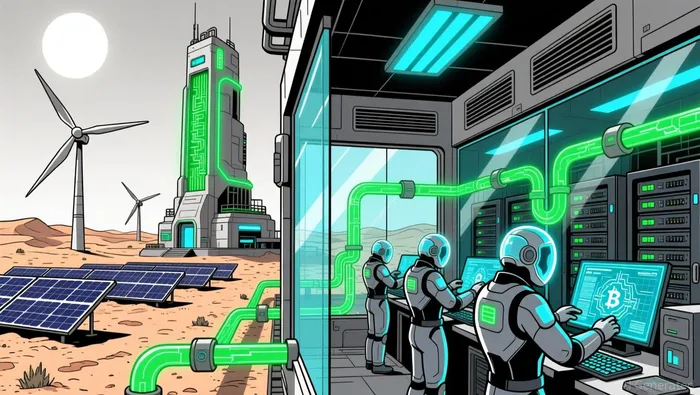
Blockchain as a Solution? The Limits of Decentralization
Blockchain technology has been taught as a tool to enhance supply chain transparency, enabling real-time tracking and tamper-proof record-keeping. A 2023 study in Sustainability even proposed integrating blockchain with mathematical optimization to improve long-term capacity planning for semiconductor manufacturers. However, practical implementation remains elusive. Scalability issues, high computational costs, and privacy concerns-particularly around sharing sensitive operational data-have limited blockchain's adoption in supply chain management.
For blockchain mining itself, the irony is palpable: an industry built on decentralization is now constrained by a centralized supply chain. While some projects have pivoted to energy-efficient proof-of-stake (PoS) mechanisms to reduce hardware dependency, this transition is not universal. PoW remains dominant in markets like BitcoinBTC--, where profitability is increasingly tied to access to low-cost energy and sustainable practices. This shift highlights a broader trend: blockchain's resilience is now contingent on the resilience of its underlying semiconductor ecosystem.
Investment Risks: From Hardware Costs to Geopolitical Exposure
The financial impact of semiconductor shortages on blockchain mining is profound. According to a 2025 market analysis, profitability in Bitcoin mining is no longer solely determined by computational power but by a complex interplay of factors, including energy costs, regulatory compliance, and geographic positioning. The scarcity of advanced chips has inflated hardware acquisition costs, forcing miners to pay premiums for limited supplies of ASICs and GPUs. This dynamic has eroded margins, particularly for smaller operations unable to compete with large-scale miners who can leverage bulk purchasing and economies of scale.
Geopolitical risks further amplify these challenges. The concentration of semiconductor manufacturing in regions like Taiwan and South Korea-both vulnerable to natural disasters and geopolitical instability-creates a high-stakes scenario for blockchain infrastructure. For investors, this means exposure to supply chain disruptions that could halt operations or force costly relocations. The U.S. CHIPS and Science Act and similar initiatives aim to diversify production, but their impact will take years to materialize. In the interim, the industry remains exposed to macroeconomic volatility, resource constraints (e.g., freshwater shortages), and labor shortages (e.g., labor shortages).
Market Responses and Mitigation Strategies
Efforts to mitigate these risks are underway. The global push for supply chain diversification-led by policies like the U.S. CHIPS Act and the European CHIPS Act-seeks to reduce dependency on single sources. However, building new fabrication facilities is a multi-year, multi-billion-dollar endeavor, and the industry continues to face shortages in critical raw materials and skilled labor. For blockchain mining, this means a prolonged period of uncertainty, where strategic geographic positioning and access to renewable energy will determine competitive advantage.
Investors must also consider the role of alternative technologies. While blockchain's integration with IoT and AI could create adaptive supply chains, these solutions require cross-industry collaboration and significant capital investment. For now, the most viable mitigation strategy remains hedging against hardware price volatility and prioritizing energy efficiency.
Conclusion: A Call for Resilience in a Fractured Ecosystem
The semiconductor supply chain's vulnerabilities are no longer an abstract risk-they are a tangible threat to blockchain mining's scalability, profitability, and long-term viability. For investors, the lesson is clear: portfolios must account for the geopolitical, environmental, and technological complexities of semiconductor production. While blockchain's decentralized ethos remains compelling, its infrastructure is inextricably tied to a supply chain that is anything but decentralized. In this new era, resilience-both in hardware and strategy-will separate the winners from the casualties.







Comentarios
Aún no hay comentarios