
The Semiconductor Renaissance: 3 High-Conviction Stocks to Capitalize on the AI-Driven Boom
The global semiconductor industry is undergoing a seismic transformation, driven by the explosive demand for artificial intelligence (AI) infrastructure. As AI models grow in complexity and scale, the need for specialized chips capable of handling massive computational workloads has created a golden opportunity for semiconductor firms strategically positioned in the AI supply chain. Three companies-NVIDIA, AMDAMD--, and Cerebras Systems-stand out as high-conviction investments, each leveraging unique strengths to dominate critical segments of this rapidly evolving market.
1. NVIDIA: The Uncontested King of AI Infrastructure
NVIDIA's dominance in the AI chip market is both well-earned and self-reinforcing. By 2025, the company's data center GPU revenue had surged to $51.2 billion, a 66% year-over-year increase, cementing its position as the de facto standard for AI training and inference. This success stems from its H100 and Blackwell-architecture GPUs, which offer unparalleled performance for large-scale AI workloads. But NVIDIA's true moat lies in its CUDA platform, a developer ecosystem that has become indispensable for AI researchers and enterprises.
Beyond hardware, NVIDIANVDA-- is expanding its reach into AI infrastructure with offerings like the DGX Cloud Lepton, which democratizes access to GPU resources for developers, and RTX PRO Servers, tailored for enterprise AI factories. These moves position NVIDIA not just as a chipmaker but as a foundational pillar of the AI economy. While competitors like AMD are closing the gap in inference markets, NVIDIA's first-mover advantage and ecosystem lock-in make it a near-essential holding for investors betting on AI's long-term trajectory.
2. AMD: Aggressive Innovation and Strategic Acquisitions
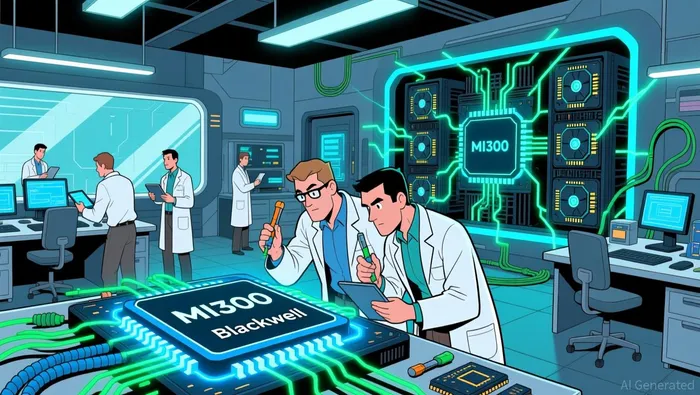 AMD has emerged as NVIDIA's most credible challenger, particularly in the AI training segment. The launch of its MI300 chip in June 2023 marked a significant step forward, offering competitive performance for AI workloads. But AMD's strategy extends beyond hardware: in 2023, it acquired Untether AI and Brium to bolster its inference capabilities, signaling a commitment to end-to-end AI solutions. These acquisitions have strengthened AMD's ability to compete in the lucrative edge AI market, where low-latency, high-efficiency chips are in demand.
AMD's growth is also fueled by its x86 architecture's resurgence in data centers, driven by cost-conscious enterprises seeking alternatives to NVIDIA's premium pricing. While it still trails NVIDIA in market share, NVIDIA held 92% of the data center GPU market in 2024, AMD's aggressive R&D spending and strategic acquisitions position it as a compelling long-term play. For investors, AMD represents a high-growth counterweight to NVIDIA's dominance.
3. Cerebras Systems: Disrupting the Status Quo with a Bold Vision
While NVIDIA and AMD dominate the mainstream, startups like Cerebras Systems are redefining the boundaries of AI chip design. Cerebras' Wafer-Scale Engine-3 (WSE-3), the world's largest and fastest AI chip, challenges conventional architectures by eliminating inter-chip communication bottlenecks. This innovation is particularly appealing for applications requiring extreme parallelism, such as drug discovery and climate modeling.
Cerebras' niche positioning carries risks-its market share remains small compared to industry giants-but its technological differentiation and growing adoption by research institutions and enterprises make it a high-conviction bet. For investors seeking exposure to the next phase of AI hardware innovation, Cerebras embodies the disruptive potential of specialized, application-specific chips.
### Conclusion: A Supply Chain in Flux
The AI-driven semiconductor renaissance is not a zero-sum game. NVIDIA's ecosystem dominance, AMD's strategic agility, and Cerebras' disruptive innovation collectively illustrate the diversity of opportunities within the AI supply chain. While NVIDIA remains the safest bet for near-term growth, AMD and Cerebras offer higher-risk, higher-reward propositions for investors willing to navigate the sector's volatility. As AI adoption accelerates, these three companies are poised to capture disproportionate shares of the value being created-a compelling case for their inclusion in any forward-looking portfolio.





Comentarios
Aún no hay comentarios