
Why Selling Pressure on Chainlink (LINK) Is a Hidden Bullish Catalyst
On-Chain Accumulation: A Signal of Institutional Confidence
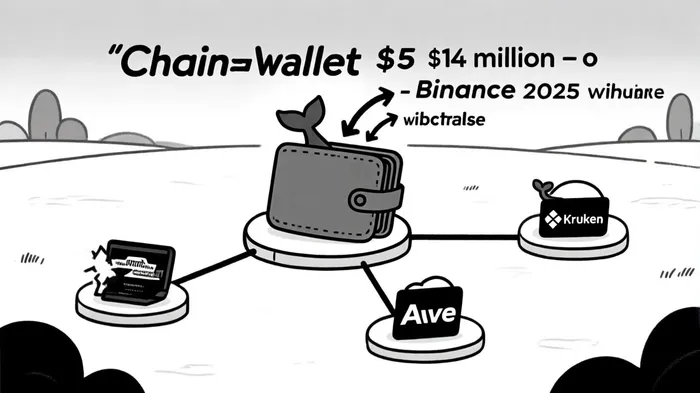
The most striking evidence of bullish sentiment lies in the on-chain behavior of large holders, or "whales." According to a report by Coinotag, whales have accumulated $9 million in LINK by withdrawing significant quantities from exchanges like Binance, with one wallet alone amassing 771,095 LINK (valued at $14 million). This activity signals a strategic shift from liquidity to accumulation, reducing immediate sell pressure and indicating strong conviction in Chainlink's long-term value proposition.
Historically, such accumulation patterns have correlated with price appreciation. For instance, Onchain Lens data shows that similar whale behavior in prior cycles preceded major LINK rallies. This trend is further reinforced by Chainlink's expanding utility, as the Chainlink Quarterly Review notes that the platform now secures over $100 billion in total value across 65+ blockchains, a milestone driven by oracle integrations and partnerships with entities like AaveAAVE--. Meanwhile, the Chainlink Reserve-a strategic on-chain reserve funded by both on-chain and off-chain revenue-has grown to hold 523,159 LINK tokens, underscoring sustained demand for the network's services.
Institutional Buying and Ecosystem Resilience
Beyond token accumulation, Chainlink's institutional-grade infrastructure has solidified its role as a backbone for tokenized finance. The launch of the Digital Transfer Agent (DTA) technical standard in Q3 2025, coupled with partnerships with Swift, DTCC, and UBS, has positioned Chainlink as a critical player in bridging traditional finance and blockchain. These developments are not just theoretical; they translate into real-world demand. For example, the Chainlink Service Value Recapture (SVR) mechanism recaptured over $1.6 million in non-toxic liquidation MEV on Aave in Q3, a 15x increase from the previous quarter (as reported in the Chainlink Quarterly Review).
Institutional confidence is also reflected in technical indicators. Open interest for LINK futures has surged to $695 million, a 7.7% increase, while the Futures Taker CVD metric from CryptoQuant shows robust buy-side activity. These metrics, combined with a bullish pennant pattern on price charts, suggest that a breakout above key resistance levels could be imminent if institutional buyers continue to absorb supply.
Selling Pressure as a Misinterpreted Weakness
Critics may argue that selling pressure-measured by large token transfers or exchange inflows-signals capitulation. However, Chainlink's ecosystem demonstrates that this pressure is being absorbed by institutional buyers rather than retail sellers. The Chainlink Reserve's growth and the SVR mechanism's success in recapturing value from liquidations highlight a system designed to mitigate volatility and reward long-term holders (as detailed in the Chainlink Quarterly Review).
Moreover, the 70% market share in oracle services and the platform's role in processing corporate actions for 24 of the world's largest financial institutions underscore a network effect that is difficult to replicate. As Deutsche Börse, Swift, and the U.S. Department of Commerce integrate Chainlink's solutions for macroeconomic data and tokenized assets, the platform's utility becomes less speculative and more foundational.
Conclusion: A Bullish Paradigm Shift
The interplay of on-chain accumulation, institutional adoption, and infrastructure innovation paints a picture of Chainlink as a project transitioning from speculative hype to institutional bedrock. While selling pressure exists, it is being strategically managed by whales and ecosystem mechanisms, creating a flywheel effect that could propel LINK toward its $50 price target. For investors, the key takeaway is clear: selling pressure is not a bearish signal here-it's a sign that the market is being primed for the next leg higher.






Comentarios
Aún no hay comentarios